
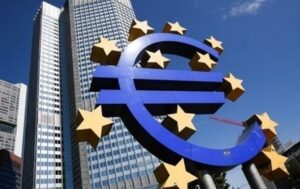
Business activity in the euro area at the end of 2025 grew weaker than expected amid a deepening recession in manufacturing and slower growth in the dominant services sector, according to preliminary data from the business activity index (PMI) prepared by HCOB and S&P Global.
According to the assessment, the HCOB Flash Eurozone Composite PMI declined to 51.9 points in December from 52.8 points in November, falling to its lowest level in three months and below the forecast of analysts polled by Reuters. The value above 50 points still indicates an increase in business activity.
The situation in industry continues to drag the index down: the eurozone manufacturing PMI in December fell to 49.2 points, the lowest since April, reflecting the continued decline in output and a steeper new orders slump, the largest since February. Deepening weakness in German industry was cited as the main factor, while France showed cautious signs
In the services sector, business activity is still picking up but the pace is slowing, with the services PMI down to 52.6 points from 53.6 points in November. Meanwhile, companies continue to increase employment, but business optimism fell to its lowest level since May, indicating that businesses are cautious about the outlook for 2026.
According to a Reuters poll of analysts, rising cost pressures and output prices at the end of the year do not change the overall picture: inflation in the eurozone has moved closer to the 2% target on average, and the market in the baseline scenario expects the European Central Bank’s key rates to remain unchanged until at least 2027.

Despite the growing share of the euro in Ukraine’s foreign trade and international reserves, the US dollar remains the exchange rate-forming currency for the hryvnya. This was reported by the first Deputy head of the NBU Sergey Mykolaychuk in an interview with Interfax-Ukraine.
“Historically, the focus has always been on the hryvnia-dollar pair. We realize that changes are possible over time with the deepening of European integration, but there is no clear transition plan. Today the dollar remains the exchange rate-forming currency,” he said.
According to the official, the structure of reserves and settlements may change in the future, however, instruments for hedging currency risks, including forwards, are available for business.
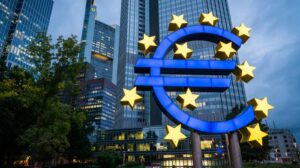
The European Central Bank (ECB) considers the current level of key interest rates to be justified and remains committed to the goal of maintaining inflation in the euro area at 2% in the long term, ECB President Christine Lagarde said.
“Our aspiration, commitment and duty is to ensure price stability, and this corresponds to inflation in the region of 2%,” she said in an interview with the German newspaper ARD. “We have succeeded, inflation is already at 2%, and we will continue to work in this direction.
“We will do everything necessary to ensure that inflation remains at this level,” Lagarde added. “Uncertainty is high, we are surrounded by unpredictability, but there is confidence and stability in terms of prices.
Meanwhile, François Villeroy de Galo, Governor of the Bank of France and member of the ECB Governing Council, warned that the 14% strengthening of the euro since the beginning of the year poses a risk of too low inflation.
In his opinion, a 10% rise in the euro reduces inflation by 0.2 percentage points over the next three years.
“This may increase the risks that inflation will be below our target, and we cannot ignore this,” de Galo said.
Earlier, ECB Vice President Luis de Guindos noted that the rise of the euro/dollar pair above $1.2 could complicate the central bank’s task of achieving the target inflation rate.
The ECB has cut rates eight times over the past year, and now the key deposit rate is 2%. Analysts and market participants generally expect that the regulator will not change rates at the July meeting in order to assess the impact of the measures already taken on the eurozone economy.
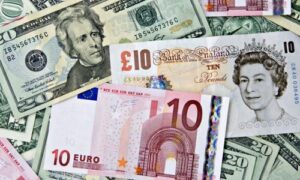
The US dollar depreciated against the euro, pound sterling, and yen on Friday. The ICE DXY index, which measures the dollar against six currencies (euro, Swiss franc, yen, Canadian dollar, pound sterling, and Swedish krona), is losing 0.06%, while the broader WSJ Dollar Index is down 0.16%.
The day before, the DXY rose by 0.4% on strong data on the dynamics of retail sales in the US for July, which confirmed the stability of the US economy and dispelled fears of a recession, Market Watch writes.
Investors are confident that the Federal Reserve will begin to ease monetary policy in September, as the July inflation report released earlier this week confirmed its continued weakening. The probability that the rate will be lowered by 25 basis points at the September meeting is estimated by the market at 74.5%, according to CME FedWatch. At the same time, expectations that the rate would be cut by 50 bps at the next meeting have declined after the publication of positive statistics.
As of 9:15 a.m. ET, the euro was trading at $1.0986 compared to $1.0971 at the close of the previous session.
The value of the pound sterling against the dollar rose to $1.2883 from $1.2854 the day before.
Traders’ attention is shifting to the annual Jackson Hole Economic Symposium, which traditionally brings together the heads of the world’s leading central banks. This year’s event will be held on August 22-24.
On Friday, the dollar/yen pair is trading at 148.97 yen against 149.3 yen at the close of the previous session. The dollar to offshore yuan exchange rate fell to 7.1768 yuan against 7.1816 yuan the day before.

The U.S. dollar is getting cheaper against the euro and the pound sterling in trading on Tuesday, stable against the yen.
The ICE-calculated index, which shows the dollar’s movement against six currencies (euro, Swiss franc, yen, Canadian dollar, pound sterling and Swedish krona), is losing 0.24%; the broader WSJ Dollar Index is down 0.21%.
The euro to dollar was up 0.4% to $1.0954 as of 3 p.m., compared with $1.0909 at the close of the previous session.
The euro was supported on Tuesday by statements from European Central Bank (ECB) President Christine Lagarde, who made it clear that the regulator is unlikely to end its monetary tightening cycle anytime soon.
“It is unlikely that in the near future we will be able to state with absolute certainty that rates have peaked,” Lagarde said during an ECB forum in Sintra on Tuesday.
According to Lagarde, the effects of the 400 basis points (bps) rate hike since last July have not yet fully materialized.
“However, our work is not over yet. If the economic outlook does not change significantly, we will continue to raise rates in July,” Lagarde said in a statement posted on the ECB’s website.
The pound rose in trading to $1.2732 from $1.2714 the day before.
The dollar-yen exchange rate is 143.52 yen against 143.5 yen at Monday’s market close.
Japanese Finance Minister Shunichi Suzuki on Tuesday called the sharp weakening of the yen seen in recent weeks “one-sided and precipitous” and said the government would “take the necessary measures” in case of excessive fluctuations.
The dollar-yuan exchange rate fell during trading to 7.2099 yuan from 7.2376 yuan the day before. Investors reacted positively to the statement of Li Qiang, Premier of the State Council of China, that the authorities still expect to achieve the goal of 5% growth of Chinese GDP in the current year and are ready to take stimulating measures.
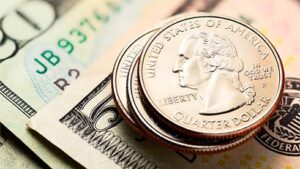
Traders are assessing the minutes of the Federal Reserve (Fed) meeting in May, which showed that a number of U.S. Central Bank executives believe further monetary policy tightening is necessary.
“Some executives noted that another rate hike is likely needed at the next meetings because their projections suggest that the process of moving U.S. inflation toward the Fed’s 2 percent target may remain unacceptably slow,” the minutes said.
At the same time, “several participants of the meeting said that if the situation in the American economy develops in accordance with their expectations, further policy tightening after the May meeting may not be necessary,” the document notes.
Judging by the quotations of futures on the rate level, the chances for the Federal Reserve to increase it by 25 bps in June are estimated by the market at 30%, the probability of raising the rate by the end of July – at 55%, according to the CME Group.
The international rating agency Fitch on Wednesday placed the long-term issuer default rating of the USA “AAA” on the review with the “negative” forecast in connection with the delay of negotiations on the issue of the limit of the country’s borrowings.
The agency’s press release notes that the political bias of the parties involved in discussing the issue is preventing an agreement to raise or suspend the U.S. government debt ceiling, while the deadline for a decision is approaching.
Ironically, this factor is also supporting the dollar as it boosts investor inflows into safe haven assets, Trading Economics noted.
The ICE-calculated index showing the dynamics of the dollar against six currencies (euro, Swiss franc, yen, Canadian dollar, pound sterling and Swedish krona) is adding 0.15%, while the broader WSJ Dollar Index is adding 0.16%.
The euro/dollar pair is trading at $1.0732 as of 9:05 a.m. Moscow time, up from $1.0752 at the close of the previous session.
The pound exchange rate dropped to $1.2343, compared to $1.2465 the day before.
The value of the U.S. currency against the yen is 139.53 yen against 139.48 yen by the end of trading on Wednesday.



