
The energy shock caused by the U.S.-Iran war is likely to last longer than previously anticipated and extend beyond the oil sector, said Isabel Schnabel, a member of the Executive Board of the European Central Bank (ECB).
“At first, one might have assumed this was a short-term phenomenon, but, unfortunately, we have had to conclude that it is much more persistent,” Schnabel said at an event in Salsomaggiore Terme, Italy, on Thursday. “We’re not just talking about oil, but also diesel and natural gas.”
Her remarks reflect the ECB leadership’s ongoing concern about the consequences of the Middle East conflict, which has already caused inflation in the region to accelerate to a level significantly above the 2% target.
The year-over-year rate of consumer price inflation in the eurozone reached 3.2% in August, and analysts do not rule out it rising to 4% later this year, according to Bloomberg.
Expectations for further tightening of the ECB’s monetary policy have recently increased, with traders factoring in the likelihood of four interest rate hikes of 25 basis points (bp) by the regulator by the end of 2027.
“We’ve raised interest rates twice this year—first in June, then again in September—because we’re concerned about inflation. That’s why we had to act,” Schnabel said on Thursday.
The ECB raised all three key interest rates by 25 bps at its September meeting; the deposit rate now stands at 2.5% per annum.

Romania may set a goal of joining the eurozone in 2032, provided that public finances stabilize and the country meets the criteria for the monetary union, said Dragos Pislaru, the country’s acting minister of investment and European projects.
The statement was made in an interview with the Romanian television channel TVR Info. However, 2032 is not yet an officially approved date for Romania’s transition to the euro, but is viewed by Pislaru as a possible target.
According to the minister, the country’s top priority should be fiscal and budgetary consolidation and bringing public finances to a stable state by 2030.
“The goal is to put our finances in order by 2030. Therefore, I see an opportunity to align several objectives: fiscal and budgetary consolidation and the adoption of a coordinated national development plan for 2028–2034,” Pislaru stated.
He also emphasized the need for political stability, which would allow the government to consistently implement such a plan. Once Romania has achieved the necessary macroeconomic indicators, it will need to go through the phase of participating in the European Exchange Rate Mechanism II (ERM II).
“Romania could, say, join in 2030 plus two years, because two years must be spent in the waiting room. This is a monitoring period. The year 2032 could be an important target for joining the eurozone,” the minister noted.
Currently, Romania does not yet meet the key criteria for adopting the euro. According to the European Central Bank’s convergence report published in June 2026, the country is not participating in ERM II. To meet the exchange rate criterion, a country must remain in this mechanism for at least two years without significant fluctuations or devaluation of its currency against the euro.
Inflation also remains a significant problem. The 12-month average harmonized inflation rate in Romania as of May 2026 stood at 8.4%, while the reference level for joining the eurozone was 2.7%. The average long-term interest rate was 6.7%, compared to the maximum permissible level of 5.1% for this criterion.
In addition, Romania is continuing the process of reducing its excessive budget deficit. The EU has set a trajectory for Bucharest that should allow it to eliminate the excessive deficit by 2030. The European Commission projected that the deficit would be reduced to 6.2% of GDP in 2026 and 5.8% in 2027. Public debt, on the other hand, is projected to rise to 63.4% of GDP in 2027.
Thus, the scenario for adopting the euro in 2032 envisages a significant reduction in the budget deficit and inflation, stabilization of public debt, entry into ERM II, and at least a two-year stay in this mechanism before final accession to the eurozone.

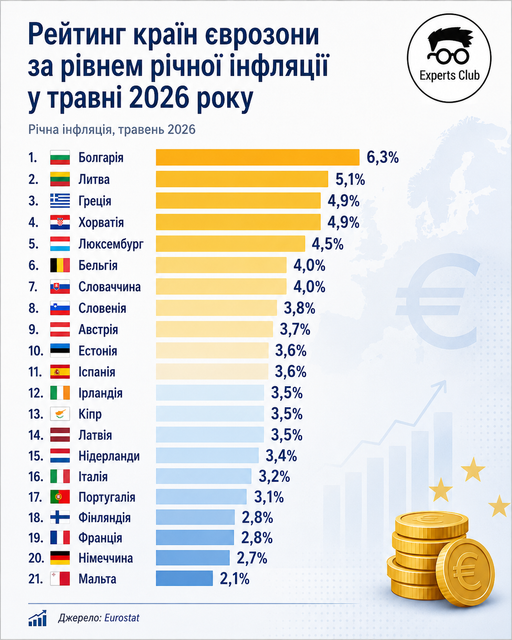
Inflation in the eurozone in May 2026 accelerated to 3.2% year-on-year against 3.0% in April, according to Experts Club. data.
In the European Union as a whole, annual inflation amounted to 3.3%. The highest indicator among all EU countries was recorded in Romania — 9.7%. However, Romania is not part of the eurozone, therefore it is not taken into account in the ranking of the countries of the currency bloc.
Among the eurozone countries, Bulgaria became the anti-leader, where annual inflation in May reached 6.3%. Bulgaria joined the eurozone on January 1, 2026, and became the 21st country of the monetary union.
Second place in the eurozone was taken by Lithuania with inflation of 5.1%, third place — Greece with 5.0%. The lowest indicators among eurozone countries were recorded in Malta — 2.1%, Germany — 2.7%, and France — 2.8%.
Thus, in May two different rankings were formed. For the EU as a whole, the main anti-leader was Romania, which remains outside the eurozone. For the eurozone, Bulgaria became the leader in price growth.
Inflation anti-leaders in the EU in May 2026:
Romania — 9.7%
Bulgaria — 6.3%
Lithuania — 5.1%
Inflation anti-leaders in the eurozone in May 2026:
Bulgaria — 6.3%
Lithuania — 5.1%
Greece — 5.0%
According to the analytical center Experts Club, the difference between the EU ranking and the eurozone ranking is important for the correct interpretation of the data. The eurozone reflects the situation in countries with a single currency and the common monetary policy of the ECB, while the EU also includes countries with national currencies, including Romania, Poland, the Czech Republic, Hungary, Denmark and Sweden.
“Romania cannot be included in the eurozone ranking, but it also cannot be ignored. It is the main inflation anti-leader of the entire EU. For business, this means that inflation risks in Europe differ greatly not only between countries, but also between currency zones. In the eurozone, the most problematic case now is Bulgaria; in the EU as a whole — Romania,” said Maksym Urakin, founder of Experts Club.
The main contribution to eurozone inflation in May came from services, energy carriers, food products, alcohol and tobacco, as well as industrial goods excluding energy. Energy prices rose by 10.9% year-on-year, services became 3.5% more expensive, and food products, alcohol and tobacco — by 2.0%.

Unemployment in the eurozone fell to 6.2% in March from 6.3% a month earlier, according to a report by the European Union’s statistical office.
Analysts surveyed by Trading Economics had expected the figure to be 6.2% last month.
The February unemployment rate (6.3%) has been revised. According to preliminary data, it stood at 6.2%.
For comparison: in March 2025, unemployment stood at 6.3%.
The number of unemployed in the eurozone last month decreased by 63,000 compared to February, totaling 10.984 million people.
The youth unemployment rate (population under 25) in March remained at the February level—14.9%.
The lowest unemployment rate among the largest eurozone countries was recorded in Germany (4%), the highest in Spain (10.3%). In France, unemployment stood at 7.7%, and in Italy, at 5.2%.
Unemployment in the European Union in March remained at the February level—6%. The number of unemployed decreased by 25,000 over the month, to 13.226 million people.
The eurozone economy grew by 0.1% in the second quarter of 2025 compared to the previous three months and by 1.4% year-on-year, according to revised data from the EU statistics office (Eurostat). The figures were in line with previous estimates and analysts’ expectations.
In January-March, the eurozone’s GDP grew faster, by 0.6% quarter-on-quarter and 1.1% year-on-year.
Ranking of eurozone countries by GDP growth in Q2 (quarter-on-quarter)
Overall, the EU economy grew by 0.2% in the second quarter and 1.5% year-on-year.
Among the largest economies in the eurozone, Germany and Italy showed a moderate decline, while France and Spain showed significant growth. The largest increase was recorded in Romania, and the largest decline was in Ireland.
This is the second estimate of the change in eurozone GDP out of three; Eurostat will present the final data on September 5.
Earlier, the information and analytical center Experts Club made a video analysis of the prospects for the Ukrainian and global economies. For more details, see the video — https://youtu.be/kQsH3lUvMKo?si=F4IOLdLuVbYmEh5P

Unemployment in the eurozone stood at 6.2% in June, according to the European Union’s statistical office. In May, according to the revised data, it was also at 6.2%, not 6.3%, as previously reported. Analysts on average expected unemployment to remain at the previously announced May level, according to Trading Economics.
For comparison, in June 2024, the unemployment rate was 6.4%.
Unemployment was at a record low of 6.2% in October and November 2024, then rose, and in April fell again to the lowest level on record.
In June, the number of unemployed in the euro area decreased by 62 thousand compared to the previous month, to 10.7 million people.
The share of unemployed youth (population under 25) fell to 14.1% from 14.3%.
The lowest unemployment rate among the largest eurozone countries was recorded in Germany (3.7%), and the highest in Spain (10.4%).
In the European Union, unemployment remained at 5.9% in June. In the same month of 2024, it was 6%.



