
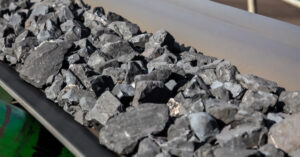
In January-September this year, Ukraine reduced manganese ore exports by 78.3% compared to the same period last year, to 9,739 thousand tons, but in August-September, it stepped up deliveries.
According to statistics released by the State Customs Service (SCS), while shipments in the first seven months of 2025 amounted to 2,977 thousand tons, exports more than doubled in August, when 5,037 thousand tons were shipped, and 1,725 thousand tons in September.
In monetary terms, exports for the first nine months of 2025 fell by 75.4% compared to the same period in 2024, to $1.615 million. The main exports were to Slovakia (98.27% of shipments in monetary terms) and Poland (1.73%).
There were no imports of manganese ore during this period.
As reported, in January 2024, Ukraine exported 44,903 thousand tons of manganese ore worth $6.563 million to the US, ending a two-year absence of supplies to foreign markets. In February-December 2024, there were no exports of manganese ore.
At the same time, for the whole of 2024, the country imported 84,293 thousand tons worth $18.302 million from Ghana (98.85%), Brazil (0.99%), and Belgium (0.11%). There were no imports in October-November.
Ukraine did not export manganese ore in 2022 and 2023, and in 2021 it exported 770 tons worth $89 thousand.
In addition, it was reported that the Pokrovsky Mining and Processing Plant (PGZK, formerly Ordzhonikidze Mining and Processing Plant) and the Marganetsky Mining and Processing Plant (MGZK, both in Dnipropetrovsk region), which are part of the Privat Group, stopped mining and processing raw manganese ore in late October-early November 2023, while NZF and ZZF stopped smelting ferroalloys. In the summer of 2024, ferroalloy plants resumed production at a minimum level.
PGZK and MGZK did not produce any products in 2024, while in 2023, PGZK produced 160.31 thousand tons of manganese concentrate, and MGZK was idle.
In Ukraine, manganese ore is mined and enriched by the Pokrovsky and Marganets mining and enrichment plants.
The consumers of manganese ore are ferroalloy enterprises.
Imports of goods from Ukraine in January-September 2025 amounted to $60.1 billion in monetary terms, which is 17.4% higher than in the same period of 2024, while exports decreased by 3.1% to $29.5 billion, according to the State Customs Service (SCS).
“At the same time, taxable imports amounted to $45.9 billion, which is 76% of the total volume of imported goods. The tax burden per 1 kg of taxable imports in January-September 2025 was $0.52/kg,” the agency’s Telegram channel reported on Wednesday.
Traditionally, China imported the most goods to Ukraine – $13.3 billion, followed by Poland – $5.7 billion, and Germany – $4.8 billion.
Ukrainian goods were exported mainly to Poland – $3.7 billion, Turkey – $2.1 billion, and Germany – $1.8 billion.
Of the total volume of goods imported into the country in January-September 2025, 69% of the categories were machinery, equipment, and transport – $23.8 billion (with customs clearance, UAH 148.3 billion, or 29% of customs payments, was paid to the budget), chemical industry products – $9.4 billion (72.9 billion hryvnia paid to the budget, or 14% of revenues), fuel and energy – $7.6 billion (146.6 billion hryvnia paid, accounting for 29% of customs payments).
According to the State Customs Service, the top three most exported Ukrainian goods were food products – $16.2 billion, metals and metal products – $3.4 billion, and machinery, equipment, and transport – $2.8 billion.
“In the first nine months of 2025, UAH 641.9 million was paid to the budget during customs clearance of exports of goods subject to export duties,” the service concluded.
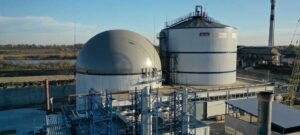
In September 2025, YUM Liquid Gas LLC exported Ukrainian-produced liquefied biomethane (bio-LNG) to Germany by tanker trucks for the first time, according to industry analytical agency ExPro Daily Gas.
According to the agency’s estimates, the company exported almost 60 tons of liquefied biomethane in September-October. The buyer was Cyprus-based Preture Liquid Gas. According to YouControl, it is the founder of YUM Biogas Company. Therefore, both companies belong to the same group of companies.
YUM Liquid Gas LLC produces biomethane from biogas at its own Yuzhefo-Mykolaiv Biogas Plant (Vinnytsia region). Biogas is produced from sugar beet pulp and broiler chicken manure.
Thus, YUM Liquid Gas has become the second Ukrainian company to export bio-LNG and the fourth company to export biomethane from Ukraine.
As reported, Oril Leader, part of the MHP agricultural holding, also exports bio-LNG to Germany, having supplied almost 2,800 tons since May 2025.
On February 7, 2025, VITAGRO exported biomethane from Ukraine for the first time. On February 11, MHP joined it, and in June, Gals Agro made its first export of gaseous biomethane.
According to information from the Ukrainian Gas Transmission System Operator, as of mid-2025, there were four biomethane plants operating in Ukraine with a capacity of 41 million cubic meters of biomethane per year, three of which are already commercially supplying biomethane to the gas transmission system. By the end of 2025, biomethane producers plan to commission additional biomethane plants with a capacity of up to 70 million cubic meters of biomethane per year and bring the total capacity to 111 million cubic meters per year.
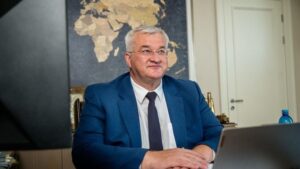
Ukrainian Foreign Minister Andriy Sybiga said that the Foreign Ministry will play a role in relation to potential partners in the controlled export of Ukrainian weapons.
“Support for our defense industry is an absolute priority for our diplomacy. It includes three priorities. The first is more investment. The second is support for the president’s initiative on the possibility of exporting surplus products from our defense industry,“ Sybiga said during his opening remarks at the third International Defense Industry Forum (DFNC3) on Monday.
According to Sybiga, the Foreign Ministry ”will play its role here with regard to potential partners.”
“Those countries that today take a passive position on supporting Ukraine, that provide covert or overt support for Russian aggression, will certainly not be included in the list of partners who will be able to cooperate with Ukraine and Ukrainian companies in this area,” the head of the ministry said.
The third priority of the Foreign Ministry in supporting the Ukrainian defense industry, Sibiga added, is “to create a real multiplier effect from our weapons.” In particular, this refers to the creation of jobs for Ukrainian citizens in Ukraine.
“This, by the way, is also our integration into the European Union. The latest Eurobarometer says that it is precisely because of our contribution to security that we are most eagerly awaited as a future member of the EU,” the minister added.
https://interfax.com.ua/news/diplomats/1110142.html
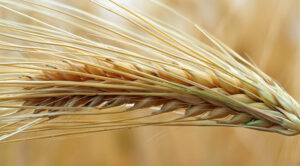
As of September 29, Ukraine exported 235,000 tons of barley, despite the absence of supplies to China. Export rates and barley prices were supported by a tender in Turkey, according to the analytical cooperative “Pusk,” created within the framework of the All-Ukrainian Agrarian Council (VAR).
“Last week, Turkey’s state procurement company announced a tender for 255,000 tons of barley. This factor became the main driver of the market, ensuring a temporary increase in prices. Currently, the conditional prices for Ukrainian barley are $215–217 per ton, or 10,150–10,250 UAH/ton in ports. There is almost no support for prices on the domestic market, as barley remains more expensive than other feed crops,” analysts noted.
Experts believe that thanks to the Turkish tender, the market may maintain relatively high price levels for another week, with a possible increase of $1–2 per ton. However, after the tender activity ends, the price may return to the range of $210–214 per ton.
“In October, the barley market will traditionally be guided by wheat price dynamics. If the wheat market continues to show growth prospects, barley will also gradually rise in price,” Pusk concluded.
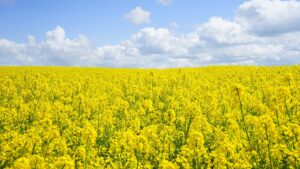
A mechanism for confirming exporters as commodity producers, which will allow them to avoid paying the recently introduced 10% duty on exports of soybeans and rapeseed, should be in place by the end of next week, said Deputy Minister of Economy, Environment, and Agriculture of Ukraine Denys Bashlyk.
“It will be as convenient as possible, the software is already 90% ready. The Cabinet of Ministers will make a decision next week,” he said at the Forbes Agro conference in Kyiv on Friday.
Bashlyk noted that there are currently situations where producers export and are forced to pay duties because there is no such confirmation mechanism.
According to him, the confirmation mechanism is planned to be implemented through the state agricultural register so that it does not take too much time, does not require “a million references” and the need to confirm each batch.
As for the duties already paid by commodity producers, the government is preparing amendments to the law on the state budget for 2025, which will allow the return of duties already paid, the deputy minister said.
In general, he noted that the Ministry of Economy is against the abolition of the 10% duty on exports of soybeans and rapeseed.
“We understand the risks that farmers may face, but it should be noted that there is another side to this story — the creation of a separate fund to which the paid duties will be transferred. And so, should the abolition of these so-called soybean amendments be on the agenda today? No, it should not,” Bashlyk said.
Farmers at the Forbes Agro conference criticized the introduction of this duty because, in their opinion, processors at the beginning of the war, due to logistics problems, received high profits at the expense of agricultural producers, and now processing does not require such privileges and should pay the market price for raw materials, competing with importers. According to the speakers, these duties will result in a reduction in rapeseed and soybean crops and a deterioration in crop rotation.
The head of Ukraine’s largest oil producer, Kernel, Yevgen Osipov, canceled his planned interview at the conference, and the founding editor of Forbes Ukraine, Volodymyr Fedorin, who was supposed to conduct the interview, said that Osipov did not like the publication’s article criticizing the duty.
As reported, Law No. 13157, signed by the president on September 2, stipulates that agricultural producers and cooperatives that export their own products will be exempt from paying duties. However, due to the lack of clear rules for documentary confirmation of the origin of goods, the mechanism does not actually work, and the export of oilseeds has been largely blocked.
A number of agricultural associations, including the All-Ukrainian Agrarian Council (VAR), the Ukrainian Agribusiness Club (UAC), the Ukrainian Grain Association (UGA), the Ukrainian Agrarian Confederation, as well as the European Business Association and the American Chamber of Commerce, have appealed to the Cabinet of Ministers and the Verkhovna Rada to repeal the law establishing a 10% duty on exports of soybeans and rapeseed as soon as possible.
On September 19, MP Yaroslav Zheleznyak (Voice faction) registered a corresponding bill No. 14055 on the repeal of the “soybean and rapeseed amendments.”



