
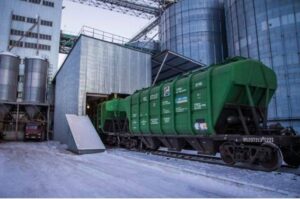
In 2023, Ukrzaliznytsia JSC transported 30.58 million tons of grain cargo, up 5.9%, or 1.708 million tons, from a year earlier, said Valery Tkachev, deputy director of the commercial work department of UZ, at a meeting with agricultural market participants on Thursday.
According to him, 22.729 mln tons of grain crops were transported for export by rail, which is 178 thsd tonnes more than in 2022. Of these, 14.324 mln tonnes (-4.9%) were shipped to the ports, and 8 mln 405 thsd tonnes (+12.2%) – to the western border crossings.
“Before the embargo on imports of Ukrainian grain by neighboring countries was imposed in April, 900 thsd tonnes to 1 mln tonnes of grain were transported by rail per month. After the ban was imposed, the volume was almost halved. The work of ports in 2023 was significantly affected by the uncertainty of the “grain corridor”, Tkachev stated.
As reported, Ukrzaliznytsia transported 63 million tons of cargo for export in 2023.

Ukraine’s exports of goods in 2023 fell by 18.5% year-on-year, from $44.2 billion to $36 billion, while imports increased by 14.4%, from $55.5 billion to $63.5 billion, the State Customs Service reported on Friday.
As a result, according to its data, Ukraine’s foreign trade turnover in 2023 decreased by only 0.3% to $99.4 billion.
It is specified that taxable imports amounted to $52.6 billion, or 83% of the total volume of imported goods. It is noted that the tax burden per 1 kg of taxable imports in 2023 increased by 38% to $0.49/kg.
According to the published data, China imported the most goods to Ukraine – $10.4 billion, Poland – $6.6 billion and Germany – $4.9 billion, while the most were exported to Poland – $4.7 billion, Romania – $3.7 billion, and China – $2.4 billion.
Machinery, equipment and transport accounted for 65% of the total volume of goods imported in 2023 – $19.8 billion (UAH 141.7 billion, or 31% of customs revenues, was paid to the budget during customs clearance of such goods), chemical products – $11 billion (UAH 74.8 billion, or 16% of customs payments) and fuel and energy products – $10.3 billion (UAH 103.4 billion, or 23% of customs payments).
The top 3 exports from Ukraine in 2023 were food products – $21.8 billion, metals and metal products – $3.9 billion, and machinery, equipment and transport – $2.9 billion.
The State Customs Service clarified that UAH 559.2 million was paid to the budget during customs clearance of exports of goods subject to export duties.

In the first half of 2023-2024 marketing year (MY, July-December), Ukraine set the record for rapeseed oil exports – 356 thsd tonnes, up six times compared to the same period last year, APK-Inform news agency reported.
“The significant increase in the rate and volume of exports of this product in the current season was primarily due to the high demand for rapeseed oil on the world market amid attractive prices. Difficulties with sunflower procurement during the off-season also encouraged Ukrainian mills to increase rapeseed processing,” the analysts explained.
According to their information, the main volumes of Ukrainian rapeseed oil shipments during six months of 2023-2024 MY were to the EU countries, where 54% of Ukrainian rapeseed oil was supplied, and China – 31%.

The Government of Ukraine has maintained zero quotas for the export of natural gas of Ukrainian origin, edible salt, anthracite, coal and coal briquettes, gold, silver, as well as precious metal waste and scrap for 2024.
The Cabinet of Ministers published Resolution No. 1402 of December 27 on the list of goods subject to licensing on its website.
According to the resolution, the quotas for the export of liquid fuel (fuel oil), which were in effect in 2023, were preserved – 540 thousand tons (no more than 60 thousand tons per month) and coking coal – 900 thousand tons.
In addition, the government has extended the ban on the export of fuel wood, wood chips or shavings for January-February 2023, after which the export of these goods will be removed from the list of licensed goods.
The licensing of wheat, rye, barley, oats, corn, soybeans, rapeseed and sunflower seeds, soybean, rapeseed, sunflower and mustard oil, and oilcake has also been retained.
ANTHRACITE, BAN, EXPORT, GAS, SALT

Exports of agricultural products in December 2023 should exceed 6 million tons, which became possible due to the opening of the Ukrainian shipping route, said Maksym Kharchenko, analyst at UkrAgroConsult, an information and analytical agency.
“Exports of agricultural products in December 1-15 totaled 3.38 million tons, which is 20% more than in the same period of the previous month. At the same time, the share of land exports in total exports decreased to 14.1% amid increased activity of seaports. At the same time, the role of the Danube ports in the first half of December was the lowest for the whole of 2023,” he said.
According to him, the rate of exports of agricultural products by road decreased by the end of the year due to the continuation of strikes in neighboring European countries. Currently, a queue of almost 4,000 trucks has formed to enter Ukraine from Poland. The Ministry of Infrastructure of Ukraine says that by the end of this year, Ukraine and Poland may come to a common position on blocking the borders.
“It should be noted that vegetable oils remain the main commodity transported by road for export,” UkrAgroConsult said.
Speaking about the export of agricultural products by rail, analysts noted that its pace in the first weeks of December is only slightly behind the pace of previous months. The total export volume in December is forecast at 800-900 thousand tons, which does not differ from the average for the last four months. Export flows by rail have not yet had time to reorient towards seaports.
UkrAgroConsult reported that as of December 19, 6.6 thousand railcars with grain (or about 400 thousand tons) were heading to Ukrainian seaports via domestic rail transportation, which is almost a thousand more than a week earlier.
At the same time, exports by sea through the ports of the Danube region in the first half of December amounted to only 0.56 million tons, which is far behind the same period last month.
“The Danube region is gradually losing its attractiveness for exporters due to the opening of a much cheaper option for exporting through Odesa ports,” analysts explained.
Partly due to the activity of the ports in the Danube region, in January-November, the Romanian port of Constanta shipped 32.6 million tons of grain, setting a record (the previous annual record was just over 25 million tons). Ukrainian grain amounted to 13 mln tons, or about 40% of the total transshipment volume. In 2022, the volume of transshipped agricultural products from Ukraine in the port of Constanza amounted to 8.6 million tons, UkrAgroConsult stated.
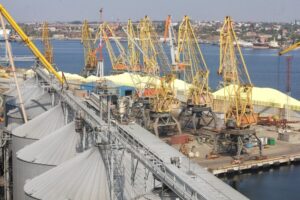
“Kernel, one of Ukraine’s largest agricultural holdings, has been using its Aeneid and Mavka vessels to export agricultural products for the second year in a row and intends to further expand its fleet, the agricultural holding reported on Facebook.
“For the second year, we have been operating our own vessels and transporting Ukrainian products in the difficult conditions of the termination of the grain deal. (…) Two Kernel vessels, Aeneid and Mavka, are currently exporting Ukrainian products. The deadweight (maximum loading) of the bulk carrier Aeneid is 47,335 tons, and the Mavka tanker is 13,500 tons. We have no plans to stop and are already working on expanding the fleet,” the statement said.
The agricultural holding noted that the use of its own fleet is economically beneficial, especially during the period of inflated freight rates during martial law. The development of its own shipping gives impetus to the entire market and strengthens the country’s export capabilities, Kernel believes.
“The Black Sea remains the only alternative for Ukrainian exports. The deep-water ports are able to accumulate and ship large-tonnage consignments of more than 60 thousand tons. This makes it possible to optimize logistics processes and significantly reduce costs. All alternative routes have extremely high logistics costs,” the agricultural holding explained and promised to continue to strengthen Ukraine’s exports and contribute to food stability in Europe and the world.
As reported, before the war, Kernel was the world’s largest producer of sunflower oil (about 7% of global production) and its exports (about 12%). It is one of the largest producers and sellers of bottled oil in Ukraine. In addition, it is engaged in the cultivation and sale of agricultural products.
In the first quarter of FY2024, the company posted a net loss of $30.9 million, while the previous year ended with a net profit of $162 million, with a 17% decrease in revenue to $564 million.
According to the report, the book value per share for the year decreased from $20.7 to $6 (or PLN26.22), in particular due to an increase in the number of shares from 77.429 million to 147.864 million.



