
Over the course of a year since the launch of the Open Agri platform, the Kernel agricultural holding has attracted approximately 480 small and medium-sized agricultural producers who cultivate more than 255,000 hectares of land; the amount of financing secured through the project has exceeded $16 million, the holding’s press service told the Interfax-Ukraine news agency.
“Today, farmers need more than just a buyer for their harvest; they need a strong partner who can help optimize costs and minimize risks. At Open Agri, we have combined expertise, financing, and legal protection, as well as practical services for farm development,” the press service quoted Open Agri project manager Igor Kotsel as saying.
It is noted that platform participants gain access to agronomic expertise, laboratory testing, legal and accounting support, as well as financing programs for future harvests.
According to reports, more than 120 farms have already conducted soil analyses and received customized nutrient maps.
“Kernel” plans to expand the project and increase the number of partner farms by the end of 2026, the press release states.
Open Agri is a platform for the company’s collaboration with small and medium-sized agricultural producers.
Kernel previously reported that it has invested 1 billion hryvnia in the development of Ukrainian communities over the past four years. Specifically, as part of the “My Community: Together with Kernel” program, 67 local initiatives have been funded over two years with more than 10 million hryvnia.
Kernel Agricultural Holding is the world’s largest producer and exporter of sunflower oil, Ukraine’s largest grain exporter, the operator of an extensive network of logistics assets, and a leading producer of grains and oilseeds in Ukraine. It is one of the largest producers and sellers of bottled oil in Ukraine. It is engaged in the cultivation and sale of agricultural products.
According to results for the first nine months of fiscal year 2026 (July 2025–March 2026), Kernel’s net profit decreased by 5% to $208 million, while its revenue increased by 0.4% to $3.092 billion, and EBITDA rose by 1% to $403 million.
AGRICULTURAL PRODUCERS, FARMERS, FINANCING, KERNEL, Open Agri
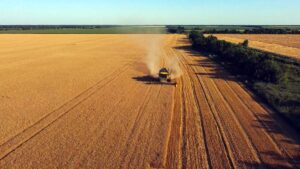
Farmers in the Odesa region were the first in Ukraine to begin the harvest; specifically, the harvest of winter barley and peas has begun, according to Oleg Kipper, head of the Odesa Regional Military Administration.
“The initial results of the harvest indicate good yields. This allows us to view the prospects for this year’s harvest campaign with optimism,” Kipper noted.
According to his data, farmers in the Odesa region are expected to harvest grains and legumes from nearly 770 thousand hectares this year. As is traditional, winter and spring wheat account for the largest share of the crops—over 522,000 hectares. Barley covers nearly 176,000 hectares, peas—about 74,400 hectares, and rapeseed—over 175,000 hectares.
As previously reported, a total of about 11.3 million hectares were sown with winter and spring grains and legumes in Ukraine this year, while total oilseed crops covered more than 20 million hectares.
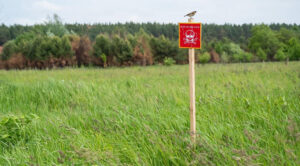
Since the start of Russia’s full-scale invasion, the Food and Agriculture Organization of the United Nations (FAO) has allocated $176.7 million to support Ukraine’s agricultural sector, with priorities including demining and training for agribusiness development, according to Shakhnoza Muminova, head of the FAO office in Ukraine.
“From 2022 to the present, FAO, together with its partners, has allocated $176.7 million to support approximately 300,000 families in rural areas and 17,000 farmers,” she told the Interfax-Ukraine news agency on the sidelines of the Agro Ukraine Summit on Wednesday.
According to Muminova, one of the most underfunded yet most critical areas remains the humanitarian demining of agricultural land.
“First and foremost, mine action requires significant funding because it is expensive. Ukraine currently has the world’s largest area of contaminated agricultural land. If this sector is underfunded, demining could drag on for several decades. And we want to return the land to production as soon as possible,” she noted.
The head of the FAO office reported that currently 133,000 square kilometers of Ukraine’s territory require surveying and are at risk of being contaminated with explosive ordnance.
According to her, the FAO’s work in Ukraine focuses on several key areas: supporting families and farmers in rural areas, as well as providing technical support to the government. Particular attention is being paid to surveying potentially contaminated areas and providing vouchers to resume agricultural activities on cleared plots.
Muminova also highlighted the lack of funding for training and agribusiness development programs.
“The Ukrainian agricultural sector is currently experiencing a significant exodus of people due to the hostilities. Many people are leaving, and the agricultural sector is suffering greatly as a result. Therefore, training remains one of the key areas in need of support,” she explained.
According to the FAO representative, the organization plans to provide support to an additional 240,000 households and farmers between 2026 and 2028. To implement this plan, the FAO needs to raise $193 million, but the initiative remains underfunded at this time.
“What strikes me most is that people do not want to leave their homeland, even if it is dangerous,” Muminova added.
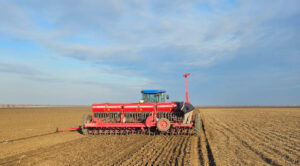
As of April 20, farmers had sown 1,251.9 thousand hectares with spring grain and leguminous crops, which amounts to 21% of the forecast for 2026, the press service of the Ministry of Economy, Environment and Agriculture reported on Tuesday.
According to оперативе statistics, over the past week farmers sowed 254.9 thousand hectares compared with 168.7 thousand hectares the previous week. The pace of field work increased by 1.5 times, but the overall figures are 15.3% behind last year’s pace, when as of April 25, 2025, 1,478.7 thousand hectares had been sown.
The Ministry of Economy clarified that so far 623.8 thousand hectares of barley have been sown (83% of the plan), peas – 238.3 thousand hectares (87%), wheat – 158.8 thousand hectares (85%) and oats – 117.5 thousand hectares (85%). Corn sowing has intensified and reached 75.7 thousand hectares (2% of the forecast), the area under millet amounts to 1.2 thousand hectares (3%), and buckwheat sowing has started (0.01 thousand hectares). Other spring grain and leguminous crops have been sown on 36.5 thousand hectares (27% of the forecast).
The highest sowing rates for grain and leguminous crops have currently been recorded in Odesa region (168.2 thousand hectares), Ternopil region (96.3 thousand hectares), Mykolaiv region (89.4 thousand hectares) and Poltava region (86.5 thousand hectares).
At the same time, sowing of industrial crops is continuing, with 440.8 thousand hectares already sown. In particular, 293.6 thousand hectares have been allocated for sunflower (6% of the forecast), and 21.8 thousand hectares for soybeans (1%). Sugar beet has been sown on 125.4 thousand hectares, which is 64% of the planned area.
As reported, as of April 25, 2025, 2,000 thousand hectares in Ukraine had been sown with spring grain and leguminous crops. In particular, corn accounted for 705 thousand hectares, barley – 702.1 thousand hectares, wheat – 199.8 thousand hectares, peas – 201.8 thousand hectares, and oats – 154.2 thousand hectares. On the same date last year, 1,236.8 thousand hectares had been sown with sunflower, 187.6 thousand hectares with soybeans, and 228.5 thousand hectares with sugar beet.
According to the forecast of the Ministry of Economy, the total area of spring grain and leguminous crops in 2026 will amount to 6.002 mln hectares, of which corn will account for 4.418 mln hectares. Among industrial crops, 5 mln hectares are planned for sunflower, 2.04 mln hectares for soybeans, and 197.2 thousand hectares for sugar beet.
AGRICULTURE, FARMERS, GRAINS, SOWING CAMPAIGN, SPRING SOWING
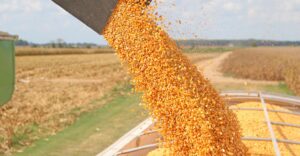
The Ministry of Agrarian Policy and Food, together with the international company Bayer and the All-Ukrainian Association of Communities, has launched a seed program that will provide free corn seeds for the spring sowing season to farmers in Donetsk, Zaporizhzhia, Sumy, Kharkiv and Chernihiv regions (excluding the temporarily occupied territories).
“This initiative is another step towards strengthening Ukraine’s food security in times of war, as it will allow farmers from the frontline and de-occupied territories to sow approximately 10 thousand hectares and harvest approximately 120 thousand tons of grain,” the Ministry of Agrarian Policy emphasized.
According to the ministry, to receive assistance, a farm must be registered in the State Agrarian Register (SAR) and cultivate from 5 hectares to 500 hectares in the specified areas.
Applications will be accepted from April 21 to April 30 or until the amount of assistance is exhausted. Each approved applicant will be able to receive up to 25 sowing units of corn seeds (1 sowing unit per 1 ha) depending on the area of land under cultivation. Seed distribution will begin in early May and will last approximately two weeks.
In 2025, the Food and Agriculture Organization of the United Nations (FAO) will continue to support Ukrainian farmers in Kherson region by providing them with equipment for loading/unloading grain storage sleeves and coordinating soil testing, said Vitaliy Koval, Minister of Agrarian Policy and Food.
“In 2025, FAO is focusing on the transformation of the agricultural sector and its urgent needs. Therefore, we agreed to transfer equipment for loading/unloading sleeves for farmers in the Kherson region. He also emphasized the importance of further support for farmers in the frontline areas. In addition, we will coordinate soil analysis after demining together. We need to ensure that such land is safe and can be used for sowing. Food security directly depends on this,” the press service of the Ministry of Agrarian Policy and Food quoted him as saying at a meeting with the acting head of the FAO Office in Ukraine, Mohammed Azuka.
The minister noted that another area of cooperation with FAO would be the State Agrarian Register.
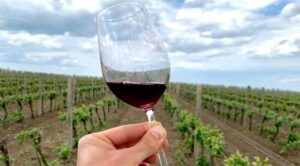
Vitalii Koval and Mohammed Azuka signed a project document entitled “Saving livelihoods by supporting small wine producers through the Food Coalition”. The project aims to create a favorable environment for small wine producers in Odesa and Zakarpattia regions. It is about providing them with technical support, access to finance to recover from the effects of the war and the decline in vineyard productivity, and to increase production.



