

In Ukraine on Wednesday, May 27, there will be scattered showers overnight in the northern regions and widespread showers during the day; thunderstorms are expected in the central and southern regions and in the Carpathian foothills, according to the Ukrainian Hydrometeorological Center.
Winds will be westerly and northwesterly, 7-12 m/s, with gusts of 15-20 m/s during the day across Ukraine.
Temperatures will range from 11-16°C at night and 18-23°C during the day, with highs of 23-28°C in Zakarpattia and the south of the country.
In Kyiv, no precipitation is expected on Wednesday night, with brief showers during the day. Winds will be northwesterly, 7-12 m/s, with gusts of 15-20 m/s during the day. Nighttime temperatures will range from 14-16°, and daytime temperatures from 21-23°.
According to data from the Boris Sreznevsky Central Geophysical Observatory in Kyiv, on May 27, the highest daytime temperature was 33.6° in 2007, and the lowest nighttime temperature was 1.7° in 1904.
On Thursday, May 28, light, brief showers and thunderstorms are expected at night in the south, east of the country, and in the Carpathians, and during the day across Ukraine, except for the southern regions and Zakarpattia.
The wind will be northwesterly, 7–12 m/s, with gusts of 15–20 m/s in some areas during the day in most regions.
Temperatures will range from 7–12° at night to 13–18° during the day; in Zakarpattia and the south of the country, temperatures will range from 11–16° at night to 18–23° during the day.
In Kyiv on Thursday, no precipitation at night, with light, brief showers during the day. Wind from the northwest, 7-12 m/s. Nighttime temperatures 10-12°, daytime 15-17°.

Ukraine plans to increase biomethane production to approximately 150 million cubic meters by 2026, and a production level of 500 million cubic meters is a realistic goal by 2030, according to a forecast by the Ministry of Economy, Environment, and Agriculture following a meeting with the European Investment Bank
“Ukraine has significant resources for producing biomethane from agricultural waste, livestock byproducts, straw, and sugar beets, which meets European requirements for ‘green’ fuel,” Deputy Minister Taras Vysotsky is quoted as saying in a press release on the ministry’s website.
He emphasized that exports to the EU should become the main driver of market development. The Deputy Minister noted that in 2025, Ukrainian private producers exported over 11.2 million cubic meters of biomethane via Ukraine’s gas transmission system for the first time.
Among the key challenges, he cited integration into the European certification system and the creation of the necessary technical database.
Following the meeting, the parties agreed to continue coordinating their work and further developing priority areas of cooperation in the fields of land reclamation, water resource management, and the development of sustainable agricultural infrastructure, as well as the biomethane sector.
As reported, on April 23, 2026, the government approved the Biomethane Production Development Program for the period up to 2035, which calls for increasing production to 2.1 billion cubic meters over 10 years.
According to data from the “Gas Transmission System Operator of Ukraine” (GTSOU), as of early February 2026, the declared capacity of biomethane producers in Ukraine, based on issued technical specifications for connection to the gas transmission system, stood at 11,000 cubic meters per hour, which equaled 96 million cubic meters per year.
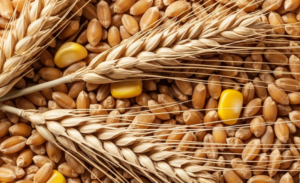
In its May report, the U.S. Department of Agriculture (USDA) issued its first forecast for wheat and corn exports from Ukraine in the 2026/2026 marketing year (MY) – 13 million tons and 23 million tons, respectively, which is 0.5 million tons and 1 million tons more than in the current MY.
According to USDA estimates, Ukraine’s wheat harvest in the next MY will decline to 23 million tons from 24.1 million tons last year, but ending stocks for the year will increase by only 0.9 million tons—to 4.53 million tons—while this year they are expected to rise by 2.9 million tons.
As for the corn harvest, USDA analysts forecast it at 30 million tons this year, compared to 30.9 million tons last year. The increase in exports is also expected to result from a decrease in ending stocks by 0.19 million tons, while this marketing year they are projected to increase by 1.91 million tons.
Taking other crops into account, the U.S. Department of Agriculture expects this year’s forage grain harvest to decrease to 36.08 million tons from 37.22 million tons last year, but an increase in its exports next marketing year to 25.19 million tons from 24.30 million tons this marketing year, also due to carryover stocks accumulated this year.
As reported, the Ministry of Economy forecasts a grain harvest of approximately 60.4 million tons in 2026, which is only 1%, or 0.64 million tons, less than last year. According to preliminary estimates by the Ministry of Economy, the harvest of major crops may amount to: wheat – about 22.4 million tons, barley – about 4.7 million tons, and corn – about 31.6 million tons.
According to the State Statistics Service, the wheat harvest in 2025 increased by 3.6% to 23.34 million tons, corn by 14.6% to 30.9 million tons, while the barley harvest decreased by 2.4% to 5.2 million tons.
The U.S. Department of Agriculture expects this year’s wheat harvest to decrease to 819.06 million tons and its exports to 211.70 million tons, down from 843.84 million tons and 222.68 million tons, respectively, last year.
The USDA’s first forecast for global corn production this year is 1,295.38 million tons, with exports for the 2026/27 marketing year at 206.91 million tons, while last year’s harvest was 1,312.68 million tons, and exports for the 2025-26 marketing year are expected to reach 213.59 million tons.

The US dollar-to-euro exchange rate at the end of 2026 will be $1.16/EUR1; the Cabinet of Ministers approved this updated estimate in the draft amendments to Ukraine’s state budget (No. 15224), whereas it had previously projected it at $1.08/EUR1.
As noted in the explanatory note to the draft, these changes have affected the assessment of the maximum levels of public debt: it will decrease by only UAH 332.2 billion, although financing of the state budget through debt operations will be reduced by UAH 651.5 billion thanks to the attraction of €13.2 billion in new budgetary support from the European Union under the Ukraine Support Loan.
According to the draft, it is proposed to set the public debt ceiling at the end of this year at 10 trillion 145. 6 billion UAH and the ceiling for state-guaranteed debt at 464.6 billion UAH, with budget revenues of 5 trillion 195.9 billion UAH and expenditures of 6 trillion 407.1 billion UAH.
As reported, in the calculations for Ukraine’s 2026 state budget, the government for the first time included a separate indicator for the projected average annual euro-to-hryvnia exchange rate—49.4 UAH/EUR1—in addition to the traditional average annual dollar exchange rate, which the Cabinet of Ministers expects to be 45.7 UAH/$1 this year.
In recent years, the share of euro-denominated obligations in Ukraine’s national debt has grown significantly, as the EU has become Ukraine’s main donor, while financial support from the U.S. has declined.
Public and state-guaranteed debt for the first quarter of 2026 increased by 190.4 billion UAH, or 2.1%, to 9.233 trillion UAH, but decreased by $2.5 billion, or 1.2%, to $210.8 billion in dollar terms.
The share of debt in euros as of the end of March this year was 44.08%, while in dollars it was 22.74%, in hryvnia 20.94%, and in IMF Special Drawing Rights (SDR) 9.12%.
In its updated April Inflation Report, the National Bank of Ukraine projects an average annual dollar-to-euro exchange rate of $1.18/EUR1, which corresponds to the current rate, compared to $1.13/EUR1 in 2025.
The official hryvnia-to-dollar exchange rate currently stands at 43.8033 UAH/$1, and the hryvnia-to-euro rate at 51.5433 UAH/$1.

The population of European Union countries is projected to decline by 53 million (11.7%) between 2025 and 2100, according to a forecast by the EU’s statistical office (Eurostat).
In 2025, the EU population was estimated at 451.8 million, resuming its growth trend in 2022 after a hiatus caused by the COVID-19 pandemic in 2021. The population is projected to grow over the next three years, peaking at 453.3 million in 2029, after which it will gradually decline to 398.8 million by 2100.
By the start of the next century, the share of children and youth (ages 0–19) in the total population will decline to 17% from 20% last year, and the working-age population (ages 20–64) will fall to 50% from 58%. In contrast, the share of people aged 65–79 will rise to 17% from 16%, and those aged 80 and older to 16% from 6%, according to a Eurostat report.
Earlier, the Experts Club think tank released a video on how the world’s population has changed in recent years; a more detailed video analysis is available here – https://www.youtube.com/shorts/MnNXy72azrw

Six Ukrainian economic forecasters and analytical teams have been included in the international Best Economic Forecast Awards ranking, published annually by FocusEconomics, based on results for 2025.
Among the Ukrainian participants in the ranking are Dmytro Taranenko and Olena Belan from Dragon Capital, Oleksiy Blinov from Forbes Ukraine and Blinov Forecasting, Vitaliy Kravchuk and Oleksandra Betliy from the Institute for Economic Research and Policy Consulting (IER), Hryhoriy Kukuruza from Ukraine Economic Outlook, and the ICU analytical team.
The FocusEconomics ranking covers more than 100 countries worldwide, and for Ukraine, it takes into account forecasts from 32 analytical teams at international banks, research centers, and rating agencies. The winners in each category are the participants whose forecasts proved to be the most accurate.
In the overall ranking for Ukraine, S&P Global Market Intelligence took first place, Dragon Capital second, and Alexey Blinov third. In the GDP forecasting category, Dmitry Taranenko and Elena Belan also took second place, while Vitaly Kravchuk and Alexandra Betliy took third.
In the inflation forecasting category, Taranenko and Belan took first place among analysts in Ukraine, Blinov took second, and S&P Global Market Intelligence took third. In the category of policy rate forecasting, first place went to Alexey Blinov. In the state budget balance forecast category, second place went to the ICU team, while in the balance of payments forecast category, first place went to Grigory Kukuruza, and third place again to Alexey Blinov.
In the exchange rate forecasting category, only foreign analytical centers were among the leaders. This shows that Ukrainian experts are particularly strong in assessing domestic macroeconomic indicators, while international players currently hold the leading positions in currency forecasts.



