
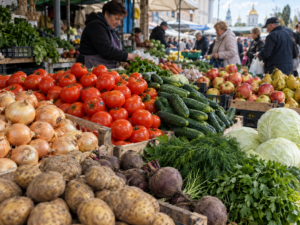
On the Ukrainian fruit and vegetable market, prices for a number of key vegetables continued to rise last week, while apples and pears began to fall in price, according to EastFruit’s review of trading platforms for the 37th week of 2026, published on September 14.
According to analysts, bulb onions became more expensive in Ukraine, while a reduction in the supply of table beets also led to higher prices. Tomatoes and cucumbers continued to rise in price. At the same time, prices for Chinese cabbage and cauliflower, zucchini and eggplants declined, while broccoli became more expensive. In the greens segment, prices for dill and parsley increased, while green onions became cheaper, EastFruit reports.
In the fruit and berry segment in Ukraine, apples and pears began to fall in price. At the same time, the cost of blueberries and garden strawberries rose noticeably, while raspberries became more expensive. Plums became cheaper, while prices for peaches and nectarines went up. Watermelons continued to become more expensive, and the price range for melons and grapes widened. Among imported fruits, lemon prices declined, EastFruit notes.
Tomatoes became the leader on the EastFruit trading platform by the number of sale listings. Market participants also increased the supply of bulb onions and white cabbage. At the same time, the number of sellers of potatoes, carrots and table beets declined. Pumpkins and eggplants once again entered the weekly top list of the most actively offered vegetables, with the increase in their sales provided, in particular, by participants from Ukraine, according to EastFruit’s review.
Among fruits, apples were sold most actively, although the number of listings for them decreased compared with the previous week. Participants from Ukraine increased the supply of pears. At the same time, the number of sellers of watermelons, plums and nectarines decreased, while the supply of melons increased, EastFruit reports.
Potatoes were in the greatest demand among buyers on the trading platform. Other vegetables from the so-called borscht set were also actively purchased.
In total, sellers from eight countries offered fruit and vegetable products on the EastFruit Trade Platform last week. Ukraine retained first place in terms of the number of listings posted, followed by Uzbekistan, Turkey, China and Iran. At the same time, the number of offers from Ukraine decreased over the week, while those from Uzbekistan, Turkey and China increased.
Galfrost LLC (Zhovkva, Lviv Oblast) plans to raise $28.5 million to expand its integrated fruit processing complex and build new production and cold storage facilities in Lviv Oblast, according to the Ukraine Investment Guide 2026, presented at the Ukraine Recovery Conference (URC2026) in Gdańsk.
The total project budget is $35.5 million, of which the company is prepared to finance $7 million with its own funds and plans to raise an additional $28.5 million through project financing.
The project involves expanding production and cold storage capacity, launching new product lines, and increasing output of freeze-dried fruits and berries, individually quick-frozen (IQF) products, and thermostable fillings for the confectionery industry. The capacity of the cold storage complex is planned to be increased to 10,000 metric tons.
The project is expected to take two years to complete, with the new facilities expected to begin operations in 2029–2031, according to the catalog.
Galfroast LLC was founded in 2007. The company specializes in the processing, freezing, and freeze-drying of fruits and berries, produces fruit ingredients for the food industry, and exports its products to foreign markets. According to the company, it processes approximately 6,000 metric tons of frozen products and produces about 100 metric tons of freeze-dried fruits and berries annually.
Last year, Galfrost LLC increased its revenue by 20.3% to 603.5 million UAH and reported a net profit of 5.9 million UAH, compared to a net loss of 10.2 million UAH the previous year.

The cost of 12 lean dishes for the 2025 Christmas table is 913.57 UAH, which is 11% more than last year, according to the Ukrainian Agribusiness Club (UACB)
“Food prices on the eve of the Christmas holidays show mixed trends: thanks to a record drop in vegetable prices, the cost of some traditional dishes has decreased, but the total cost of the Christmas table has increased due to the rise in prices for fruit, fish, and groceries,” the association explained.
Analysts noted that a distinctive feature of this winter season was “vegetable deflation.” Thanks to a good harvest, prices for vegetables used in borscht have fallen significantly: cabbage has fallen in price by 73%, carrots by 63%, onions by 58%, potatoes by 54%, and beets by 51%. This has led to significant savings in the preparation of dishes such as cabbage dumplings (their cost has fallen by 47%), potatoes with garlic (-40%), and vinaigrette (-18%). Even lean borscht will cost 18% less this year than last year.
At the same time, the main symbols of the Christmas table – kutia and uzvar – have noticeably increased in price, according to the UACB. The kutia index rose by 37%. This is due to the rise in prices of all its components: nuts jumped in price by 60%, honey by 40%, and poppy seeds and raisins by more than 30%. The ingredients for uzvar led the way in terms of price growth: prunes rose in price by 168%, dried pears by 140%, and apples by 110%, which led to a 150% increase in the price of the drink.
Fish dishes also became more expensive: the cost of herring rose by 24%, and fish (hake) for baking – by 25%. In addition, the final cost of dishes is influenced by sunflower oil, which is a basic element of the Lenten table and has risen in price by 22% over the year.
As for meat dishes (for those who do not observe Lent or are already preparing for the New Year), their preparation is more expensive than last year. Baked pork neck will cost 7% more (330 UAH/kg). Lard is outpacing the growth in meat prices – over the year, the product has increased in price by 16% and costs 272 UAH/kg. The cost of meat borscht has increased by 27%, reaching 196 UAH, with pork ribs accounting for over 60% of the price (119.5 UAH per 500 g). Chicken prices are rising due to the increase in feed costs, while pork prices are stabilizing due to imports.
Sliced cheese will be one of the most expensive items on the New Year’s table—700 UAH/kg, which is 40% more than last year. Despite the general trend of declining wholesale prices for raw milk, producers are maintaining high prices for cheese and butter due to expensive energy resources. Eggs, which are essential for Olivier salad, rose by 10% compared to the same period last year and reached 81.6 UAH per dozen, according to the UACB.
The fruit harvest in the 2025 season is about 60% of the pre-war level, and fruit storage facilities are loaded at 50% of pre-war volumes, so consumers should not expect the low fruit prices that existed before the war, said Taras Minko, head of the Ukrsadprom association.
“When fruit cost pennies, it was good for consumers, but for the industry itself, it was a huge minus, as it led to the bankruptcy of enterprises. If this trend had continued to this day, there would be no orchards left in Ukraine. We would be importing Polish, German, and other apples at European prices, which currently stand at EUR 2.603 per 1 kg,” he said at the Agro2Food exhibition.
The head of the industry association explained that low fruit prices in the pre-war period were due to high orchard productivity and intensive industrial horticulture in Ukraine.
According to him, 2022 was a lost production season for Ukrainian horticulture. Part of Ukraine was occupied, and a number of fruit storage facilities and horticultural farms were destroyed and looted.
“The main factors driving up fruit prices in recent years have been the cost of energy, labor shortages, and labor costs. There is a shortage of people—they are leaving the country. Those who remain want to work less and earn more. The discrepancy between wages and productivity is currently incomparable,” Minko emphasized.
He added that 250 people are needed to harvest a 25-hectare orchard. As a result, in 2022, many enterprises harvested 30% of their crops, in 2024 – 60%, and the current situation is no better.
In addition, according to the head of Ukrsadprom, a significant amount of fruit storage capacity has been destroyed in Ukraine. As an example, he cited statistics from association members who collectively cultivate 10,000 hectares of orchards. Before the war, they had about 110-120 thousand tons of storage in refrigerators.
“Currently, about 60% remains (of fruit storage facilities – IF-U). Some have closed, and some have lost their apple harvest due to climate change. This season, refrigerators with a capacity of about 50-60 thousand tons are in use,” Minko stated.
He noted that Ukraine currently lacks a culture of consuming jams and preserves, which hinders the development of the processing industry. At the same time, he predicts that in the next five years, Ukraine will see a boom in the construction of processing enterprises specializing in the manufacture of such products.
“If you look at today’s market, those who will look at such processing will have great prospects regardless of the number of enterprises existing today. While our parents were busy making preserves, our children will buy ready-made products. Therefore, this is a very promising and interesting industry, which will boom in 3-5-7 years,” concluded the head of Ukrsadprom.

In order to further promote fruit and vegetable products in Uzbekistan, a commission for the export of fruits, vegetables and food products will be established, headed by the Prime Minister.
For this purpose, Uzbek trading houses in Germany, Hungary, Poland, Spain, the United States, and Kazakhstan will be transferred to the management of entrepreneurs.
It has been announced that new trading houses will be opened in major port cities such as Nagoya (Japan), Mersin (Turkey), Rotterdam (Netherlands), Qingdao (China), Klaipeda (Lithuania) and Doha (Qatar).
Thanks to an investment of $8 million, modern laboratories with international accreditation will be launched this year in Zangiat, Fergana, and Samarkand.
A reference laboratory will also be set up in Tashkent to ensure that private laboratories meet international standards. For these purposes, $12 million will be allocated from the World Bank. In the future, internationally recognized reagents will be exempt from customs duties and will not require a mandatory environmental certificate.
For export companies with a shortage of working capital, the Business Development Bank will provide UAH 1.5 trillion in soft loans of up to 50% of the contract amount with the farmer and the procurement warehouse. Loans will be issued at 18% per annum with a grace period of six months for a period of up to 1.5 years.
Suppliers of various fruits and vegetables will be exempt from all taxes regardless of turnover, and will now be able to work as self-employed individuals.
Thanks to the measures taken, fruit products worth USD 1 billion are expected to be exported this year. As part of regional programs, 528 projects worth $833 million will be launched.
For more details, please follow the link
In 2023-2028, Uzbekistan will implement a project to create a value chain in the fruit and vegetable industry with the participation of the Japan International Cooperation Agency (JICA).
The total cost of the project is $323 million, including:
– a loan from the Japan International Cooperation Agency (JICA) – $200 million;
– the contribution of the Republic of Uzbekistan to the Project in the form of value added tax coverage and customs duty exemptions – $58.3 million;
– contribution of Project participants (loan recipients – Project initiators) – $64.8 million.
The project is being implemented in all regions of Uzbekistan, and its implementation period is 6 years – from 2023 to 2028.
The International Center for Strategic Development and Research in Food and Agriculture under the Ministry of Agriculture of Uzbekistan has been appointed as the executive body responsible for the timely and complete implementation, coordination and management of the project.



