
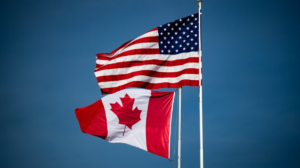
On August 27, U.S. President Donald Trump signed an executive order renaming Lake Ontario “Lake America.”
However, it is important to note that this does not constitute an international renaming of the lake. Lake Ontario is located on the border between the U.S. and Canada, and Trump’s executive order applies only to federal agencies and official U.S. geographic names. Canada is under no obligation to recognize the new name and continues to use “Lake Ontario.”
According to Executive Order No. 14420, the U.S. Secretary of the Interior, together with the U.S. Board on Geographic Names, must add the name “Lake America” to the federal Geographic Names Information System within 30 days. After that, the new name must be used in documents, maps, and communications by U.S. federal agencies.
Trump explained this decision by citing the lake’s economic and historical significance to the United States. The text of the executive order highlights the lake’s role in American trade, shipping, and military history, as well as Washington’s investments in protecting the Great Lakes ecosystem.
The decision was made against the backdrop of a new escalation in trade relations between the U.S. and Canada. Negotiations between the two countries on a trade agreement were suspended on August 21 after Canadian Prime Minister Mark Carney stated that the terms proposed by Washington did not serve the country’s interests. Canada subsequently announced that it was preparing corresponding trade measures.
The Canadian side did not recognize the renaming. Carney stated that in Canada, the body of water would continue to be called Lake Ontario. The name “Ontario” itself comes from the language of Indigenous peoples and was in use long before the modern United States and Canada came into existence.
While signing the executive order, Trump also floated the idea of further geographical renaming.
“We have a bay, and now we have a lake. We need an ocean,” the U.S. president said, adding that Washington could theoretically consider a new name for the Atlantic or Pacific Ocean—or both. So far, there are no executive orders or official procedures regarding the renaming of oceans.
This decision continues the trend of geographical renaming during Trump’s second presidential term. In January 2025, he ordered U.S. federal agencies to use the name “Gulf of America” instead of “Gulf of Mexico” and restored the name “Mount McKinley” to Denali in Alaska.

Ukrainian high school student Taras Symak from Kolomyia won a bronze medal at the 22nd International Geography Olympiad (iGeo 2026), which took place August 11–17 in Istanbul.
Taras Symak is a student at the Vasyl Stefanyk Lyceum No. 1 in Kolomyia. He has previously won prizes at several student Olympiads, and in the spring of 2026, he won the regional round of the All-Ukrainian History Olympiad.
This year’s iGeo featured 184 high school students from 50 countries around the world. Each national team could consist of a maximum of four participants, selected based on the results of national Olympiads.
Among the countries whose representatives won awards in Istanbul were Serbia, Belarus, Romania, Mongolia, Turkey, and Iran.
In particular, Serbian high school student Petar Tolimir from Belgrade won a gold medal. The Belarusian participants won gold, silver, and bronze medals. The Romanian team finished the Olympiad with two silver and two bronze medals.
Mongolia achieved a historic result—Amina Ayanbek won the country’s first-ever gold medal at the International Geography Olympiad. Another Mongolian participant received a bronze medal. A representative from the host country, Turkey, took silver, while Iran received bronze.
The International Geography Olympiad is considered the premier international geography competition for high school students aged 16–19 and is held under the auspices of the International Geographical Union.
Unlike traditional subject-based tests, participants are required not only to demonstrate knowledge of geographical facts but also to analyze maps, statistical data, economic and demographic processes, and conduct fieldwork.
The final score is based on three components: 40% from a written exam, 40% from field research, and 20% from a multimedia test using maps, photographs, graphs, and statistics.
The first iGeo took place in 1996 in The Hague with only five countries participating. Over the course of three decades, the Olympiad has become one of the leading international academic competitions for high school students, alongside the Olympiads in mathematics, physics, chemistry, biology, and computer science.
The next, 23rd International Geography Olympiad, is scheduled to take place in 2027 in Jelgava, Latvia.
EDUCATION, GEOGRAPHY, high school student, OLYMPIAD, UKRAINE
Ukraine in 2018 expanded geography of export of goods and increased the number of companies, which were authorized to export food of animal origin, according to a report of the State Service for Food Safety and Consumers’ Protection. According to the report, in 2018, 85 new markets were opened for various types of products – these are the markets of Albania and Ghana (poultry and products made of it), Hong Kong (poultry and products made of it, eggs and egg products), Morocco (poultry and products made of it , egg products), Macedonia (dairy products, feed), UAE (live sheep and goats, young poultry, live poultry, hatching eggs), Tunisia (poultry meat), Montenegro (eggs and egg products), and other countries.
In addition, 306 Ukrainian enterprises, including 126 food producers (poultry, fish, honey, eggs, and dairy products) now are authorized to export its products to the countries of the European Union.



