

Ukrainian high school student Taras Symak from Kolomyia won a bronze medal at the 22nd International Geography Olympiad (iGeo 2026), which took place August 11–17 in Istanbul.
Taras Symak is a student at the Vasyl Stefanyk Lyceum No. 1 in Kolomyia. He has previously won prizes at several student Olympiads, and in the spring of 2026, he won the regional round of the All-Ukrainian History Olympiad.
This year’s iGeo featured 184 high school students from 50 countries around the world. Each national team could consist of a maximum of four participants, selected based on the results of national Olympiads.
Among the countries whose representatives won awards in Istanbul were Serbia, Belarus, Romania, Mongolia, Turkey, and Iran.
In particular, Serbian high school student Petar Tolimir from Belgrade won a gold medal. The Belarusian participants won gold, silver, and bronze medals. The Romanian team finished the Olympiad with two silver and two bronze medals.
Mongolia achieved a historic result—Amina Ayanbek won the country’s first-ever gold medal at the International Geography Olympiad. Another Mongolian participant received a bronze medal. A representative from the host country, Turkey, took silver, while Iran received bronze.
The International Geography Olympiad is considered the premier international geography competition for high school students aged 16–19 and is held under the auspices of the International Geographical Union.
Unlike traditional subject-based tests, participants are required not only to demonstrate knowledge of geographical facts but also to analyze maps, statistical data, economic and demographic processes, and conduct fieldwork.
The final score is based on three components: 40% from a written exam, 40% from field research, and 20% from a multimedia test using maps, photographs, graphs, and statistics.
The first iGeo took place in 1996 in The Hague with only five countries participating. Over the course of three decades, the Olympiad has become one of the leading international academic competitions for high school students, alongside the Olympiads in mathematics, physics, chemistry, biology, and computer science.
The next, 23rd International Geography Olympiad, is scheduled to take place in 2027 in Jelgava, Latvia.
EDUCATION, GEOGRAPHY, high school student, OLYMPIAD, UKRAINE
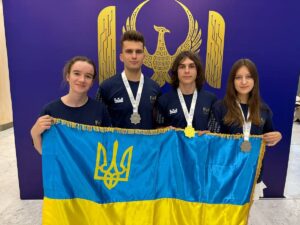
Ukrainian high school students won one gold and two silver medals at the 38th International Olympiad in Informatics (IOI 2026), which took place August 9–16 in Tashkent, Uzbekistan.
A total of 375 students from 97 countries participated in the competition. Over the course of two competition days, participants solved complex algorithmic programming problems.
Vladislav Khalin achieved the best result among Ukraine’s representatives. He scored 398.32 points, placed 16th in the overall individual rankings, and received a gold medal.
Ilya Shevchenko, with a score of 336.44 points, placed 58th and received a silver medal. Daria Perekopskaya brought home another silver medal for Ukraine, scoring 333.01 points and placing 62nd.
The fourth member of the Ukrainian team, Daria Lobas, placed 198th with a score of 219.04 points.
First place in the individual rankings of the 2026 IOI went to Qiwen Xu of China, who scored 498.27 points out of a possible 600.
The International Olympiad in Informatics (IOI) is one of the most prestigious international subject-based Olympiads for high school students. The competition is held annually and is designed to test skills in algorithmic thinking, programming, and solving complex computational problems. Unlike team sports tournaments, the official IOI results are determined primarily on an individual basis.
According to official IOI statistics, Ukrainian high school students have won 110 medals throughout the history of their participation, including 14 gold, 44 silver, and 52 bronze.
The official results of the 2026 IOI have been published by the International Olympiad in Informatics statistical system.
computer science, EDUCATION, high school student, OLYMPIAD, UKRAINE
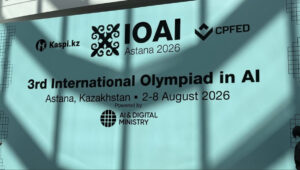
Ukraine’s national team is participating for the first time in the International Olympiad in Artificial Intelligence (IOAI), whose third final is being held in Astana from August 2 to 8, 2026. More than 500 school students from 108 countries have arrived for the competition.
Ukraine did not participate in the first two IOAI competitions, held in 2024 in Burgas, Bulgaria, and in 2025 in Beijing.
The Ukrainian team includes four participants from Kyiv and Irpin. One of the finalists represents the A+ Architectural and Engineering Collegium.
More than 2,200 school students from across Ukraine took part in the selection process for the national team. The program included testing basic digital skills and media literacy, assessing knowledge of artificial intelligence, machine learning and data processing, a technical English-language examination and a practical round.
After the main stages, the 50 best participants underwent three weeks of training with artificial intelligence instructors. The final composition of the national team was determined based on the results of the training, tests, practical assignments and interviews.
The official national coordinator of the IOAI in Ukraine is the A+ educational holding company, which received accreditation from the international olympiad in November 2025. Oleksandr Shapovalov is the project’s national coordinator, Oleksandra Hryshko is the international coordinator, Vitalii Sandul is the academic director, and Vasyl Orishchuk is the head of the scientific committee.
Developer KAN Development became the general partner of the Ukrainian national team, while the ITVDN educational IT platform became the olympiad’s partner in Ukraine.
The olympiad includes individual and team competitions. Participants work on practical tasks involving artificial intelligence and machine learning, analyze data, create models and evaluate their quality. Each country may send up to two teams, each consisting of no more than four school students and a team leader.
The first team round took place on August 3 following the official opening ceremony. The final stage of the team competition and the awards ceremony will take place on August 7.
During the individual rounds, participants work for six hours. Based on the results of the first stage of the team competition, the organizers select the ten best national teams, which earn the right to continue competing in the final.
A total of 103 countries and territories and more than 120 teams initially registered to participate in IOAI 2026. Following the opening, the organizers reported delegations from 108 countries and territories. The difference is related to the final composition of the participants who arrived in Astana.
The International Olympiad in Artificial Intelligence was established in 2024. The first tournament in Bulgaria brought together 41 teams from 32 countries, while the second in China attracted about 300 school students from more than 50 countries. The fourth IOAI is scheduled to take place in Singapore in 2027.
Ukraine’s debut at the IOAI comes amid the development of a national system of artificial intelligence competitions. The Ukrainian selection process was open to school and college students between the ages of 14 and 20, and participation in all its stages was free of charge.
AI olympiad competitions differ from traditional computer science contests. Writing a program is not enough: participants must prepare and analyze data, select a machine-learning method, train a model, verify its accuracy and justify the result obtained.
Participation in the IOAI enables Ukraine to compare the level of preparation of its school students with teams from leading technological countries and begin developing its own system for training young artificial intelligence specialists.
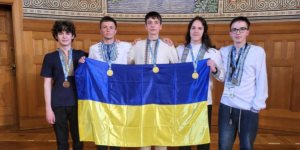
Ukrainian high school students won five medals at the European Physics Olympiad (EuPhO 2026), which took place June 12–16 in Gothenburg, Sweden.
According to the official results of the Olympiad, the Ukrainian team won three gold, one silver, and one bronze medal.
The gold medals were won by Sviatoslav Lavreniuk, Nazarii Vrashchuk, and Mykyta Voznyi. Lavreniuk scored 36.90 points and took second place in the overall individual standings of the Olympiad. Vraschuk, with a score of 30.10 points, took tenth place, while Voznyi, with 29.60 points, took eleventh.
Oleg Kurnitsky received a silver medal, scoring 17.20 points and placing 50th. Mykhailo Rubtsov won a bronze medal with a score of 12.50 points and a 101st-place finish in the overall standings.
The overall winner of EuPhO 2026 was Bryant Yu of the United States, who scored 38.60 points. Third place in the overall standings went to Haoyi Li of China with a score of 34.60 points.
A total of 199 students from 41 countries participated in the competition. At the conclusion of the Olympiad, 23 gold, 37 silver, and 51 bronze medals were awarded, along with 34 honorable mentions.
The official team rankings were not published in the final results of EuPhO 2026. However, China led all countries in the number of gold medals, with its representatives winning five gold medals.
The European Physics Olympiad is held for high school students. Each country may send a team of up to five participants. In 2026, the Olympiad took place in Gothenburg with the participation of Chalmers University of Technology and the University of Gothenburg.
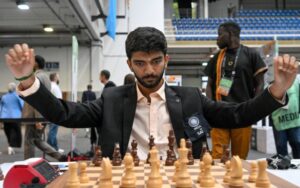
India won the Open and Women’s Olympiads in Budapest, while for the first time in history no European team reached the podium in either event
India’s domination of the 188-team Budapest Olympiad was complete. Their winning Open score of 21/22 was a record, they finished four points clear of the chasing pack, while their four individual golds included a 3000+ rating performance by Gukesh Dommaraju, 18, who challenges for the world crown in November.
It was a seminal moment in chess history, comparable to the 1945 USA v USSR radio match when the Americans, quadruple Olympiad gold winners in the 1930s, were crushed 15.5-4.5 to launch 45 years of Soviet supremacy, interrupted only by Bobby Fischer.
India’s superiority was reminiscent of the legendary USSR teams of the 1950s and 1960s, which were packed with world champions and challengers and rarely lost a game, let alone a match. In Gukesh and Arjun Erigaisi, 21, India have what could prove to be the Mikhail Botvinnik and Vasily Smyslov or Anatoly Karpov and Garry Kasparov of the 2020s and 2030s.
For the first time in any Olympiad, no European team reached the podium in either the Open or the Women’s event, although fifth to 23rd places in the Open were all taken by European squads.
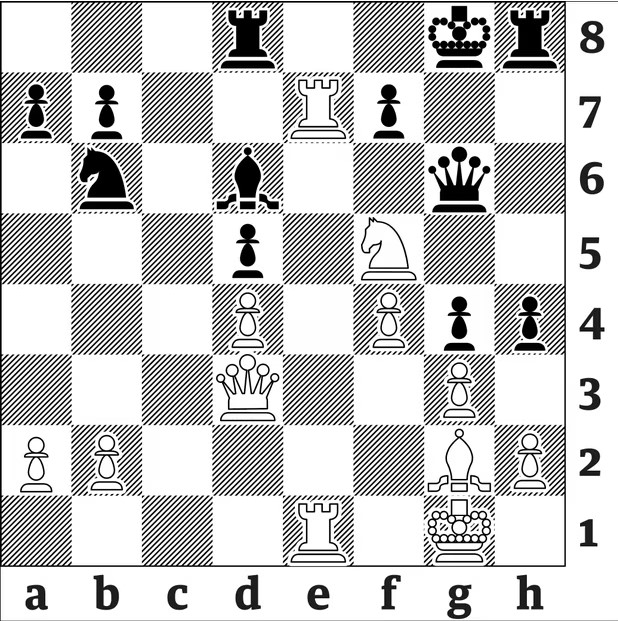
Yagiz Erdogmus v Nikita Meshkovs, Turkey v Latvia, Budapest Olympiad 2024. White to move and win.
Gukesh and Erigaisi, who won the boards one and three golds, scored at a pace that even Magnus Carlsen was unable to match. The Norwegian’s ambition of eliminating one of the few gaps in his career record remains unfulfilled, as he had to settle for top board bronze.
Gukesh is now up to No 5 in the world rankings, while Erigaisi has jumped to No 3. Both are poised to pass the 2800 rating landmark as soon as this weekend, when they are scheduled to play for Düsseldorf in the opening two rounds of the German Bundesliga. Games are due to start at 1pm BST on Saturday and 10am on Sunday.
On Wednesday, India’s prime minister, Narendra Modi, received the two Indian teams at his residence to congratulate them on their achievement, while Gukesh’s win against China’s Wei Yi has been awarded the Olympiad Best Game prize.
If Gukesh fails to reach 2800 this weekend, he will surely do so during his $2.6m world championship match against China’s Ding Liren, which opens in Singapore on 25 November. Ding will start the 14-game series winless in classical chess since 27 January, when he defeated Max Warmerdam in round 12 of Wijk aan Zee. The latest odds are Gukesh 2/5, Ding 9/5, and the contrast is obvious and acute with 2018, when Ding won Olympiad team and individual gold for China.
If Gukesh and Erigaisi can continue their rating advance deep into the 2800s, then Carlsen’s current No 1 mark of 2830 could become a realistic target in a year or two, despite rating deflation.
Vishy Anand, world champion from 2007 to 2013, was the inspiration for India’s success. Anand mentored several of the players, and was on hand to witness the decisive moments. The result was redemption for the 2022 Olympiad at Chennai, when on home ground India faltered in the final rounds and were passed by Uzbekistan. This time Uzbekistan settled for bronze behind India and the United States, still an excellent result for its young team and its world No 6, Nodirbek Abdusattorov.
For the US, who lost to the winners and also had a costly defeat against Ukraine, the lingering unanswered question is whether they could have won gold if Hikaru Nakamura had chosen to compete in Budapest instead of streaming his commentaries. Nakamura identified Wesley So as a weak link, but the former Filipino, after a shaky start, scored the win against China which ensured silver medals for the US.
Final leading Olympiad scores were India 21/22 match points, United States 17, Uzbekistan 17. China, Serbia and Armenia also totalled 17 points, but had worse tiebreaks.
England, seeded eighth, ended up 20th on 15/22. The eight-time British champion Michael Adams, now aged 51, was the highest scorer with an unbeaten 6/9, while the former Russian Nikita Vitiugov on top board was restricted to a 50% score in which his two wins were scored against weaker opposition in the first and last rounds.
England’s team is ageing, and although the youngest ever English grandmaster, Shreyas Royal, 15, can expect a callup for the next Olympiad at Tashkent 2026, that will only solve the problem on one board. There are many other promising English juniors, but none of them appear to have the potential to become 2500s in the next two years. A special incentive may be needed, similar to Jim Slater’s 1973 offer of substantial rewards for new British grandmasters.
India won the Women’s Olympiad with 18/22. Kazakhstan, also with 18 but an inferior tiebreak, took silver and the United States won bronze on 17. Carissa Yip, 21, and Alice Lee, 14, both won board medals for the US, and that could well be a benefit of the Cairns Chess Queens award of $100,000 each for the first five US female players who becomes a grandmaster at Open level in the next five years. Irina Krush, the longtime US No 1, has already received it.
Jovanka Houska was England’s best scorer on 8/10, while Lan Yao and Harriet Hunt also bettered 64%. The bottom boards underperformed, and there was a tendency for defeats to come in pairs, but further experienced players and rising talents will be available in 2026 to confirm the ongoing improvement in English women’s chess.
The chess elite will come to London next month when the franchise-based six-team Tech Mahindra Global League is played at Friends House, Euston, from 3-12 October. World champions Carlsen and Anand, the world No 2, Nakamura, and the double world title challenger Ian Nepomniachtchi will all lead teams. The Olympiad hero, Erigaisi, is also competing.
The time limit is rapid chess, 20 minutes per player per game, with the added bonus for spectators that there is no per-move increment, implying some exciting time scrambles. Daily and season tickets are available from the Chess and Bridge shop in Baker Street, or online.
3939: 1 R7e6! so that if fxe6 2 Ne7+ and 3 Qxg6+ wins. The game ended 1…Qxe6 2 Rxe6 fxe6 3 Nxd6 Rxd6 4 Qg6+ Kf8 5 Qf6+ Kg8 6 f5 hxg3 7 Qg6+ Kf8 8 fxe6 1-0. At Budapest, Erdogmus became the first player ever to reach a 2600 rating at age 13.

The International Programming Olympiad “BalaTech” for schoolchildren will be held on February 19, 2022 in an online format. Estimated 50,000 schoolchildren from the CIS countries will take part in the event and compete for a prize fund of $10,000 USD in the form of:
REGISTER now on BalaTech (www.balatech.org), and/or share this wonderful opportunity with your network. More activities can be followed on Instagram by hashtags: #Balatech #UNDP #AcceleratorLab
United Nations Development Program is the official general partner, who is committed to providing accessible and inclusive digital education for the next generation to be ready for the future works! And “BalaTech” is recognized by the UNDP “Digital x Scale Accelerator” as one of the ten most impactful digital solutions in 2021, with the generous support from the Government of Japan. Thanks to UNDP, BalaTech provides all learning contents and participation at the Olympiad 2022 for FREE for all children and youth.
“BalaTech” ( www.balatech.org ) is a multilingual educational platform for children and youngsters to learn programming in an interactive way among peers. BalaTech makes learning experience fun and engaging through gamification. There are 10 learning modules with 175 challenge-based tasks that users can learn and play for FREE. For completed tasks, users receive their points to unlock the next level game with diverse virtual settings where they continue their learning adventure. With the help of UNDP “Digital X”, BalaTech has enhanced the user’s experience with a better UX design and learning algorithms. Moreover, the platform is designed to be gender sensitive to encourage more girls in learning programming. Anyone with a smartphone (not necessarily laptops) equipped with low-gadget basic internet can access the platform to learn and play from the beginning level. No prerequisite programming knowledge is required. Annually, BalaTech organizes the Olympiad to popularize programming learning among school students. The following entails the criteria and key messages of “BalaTech Olympiad” in 2022:
* For any inquiries on partnership opportunities on BalaTech, please contact: +996 550984747, tech.balatech@gmail.com. For UNDP partnership on digital innovation, please contact the Head of Experimentation at Accelerator Lab UNDP Kyrgyzstan, Jenny Jenish kyzy (Ensi Tszie) at ensi.tszie@undp.org
References:
Meet Digital X’s 10 ambitious new teams | Digital UNDP
Open4business – information partner



