

The “Autostrada” Group of Companies has begun the reconstruction of a 1.2-meter-diameter sewer collector in the metro construction zone in Vinogradar; to carry out this work, a remotely controlled shield system from Herrenknecht AG was purchased, with an estimated cost of EUR 1 million.
According to the Autostrada press service, the project will involve laying a new storm sewer system with a total length of 400 m using over 200 pipes. The work is being carried out using the microtunneling method (a high-precision trenchless technology for laying underground utilities without breaking ground), which allows work to proceed in densely built-up urban areas without impacting traffic or the surrounding infrastructure.
The preparatory phase is currently underway—two shaft shafts (launch and reception chambers) are being constructed, from which tunneling will begin in just a few months.
To carry out the work, Autostrada has purchased a remote-controlled shield system from the German manufacturer Herrenknecht AG. The cost of the equipment is approximately 1 million euros. The maximum length of a single tunneling run can reach up to 150 m, ensuring efficiency and continuity of work.
On the section between the “Mostytska” and “Varshavska” stations, over 1,000 m of double-deck monolithic tunnels have already been constructed (500 m per deck). Work on their finishing is being carried out simultaneously on two sections, which significantly accelerates the pace of construction. The construction of monolithic structures on the fork branch section toward the future “Vinogradar” station has also been completed.
At the “Mostytska” station, construction of prefabricated full-section tunnel linings, each approximately 200 m long, has been completed. The next stage is the installation of cable structures in the completed tunnels, which serves as a preparatory step for the subsequent installation of utility networks and the station’s power supply systems.
In the shaft above the deep-level tunnel between the “Syrets” and “Mostytska” stations, installation of the ring-laying machine has been completed; this machine will replace the rings of the left-hand tunnel lining with larger-diameter rings. The right-hand tunnel in this section has already been built.
Construction of the turnaround sidings at the “Varshavska” station is in its final stage. Currently, a shield-type airtight seal—a massive steel structure designed to isolate tunnels and stations—is being installed here. It protects the metro from potential emergencies, including shock waves, flooding, and hazardous substances, and serves as a critical component of the civil defense system, enabling the division of underground structures into sealed compartments.
At all metro construction sites in Vinogradar, work is underway to relocate utility lines outside the construction zone. The relocation of water supply and drainage systems, as well as power lines, is being carried out in stages. Such work ensures the uninterrupted operation of the city’s infrastructure and creates the necessary conditions for the continued execution of construction and installation processes without restrictions.
As previously reported, in August 2024, the municipal enterprise “Kyiv Metro” signed a contract to continue construction of the Syretsko-Pecherska Line toward the Vinogradar residential area. The winner of the tender was Avtostrada Group of Companies LLC. The project duration is set at 30 months, with a total cost of 13.785 billion UAH. The procurement was conducted on the Prozorro public procurement platform. “Avtostrada” resumed metro construction in November 2024.
In December 2023, the Kyiv Metro municipal enterprise terminated its contract with Kyivmetrobud JSC through the courts due to failure to meet construction deadlines. The issue of recovering a portion of the advance payment—the use of which is not confirmed by the relevant certificates of work performed—as well as penalties, is being resolved in court.

Freight traffic has been suspended on the M-15 Odessa-Reni highway, Oleg Kipper, head of the Odessa Military Administration, said on Friday.
“Given the current situation in the region and in order to eliminate the consequences of enemy shelling in the Odessa region, the Odessa Regional Defense Council decided on December 19, 2025, to suspend freight traffic on the M-15 Odessa-Reni highway. We ask transport company owners and drivers to take the above information into account when planning freight transport routes,” the Telegram message said.
Earlier it was reported that on Thursday, traffic on the M-15 Odessa-Reni highway (to Bucharest) was temporarily blocked in the Odessa region, in the territory of the village of Mayaki. According to the local publication Dumskaya, the highway was blocked due to strikes by Russian drones. It was also reported that near the bridge near the village of Mayaki, a UAV hit a car, killing a woman and injuring three children.
The State Border Service reported restrictions on traffic to certain checkpoints across the state border with Moldova due to enemy air attacks. The Moldovan side reported the temporary closure of the Mayaki-Udobnoe-Palanka and Starokazachye-Tudora checkpoints.

Automagistral Pivden SRL (Ukraine) – Precon Transilvania SRL (Romania) has been recognized as the winner of one of three lots for the construction of the Arad-Oradea section of the highway with a project budget of EUR 600 million, the press service of Avtomagistral-Pivden reports.
The Ukrainian Embassy in Romania noted that the victory of the Ukrainian company in one of the largest infrastructure construction tenders is a significant event in terms of strengthening bilateral economic relations between Ukraine and Romania.
“The presence of the largest Ukrainian construction company in Romania will help strengthen the position of Ukrainian business in the EU market, develop joint projects and partnerships between Ukrainian and European companies, and exchange of experience. The EU market is traditionally represented by the world’s leading companies. The victory in the competition with the strongest rivals is evidence of the Romanian customer’s trust in the Ukrainian contractor,” the embassy said in a Facebook post.
In total, the four-lane Arad-Oradea highway will have a total length of 120.47 km and will provide a connection to the Romanian-Hungarian border. The lot won by an association of Ukrainian and Romanian companies includes a 47.07 km section, to which a connecting road to the Arad West industrial zone (2.9 km) is added. The project provides for 29 bridges with a total length of 2.5 km, six traffic interchanges, four sites for large vehicles, and two road repair stations (for highway maintenance).
“The victory of Avtomagistral-Pivden is evidence that our country is able to successfully enter the European market with high-tech services. Our company’s participation in one of the largest infrastructure projects in the EU will be important for dozens of other Ukrainian companies that supply materials and services,” the release says.
Avtomagistral-Pivden LLC has been on the market since 2004. It designs and builds highways, bridges, interchanges, airfield complexes, and hydraulic structures. The company’s owner is listed in Opendatabot as Oleksandr Boyko. According to the financial results for 2023, the company’s net profit amounted to UAH 624.9 million, and revenue was UAH 8.215 billion.
CONSTRUCTION, HIGHWAY, ROMANIA, TENDER, Автомагістраль-Південь
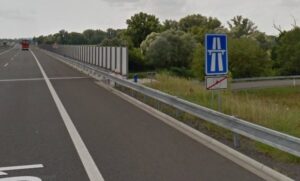
Slovakia may begin construction of a highway leading from Kosice to the Uzhhorod-Vysne Nemecke checkpoint on the border with Ukraine, the press service of the Ukrainian Ministry of Finance reported on Friday.
The project of building a new highway was discussed at bilateral talks on improving cross-border communication in Slovakia with the participation of Deputy Finance Minister of Ukraine Oleksandr Kava as part of a government delegation headed by Prime Minister Denys Shmyhal.
“The meeting also discussed the project of building a highway from the Uzhhorod-Vysne Nemecke checkpoint to the suburbs of Kosice. This is part of Slovakia’s main highway, the D1, which connects the country’s two largest cities, Bratislava and Kosice, and is also part of the pan-European network of expressways,” the statement said.
The parties also discussed the issue of opening the Uzhhorod-Vysne Nemecke checkpoint not only for cars, but also for pedestrians and cyclists. The checkpoint will be accessible by public transport from both sides of the border without the need to use a car.
“This is especially important for residents and guests of the regional center of Zakarpattia Oblast, as it will provide them with more opportunities for movement,” the press service adds.
In addition, it is planned to expand the automobile part of the checkpoint from four to five lanes, which will increase its capacity.
Kava, quoted in the report, noted that the agreements reached are a step towards creating a smooth and dynamic cross-border connection.
“They will not only improve the daily lives of our citizens, but will also contribute to overall economic growth together with partner countries,” the deputy minister said.
Earlier, Deputy Minister of Communities, Territories and Infrastructure Development Serhiy Derkach said that a passenger terminal with several lines of traffic for passenger buses would be built at the Uzhhorod-Vysne Nemecke checkpoint on the border with Slovakia by the end of 2024.

The Ministry of Communities, Territories and Infrastructure Development is designing a new road parallel to the existing Odesa-Reni highway, part of which runs through the territory of the Republic of Moldova (Palanca village), Deputy Minister of Communities, Territories and Infrastructure Development Yuriy Vaskov said.
“We are designing a road in parallel with the existing Odesa-Reni highway to organize a connection on Ukrainian territory,” Vaskov said at Infrastructure Day 2023, organized by the European Business Association in Kyiv on Friday.
According to him, the construction of a facility is planned directly on the Odesa-Reni highway.
“In order to solve the problem point by point, we, as the Ministry of Reconstruction, have found funding and want to build a structure to avoid stopping vehicles,” Vaskov said, adding that the issue is being coordinated with the Moldovan side, in particular, with territorial communities in Moldova.
The Deputy Minister noted that there are attempts to illegally cross the border, both successful and unsuccessful.
As you know, a part of the Odesa-Reni highway on the section from Mayaky village to Udobne village (from 51 to 50 km) runs through Moldovan territory.
On June 30, 2011, an act was signed in Chisinau (Moldova) to define and fix the boundaries of the Odesa-Reni highway section near Palanca village and the land plot. Palanca village, as well as the land plot on which it runs. The road section was de jure transferred to the ownership of Ukraine on November 18, 2001, but the act of determining the boundaries on the ground was never determined.
According to the 1999 border agreement, Moldova transferred a 7.7 km section of the Odesa-Reni highway to Ukraine for use, but the territory adjacent to the road near Palanca remained in Moldovan ownership. After the change of power in Moldova in 2009, Ukraine demanded that the territory of almost 1,000 hectares be transferred to its ownership, arguing that Moldova had transferred 450 meters of the Danube coastline to Ukraine in 2002, which enabled it to build the Giurgiulesti seaport.

On the Zhytomyr highway on the M-06 Kyiv-Chop highway, traffic was partially opened for trucks on Saturday, the right passage of the destroyed bridge will be restored at the next stage, Minister of Infrastructure Oleksandr Kubrakov said.
“The movement of trucks on the Zhytomyr highway is open. Today we opened the left lane on the international road M-06 Kyiv – Chop near Parking and resumed traffic on the highway for trucks,” Kubrakov wrote on Facebook.
He noted that with the opening of the bridge on the M-06 highway, traffic will be resumed in almost all the main strategic directions of Ukraine and promised that the next step would be the restoration of the right passage of the destroyed bridge.
“We plan to complete the work in the fall,” the minister stressed.
According to him, it took less than two months to build a temporary passage for transport on the site of those destroyed as a result of hostilities.
“It took less than two months to build a temporary span structure on the remains of old structures, arrange a monolithic slab of the span structure and lay a layer of asphalt concrete. The road markings have been updated and appropriate road signs have been installed,” he said.
He stressed that thanks to the blown up bridge on the road to Irpin in the first days of the Russian invasion, the occupiers could not move further and surround the capital.
Kubrakov also reports that immediately after the liberation of the capital region, the construction of temporary crossings and detours began.
“A temporary bridge near Stoyanka was erected in mid-April, but only light vehicles could move through it – trucks were forced to take a detour, wasting extra time and fuel,” he added.



