
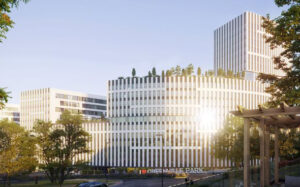
The Greenville group of companies commissioned 15,400 square meters of housing in Lviv in 2025 and continues to implement two projects in the capital, its press service told the Interfax-Ukraine news agency.
“In 2025, we have virtually completed the Greenville Park Lviv residential complex in Lviv. A total of 15,435.6 square meters (276 apartments) were built during the year. In November 2025, the final building of the complex was commissioned, so now all residential buildings of Greenville Park Lviv have been fully completed. Final work is currently underway on the construction of a parking lot, which is the final stage of the project,” said Yulia Bilen, head of the Greenville sales department in Lviv.
According to her, the aspect of inclusiveness was incorporated into the Greenville Park Lviv project even before the full-scale war, in particular, barrier-free entrances, convenient layouts, and accessible common areas were provided for. However, important changes were made during construction.
“Yes, with the first blackouts, we quickly adjusted the technical solutions. In particular, we provided a backup power supply in the tallest 20-story building. The building was equipped with a generator that guarantees the operation of elevators and common areas during power outages,” Bilen explains.
As for the company’s projects in the capital, multi-level underground parking lots are being built in the stylobate part of the Greenville Park and Greenville business-class residential complexes in Pechersk, as well as shelters and generators. Measures for inclusivity are provided for in the DBN “Inclusivity of Buildings and Structures”: ramps, signs with Braille inscriptions, voice guidance in elevators, etc. There is also a system that brings the elevator car to the nearest floor, which prevents it from getting stuck during emergency power outages.
“We try to adhere to the ‘8/80’ principle: when the territory of a residential complex is equally comfortable for an 8-year-old child and an 80-year-old pensioner. Such an environment includes wide pedestrian areas, ramps, elevators with wide entrances, navigation, voice guidance, lighting, etc.,” explained Natalia Dubik, head of Greenville’s Kyiv projects.
Greenville is a vertically integrated group of companies that has been operating in the field of renewable energy and residential and commercial real estate for over 20 years. According to the LUN new construction portal, the company is engaged in development activities in Kyiv and Lviv. Since 2010, 45 buildings have been commissioned, and 6 buildings are under construction.

Citizens of Ukraine at the end of the third quarter of 2025 entered the top ten largest foreign buyers of real estate in Spain – they accounted for 758 sales transactions, according to the data of the Spanish Registration Service (Registrars) for Q3.
Leaders among foreign buyers were citizens of the UK (1 871 transactions), Germany (1 539) and the Netherlands (1 416). Romania (1,321) and Morocco (1,317) followed, as well as France (1,241) and Italy (1,177).
Poland (1,096) and Belgium (1,021) are also in the top 10. Ukraine ranked 10th (758), ahead of China (687) and Sweden (578).
Other countries represented in the statistics include Ireland (424 transactions), the US (405), Russia (403) and Bulgaria (251).

In Spain, foreign property buyers have slowed down a bit, but they’re still the main drivers of the market – especially folks from the UK, Germany, and the Netherlands.
According to the Spanish property registry, foreigners purchased nearly 23,700 residential properties in the third quarter of 2025, which is 4% less than in the same period in 2024. The share of transactions involving non-residents fell to 13.6% from 14.9% a year earlier, but is still about 36% higher than the average for the last ten years.
Who is buying: top nations in the Spanish housing market
In the third quarter of 2025, the largest groups of foreign buyers were:
Among other important buyers in the third quarter, moderate growth was recorded from Romania and Morocco, while demand from France, Italy, Belgium, and Poland declined slightly. Interest from buyers in the US and Morocco remained close to last year’s level. Demand from the Russian Federation and China fell significantly, by approximately 34% and 23%, respectively.
The full picture for 2024
According to the summary data for 2024, foreigners bought about 93,000 residential properties in Spain, accounting for about 14.6% of all transactions on the market. This is one of the highest figures in the history of observations.
According to the results for 2024, the main national groups are as follows:
Thus, the top ten in terms of purchase volume is primarily made up of Europeans – British, Germans, Moroccans, Dutch, Romanians, Italians, French, and Poles, supplemented by buyers from China and Ukraine.
Regions that attract foreigners
The most popular regions among foreign buyers remain the Mediterranean coast and islands: the Valencian Community, Andalusia, Catalonia, the Balearic Islands, and the Canary Islands. They account for the vast majority of foreign purchases, and in some provinces, such as Alicante and Malaga, the share of foreigners in the total volume of transactions reaches 30-40%.
What does the correction in demand mean?
Experts view the slight decline in the number of transactions in the third quarter of 2025 as a technical correction after a record-breaking 2024 rather than a reversal of the trend.
The share of foreigners remains significantly higher than the pre-crisis average, and Spain continues to attract buyers with its combination of climate, relatively affordable prices, and developed infrastructure.
At the same time, the structure of demand is gradually changing: the positions of the British and Germans remain strong, but buyers from the Netherlands, Central and Eastern Europe, and North Africa are playing an increasingly prominent role. For the local market, this means that the high proportion of foreign buyers will remain, but with greater diversity in terms of nationalities and sources of capital.
Source: https://open4business.com.ua/hto-z-inozemcziv-lidyruye-z-pokupky-zhytla-v-ispaniyi-analiz/

The growth rate of housing construction costs in Ukraine in 2026 will slow down slightly compared to previous periods, with an average increase of 10–15% over the year, according to Ukrainian developers.
“In 2026, we expect further growth in construction costs, but the pace of this growth is likely to be more moderate than in previous periods. The main factors remain the cost of construction materials, energy, logistics, and labor, as well as currency fluctuations,” the press service of the DIM group of companies told Interfax-Ukraine.
Containing the growth of construction costs is possible thanks to the adaptation of the construction market to new conditions: optimization of design solutions, construction processes, and supply chains. At the same time, maintaining a balance between the economic efficiency of projects and the preservation of housing standards remains an important condition, the company noted.
At the same time, pressure on costs next year will come from the cost of energy, logistics, import-dependent building materials, as well as stricter requirements for engineering systems and safety, said Perfect Group project manager Oleksiy Koval. According to him, the company expects costs to grow by 15-20% in 2026.
“Our baseline scenario is a 15-20% year-on-year increase in production costs, but the range will depend on the exchange rate, material prices, and the situation on the labor market. We are building in a safety margin through longer contracts with contractors, optimising project solutions without compromising quality, and planning purchases of critical materials in advance,” he said.
Wages in the industry remain an important factor in the growth of construction costs, Koval added. To combat the labor shortage, Perfect Group is working on employment contracts with foreigners, particularly from India, to attract them to contract work.
In turn, Dan Saltsov, commercial director of Greenville’s Kyiv projects, predicts a moderate increase in the cost of housing construction within the range of 6-12% per year.
“It is likely that the cost will continue to grow by 6-12% per year. Trends in recent years confirm an annual increase. The main factors influencing this are inflation, rising prices for construction materials, higher wages, labor shortages, and currency fluctuations. The market is undergoing structural changes,” said the expert, adding that a decline in housing prices is not to be expected.
This is also confirmed by experts from the developer RIEL. As the company told Interfax-Ukraine, in addition to rising costs, the price per square meter will also be affected by the rising cost of loans in the construction sector.
“We predict further price increases due to rising costs, growth in investments that developers make at the start of a project, and the rising cost of loans in the construction sector. However, in our opinion, demand will remain stable, although a significant increase in new construction should not be expected,” the developer said.
According to the forecast of the construction company Intergal-Bud, the cost of housing will continue to grow within the range of 10-15% compared to 2025.
“The cost per square meter is likely to continue to grow, but without sharp jumps, within the range of 10-15%, and will have objective reasons related to the rise in the cost of construction materials, engineering solutions, labor shortages, as well as security, military, and political factors,” said Olena Ryzhova, commercial director of Intergal-Bud.
According to her, the primary residential real estate market will maintain cautious positive dynamics in 2026. Thus, demand for housing in the “comfort” and “business” segments will remain stable, as will the purchase of apartments in the early stages of construction, traditionally one of the most reliable assets for preserving funds.
However, the residential construction market has not yet recovered to its pre-war levels, the Kovalskaya Group emphasizes. According to the developer, construction costs will continue to rise in response to the rising cost of building materials and energy, as well as due to a reduction in new projects.
“Given the realities we are seeing, the construction market has not yet recovered to pre-war levels. Developers are mainly completing previously started projects, with only one new project for every five completed. The rise in the cost of construction materials and electricity, as well as the reduction in supply, will lead to an increase in the cost of construction. The sale price of apartments is expected to grow by 10-15% per year in currency terms,” the company notes.
As reported with reference to data from Ukrainian developers, the cost of housing construction in Ukraine in the first nine months of 2025 grew by an average of 10-25%, depending on the class of housing. According to the State Statistics Service, prices for construction and installation works in the third quarter of 2025 increased by 5.3% compared to the same period last year, while prices in the primary housing market increased by 12.8% during the same period.

The average price on the primary market at the end of 2025 was $2,011 per square meter, or 84,600 UAH per square meter, an increase of 3.3% in dollar terms over the year, according to a press release from City One Development to Interfax-Ukraine.
According to the company’s analytical report, 2025 was a year of quiet recovery without any sharp movements for the primary residential real estate market in Kyiv.
“In fact, the market went through two different phases. At the beginning of the year, demand remained subdued: buyers took a wait-and-see position, which led to a slight (-1.2%) price adjustment. However, the second half of the year showed a change in sentiment – the number of transactions increased, and prices returned to a smooth increase (on average, they rose by 4.5%). As a result, 2025 ended with a moderate (+3.3%) increase,” said City One Development analyst Olena Shirina.
She emphasized that a distinctive feature of 2025 is the significant difference between formal statistics and the real state of the market, since average price indicators remain “burdened” by projects that have been on sale for years but are not actually being built or are in a frozen state. If such objects are excluded from the calculations, the real average price of active new buildings in Kyiv is about $2,140/sq. m, which is approximately 6-7% higher than the official statistics.
As for the structure of supply, only 3% of the supply is economy class. The dominant segment is now comfort, accounting for about 50% of the supply, business class accounts for about 35%, and premium holds a share of 8-10% despite the reduction in the number of projects.
The most significant price dynamics in 2025 were demonstrated by affordable formats, which is logical in conditions of limited effective demand. Economy class rose by 5% to $1,103/sq. m., comfort class by 4% to $1,365/sq. m., business class by 2% to $2,450/sq. m., and premium class by 4% to $4,596/sq. m.
The new supply for 2025 was a record for the capital, given the military conditions. According to City One Development’s monitoring, 10 new residential complexes have entered the Kyiv market since the beginning of the year.
The first half of the year was dominated by large comfort complexes aimed at the mass buyer. The average starting price was $1,428/sq. m.
The second half of the year brought business and premium class projects to the market with higher starting prices and more complex concepts. The average starting price was $2,727/sq. m.
This indicates a gradual return of developers to more complex formats and a resumption of investment interest in the market.
“The total number of residential complexes on the market has decreased by approximately 25% over the four years of the war, creating a shortage of quality supply. Developers are launching new projects cautiously, focusing on solvent demand and investors, with new projects being more expensive than the market average. The number of new residential complexes is significant for the fourth year of the war, but insufficient for a city with a population of over a million — supply will remain limited, and there will be less affordable housing, with competition between developers increasingly based on product rather than price,” says Shyryna.
According to her, if current macroeconomic and security factors remain unchanged, 2026 has all the prerequisites to start with moderate price increases and a subsequent shortage of quality supply. “The market has already passed its lowest point and is gradually entering a growth phase, where the reliability of the developer, a well-thought-out concept, and the long-term value of the project will play a key role,” says Shyrina.
City One Development is an investment and development company with more than 15 years of experience. It specializes in the creation, implementation, and management of large-scale infrastructure residential complexes, as well as actively investing in the development of Ukrainian industry.
City One Development’s portfolio includes more than 1.24 million square meters of completed projects and 500,000 square meters under construction.
The company’s residential projects in the capital include Novopecherski Lypky, Boulevard of Fountains, Svyatobor Park Resort, and The Light. Its industrial projects include two float glass production plants as part of the City of Glass and Galicia industrial parks.

Portugal officially collects and publishes statistics on real estate transactions involving foreign buyers, but the publicly available data is usually aggregated by group (Portuguese buyers, EU residents, non-residents/non-EU), without a detailed breakdown by nationality. Detailed rankings of buyer countries are usually provided by specialized analytical companies and media based on real estate network databases.
According to data from the Portuguese National Statistics Institute (INE), in 2023, foreigners accounted for about 7.6% of all home purchases in the country, but provided approximately 13% of the total value of transactions. At the same time, buyers from non-EU countries pay an average of around €405,000 per property, while foreigners from the EU pay around €277,000, and the average market price is around €200,000.
In some regions, the proportion of foreigners is much higher. In the Algarve, they account for about 27% of all transactions and up to 38% of the total sales value, with 4 out of 5 properties there being purchased by non-residents. In cities, primarily Lisbon and Porto, the share of foreign transactions is smaller, at around 4-6%, but it is in the capital that the most expensive purchases are concentrated.
Private analysts provide a detailed picture by nationality. In Lisbon, according to Confidencial Imobiliário, 4,750 apartments and houses worth €2.22 billion were sold in the Urban Rehabilitation Area in 2023, of which 1,580 properties (about a third) were bought by foreigners. Buyers from North America led the way (approximately 16% of all “foreign” transactions), followed by the French (13%) and the British (9%). Chinese, Brazilian, and German investors also had a significant presence.
In the Algarve, according to estimates by Engel & Völkers, British buyers predominate, but there is also an active presence of citizens from Germany, France, Sweden, Switzerland, and the Netherlands; interest from Americans is growing noticeably.
Based on this data and market reviews, we can identify a conditional “top 10” of the most active foreign buyers of Portuguese real estate (by number of transactions and total investment volume):
Investors under the previous “golden visa” scheme (primarily from China, Brazil, Turkey, the US, and South Africa) are listed separately, but following the reform of the program, their share is gradually being redistributed in favor of “regular” transactions.
Thus, Portugal publishes official data on the share and prices of transactions with foreigners, but a detailed map by nationality is based mainly on research by specialized agencies and market analysts. Taken together, they show that demand is primarily driven by investors from Western Europe, North America, and Brazil, while the role of buyers from Eastern Europe and the CIS remains niche.



