

In April 2026, foreign buyers accounted for 649 real estate transactions in Cyprus, or 40.3% of the total number of registered sales, according to the Cyprus Mail, citing data from the Cyprus Department of Lands and Surveys. A year earlier, foreigners accounted for 552 transactions, or 39.3% of the market.
A total of 1,611 real estate sales were registered in Cyprus in April, which is 15% more than in April 2025. From January to April 2026, total sales rose by 14% to 6,320 transactions, compared to 5,541 during the same period last year. Sales to foreigners over the four-month period increased to 2,693 transactions from 2,223 a year earlier.
According to data from the Cyprus Department of Lands and Surveys, among the registered sales contracts involving foreigners in April, 197 properties were purchased by buyers from EU countries and 452 by buyers from non-EU countries. For January–April, the figure stood at 872 properties for EU citizens and 1,821 properties for buyers from third countries.
Paphos remains the most active region in terms of foreign demand. In April, 84 properties were registered there with contracts from EU buyers and 141 properties from non-EU buyers. In Limassol, the figures were 33 and 151 properties, respectively; in Larnaca, 37 and 98; in Nicosia, 29 and 40; and in Famagusta, 14 and 22.
In long-term statistics, the British, Russians, Greeks, and Israelis lead among the largest foreign buyers of real estate in Cyprus. According to data submitted by the Cypriot Ministry of Interior to parliament and published by Open4Business, foreign buyers purchased more than 37,000 properties between 2021 and 2024. The United Kingdom ranked first with approximately 11,800 properties, Russia second with about 4,900, Greece third with about 4,700, Israel fourth with 3,900, and Lebanon fifth with 2,100 properties.
Ukrainians are also among the notable buyers of Cypriot real estate. In the 2021–2024 ranking, Ukraine is listed in 9th place among buyer countries, with Ukrainian buyers being particularly prominent in Limassol and Paphos. Exact quantitative data on Ukrainians is not disclosed in the published summary.
Recent data by nationality for the period from September 2024 to September 2025 confirms the dominance of British, Russian, Israeli, and Greek buyers. In Larnaca, Israelis were the largest group with 850 transactions, followed by Lebanese with 723 and British with 302. In Limassol, Russians led with 846 transactions, followed by Israelis with 571 and Greeks with 261. In Paphos, the British took first place with 890 transactions, followed by Israelis with 683 and Russians with 327.
The growth in foreign demand is intensifying the debate in Cyprus over housing affordability and the rules governing property purchases by third-country nationals.

Foreign buyers continue to play a significant role in Spain’s housing market, despite record price increases and a gradually intensifying political debate over housing affordability, according to data from Spanish property registries.
In the first quarter of 2026, foreigners completed nearly 25,000 housing transactions, accounting for about 14% of all sales in the country. This figure marked the fourth-best result in the history of the data series. Meanwhile, the average price per square meter in Spain reached a new all-time high of EUR 2,429 per square meter.
Despite a slight year-over-year decline of 3.2% in the number of foreign transactions, international demand remains steady. The majority of foreign buyers are EU citizens, accounting for 58.3% of such transactions. The largest groups of buyers in the first quarter were citizens of the United Kingdom (6.8%), the Netherlands (6.6%), Morocco (6.2%), Germany (6.0%), and Italy (5.5%). Buyers from France, Romania, and Poland also account for a significant share.
Geographically, foreign demand remains concentrated in tourist and coastal regions. The highest share of transactions with foreigners was recorded in Alicante—44.6%, Málaga—34.3%, the Balearic Islands—28.9%, the Canary Islands (22.8%), and Murcia (21.7%). This confirms that foreigners primarily purchase housing in areas popular for leisure, rentals, and migration.
This growth in demand is occurring against the backdrop of a general rise in housing prices. The average price of real estate in Spain rose by 8.9% over the year. Resale homes increased in price by 9.6%, while new construction rose by 6.9%. The most expensive regions remain the Community of Madrid—EUR4,407 per square meter, the Balearic Islands—EUR4,173, the Basque Country—EUR3,474, and Catalonia—EUR2,852. Among cities, San Sebastián leads the way at EUR6,154 per square meter, followed by Madrid at EUR5,428 and Barcelona at EUR4,922.
Mortgage lending is also supporting demand. In the first quarter, the number of mortgages rose by 15.2% year-over-year, and about three-quarters of housing transactions were financed with a loan. This shows that the market relies not only on buyers with cash on hand but also on the availability of bank financing.
Over the longer term, foreign demand also remains high. In 2025, foreigners purchased nearly 97,300 houses and apartments in Spain, setting a new record. Their share of total transactions was 13.8%, compared to 14.6% in 2024 and 15% in 2023.
Ukrainian buyers are also a notable presence in the Spanish market. According to data from Spanish notaries, in the first half of 2025, Ukrainian citizens completed 2,165 real estate transactions in Spain, setting a historic record for themselves. Idealista notes that Ukrainians joined the group of nationalities that purchased housing in Spain more actively in 2025 than ever before.
Separate statistics on Ukrainians show that their interest in Spain is linked not only to investment but also to relocation, temporary refuge, and long-term residency.

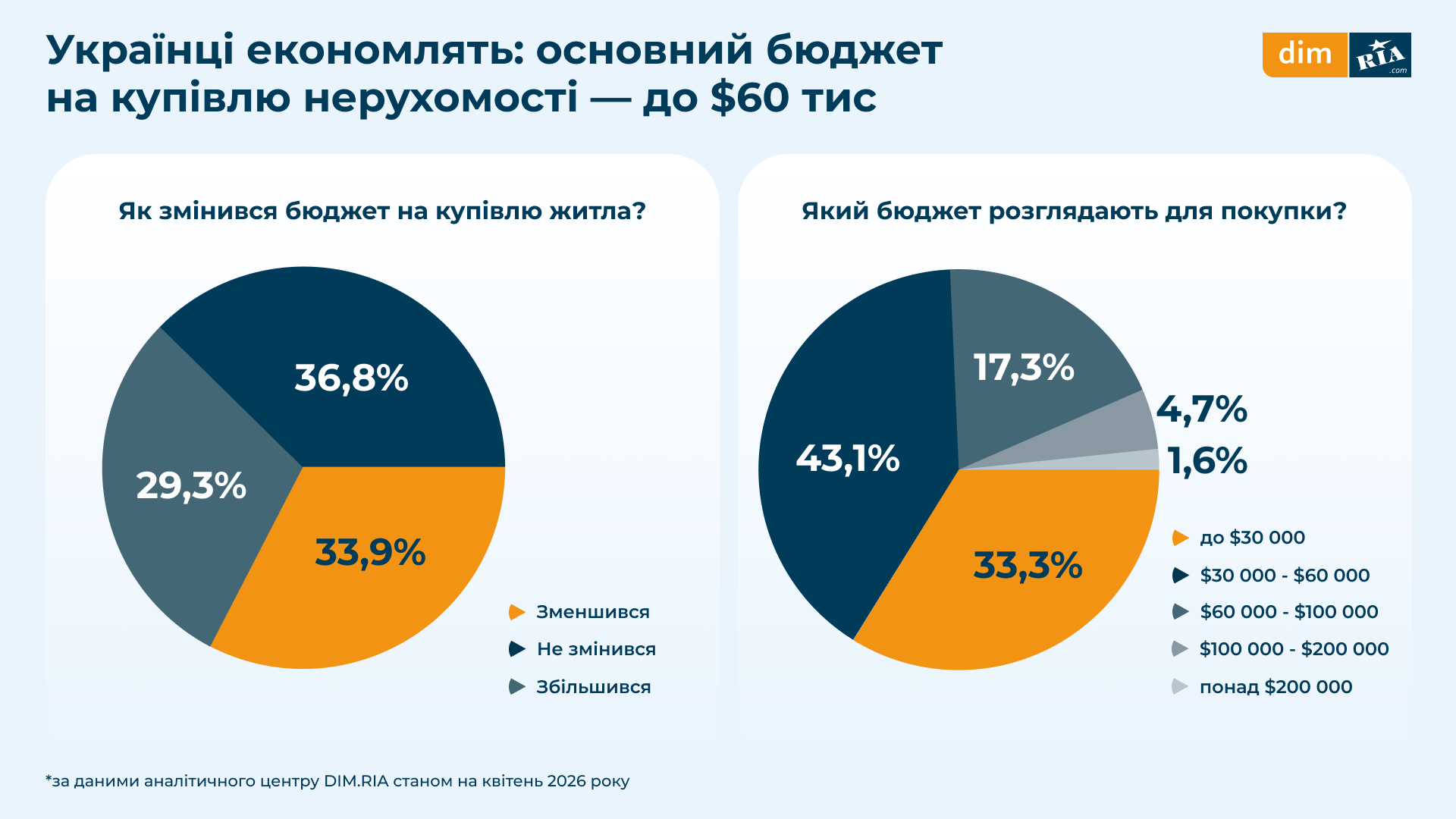
The Ukrainian marketplace for verified real estate, DIM.RIA, conducted a survey of its audience, in which over 2,500 Ukrainians participated. The aim of the study was to determine Ukrainians’ plans, priorities, and budgets regarding the purchase and rental of housing. The results showed that in 2026, every second Ukrainian plans to purchase real estate, with the majority of home seekers targeting a budget of up to $60,000.
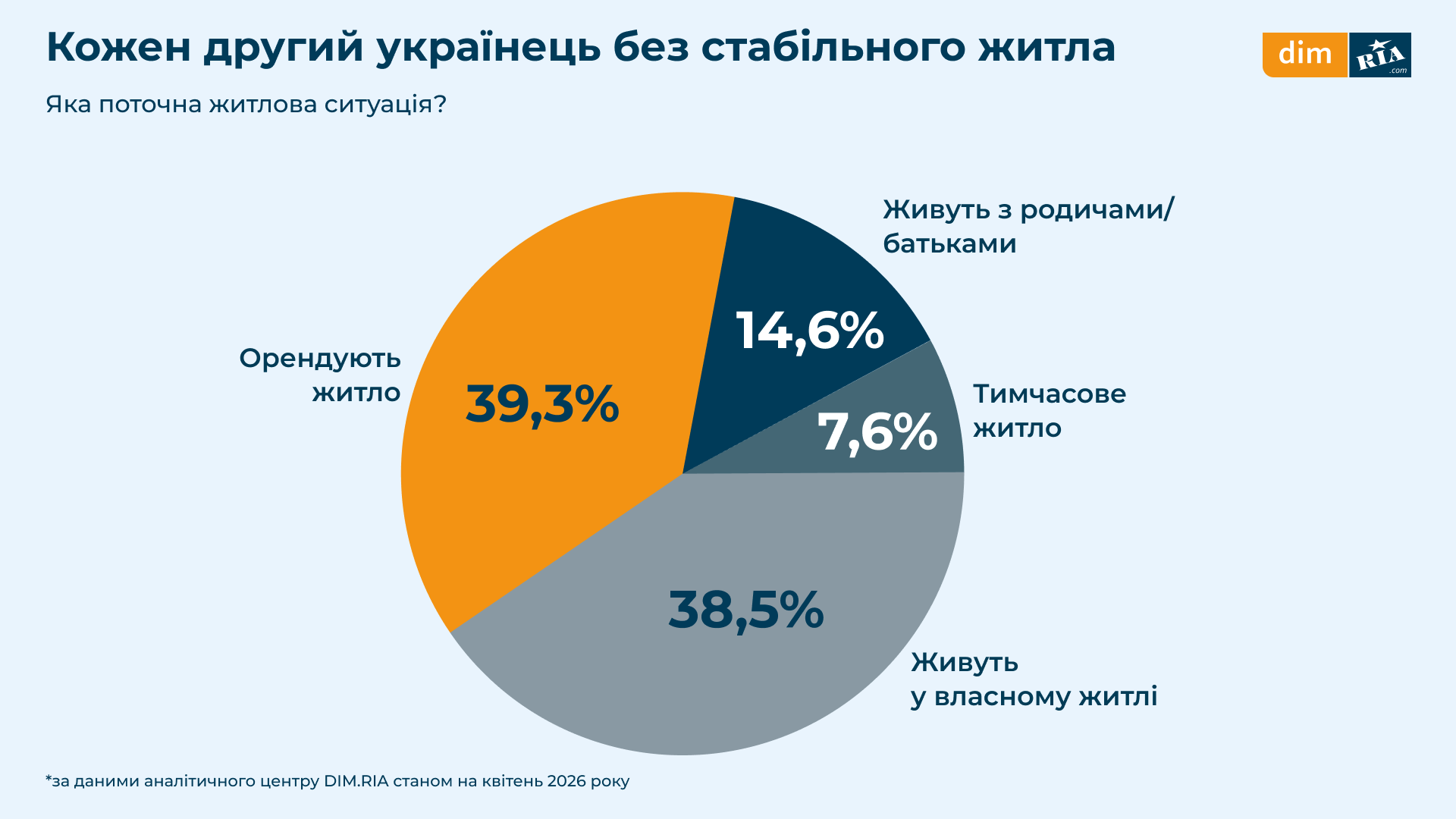
Despite the war, most Ukrainians will continue to live in their hometowns in 2026. At the same time, 33.7% have changed their place of residence since February 24, 2022. Moreover, nearly half of those surveyed do not own their own home: almost 40% rent, and 7.6% live in temporary housing.
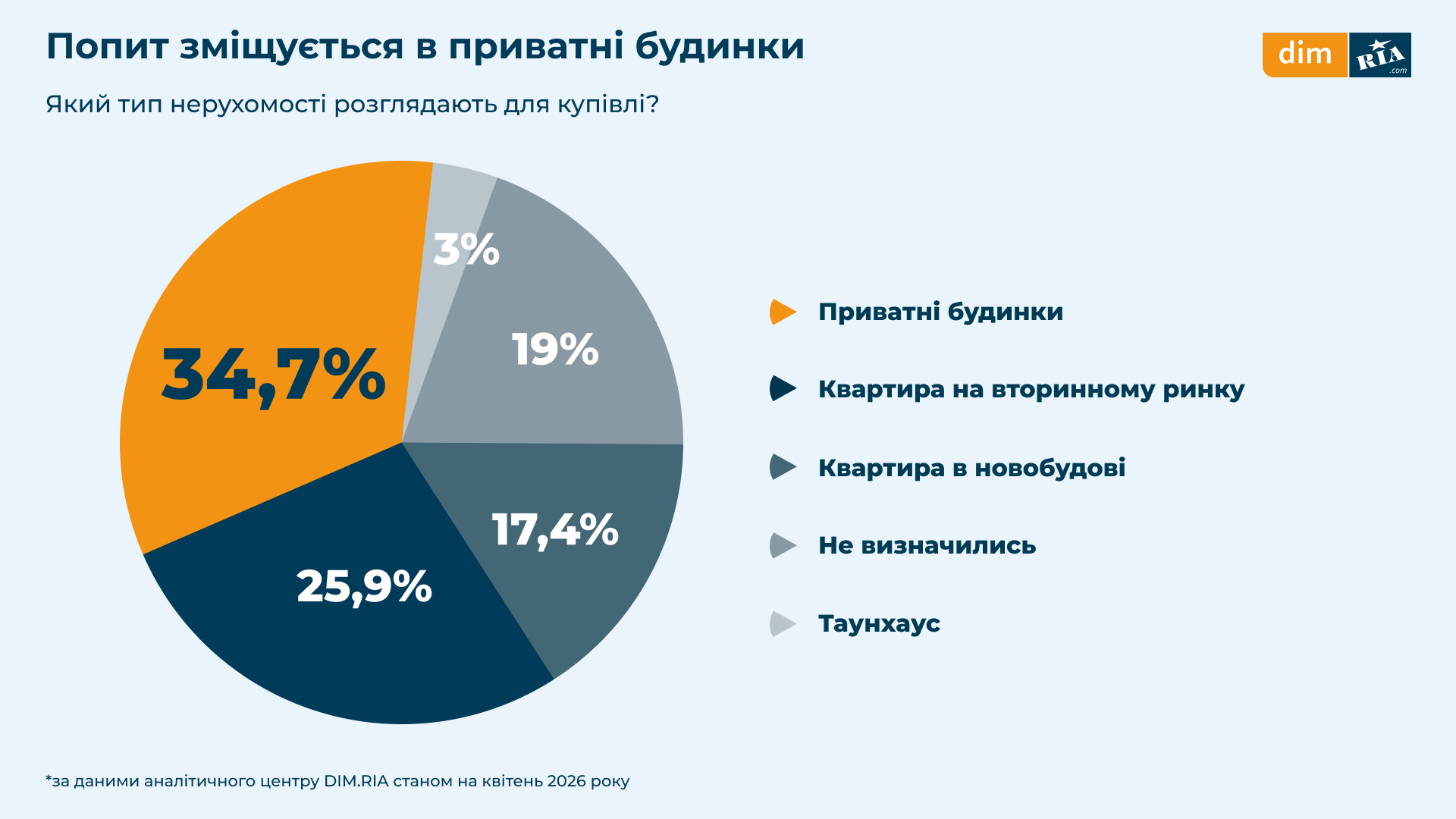
51.1% of Ukrainians plan to purchase real estate this year. Interest in single-family homes is growing in 2026: 34.7% are specifically looking to buy this type of property. Owning a home allows for greater control over utilities (electricity, heating, water), which in turn provides a greater sense of security and control.
25.9% are considering the secondary market—this allows them to move in faster without waiting for construction or renovation to be completed
A third of respondents have seen their budget for purchasing real estate decrease in 2026: for 33.9%, the budget has decreased; for 29.4%, it has increased; and for 36.8%, it has remained unchanged. The largest share, 43.1% of respondents, are willing to spend between $30,000 and $60,000 on housing, while 33.3% can allocate even less, up to $30,000. Thus, over 76% of respondents are targeting a budget of up to $60,000.
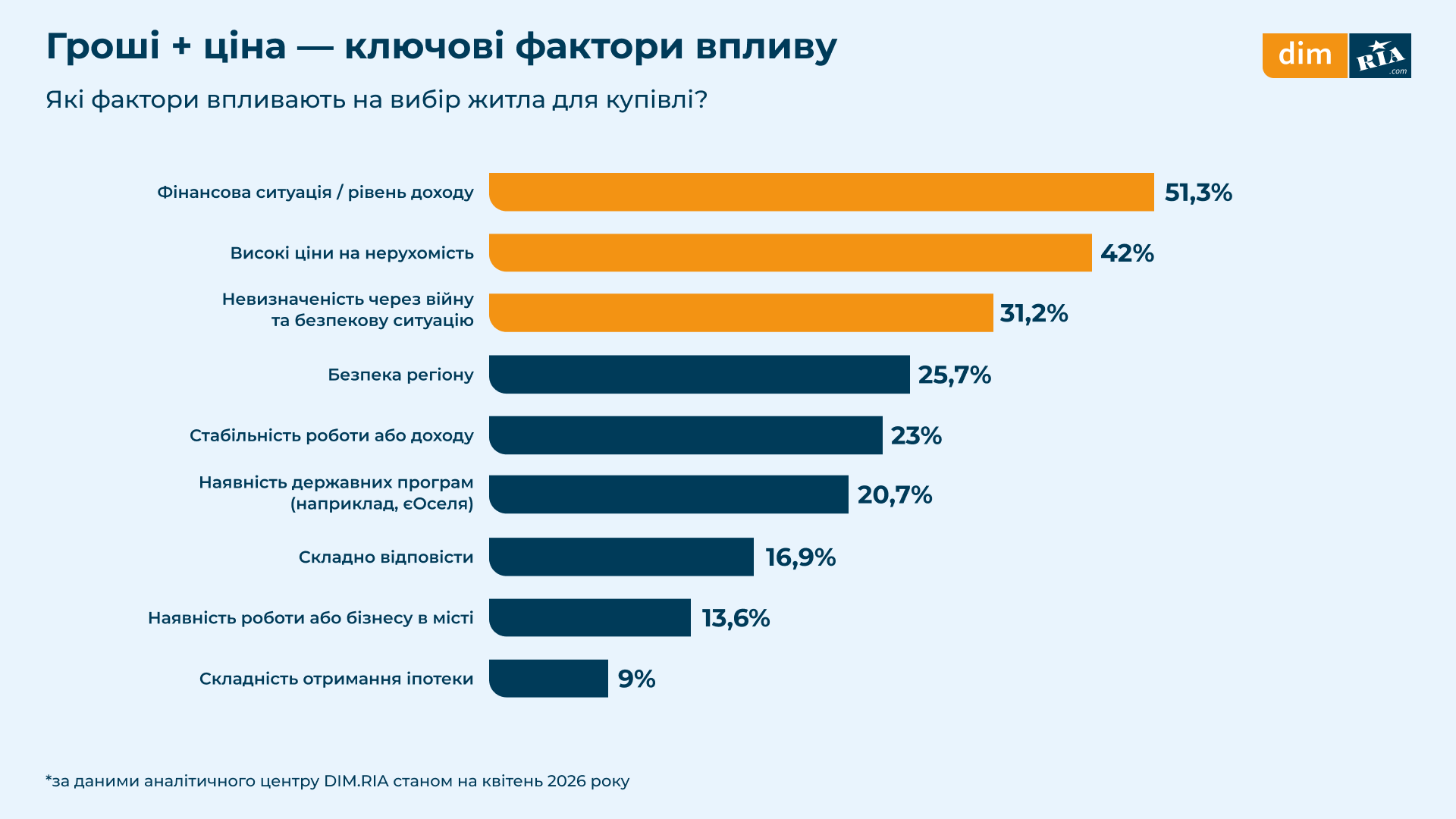
Among the priorities Ukrainians consider when choosing a home to buy, income level, real estate prices, and the overall security situation in the country take center stage. In contrast, government programs, such as eOselya, and mortgages take a backseat in the decision-making process. The key factors when renting are financial situation and contract terms
Overall, the real estate market remains focused on affordable housing, and financial factors determine both purchasing and renting
DIM.RIA – a marketplace for buying and renting verified housing. A product of the Ukrainian IT company RIA.com. Currently, the marketplace has a website and an app for iOS and Android devices.

The average cost of long-term housing rentals in Spain reached a historic high of EUR15 per square meter per month in April 2026, according to the Idealista portal.
According to analysts, rents have risen by 5.2% over the past year. However, the growth rate has been the most moderate since the summer of 2022, indicating a gradual slowdown in the market following several years of sharp rate increases.
Despite the slowdown, the market remains tight. The main reason is the persistent gap between supply and demand. In major cities, tourist regions, and university centers, demand is driven by local renters, foreign workers, students, digital nomads, and short-term rentals. At the same time, new supply is entering the market slowly, and some landlords prefer tourist rentals over long-term contracts.
For tenants, record-high prices mean housing is becoming even less affordable. The problem is particularly acute in Madrid, Barcelona, Valencia, Málaga, and the Balearic and Canary Islands, where rental demand is driven not only by domestic migration but also by foreigners. According to Idealista, rents in Spain rose to EUR15 per square meter in April, though no longer at the double-digit rates seen in previous years.
The migration factor remains one of the key drivers of the market. According to data from Spain’s National Institute of Statistics, as of January 1, 2025, the largest groups of foreigners in the country were citizens of Morocco—968,999 people—Colombia—676,534—and Romania—609,270. Other major groups include immigrants from Venezuela, Italy, China, Peru, the United Kingdom, Ukraine, and other countries.
In 2024, the number of Colombian citizens grew the fastest—by 98,057 people—followed by Venezuelans—by 52,555— and Morocco—by 48,306. At the same time, the number of Ukrainian citizens, according to INE data, decreased by 7,907 people, which may be due to changes in residency status, the relocation of some Ukrainians to other countries, or naturalization.
The influx of foreigners is driving up demand for rentals, particularly in cities with job opportunities, universities, and a developed service sector. In the fourth quarter of 2025, the main groups of new immigrants to Spain were citizens of Colombia, Venezuela, and Morocco.
Investment demand is creating additional pressure on the market. Foreign homebuyers in Spain pay significantly more than locals: in the second half of 2025, non-residents purchased homes at an average of EUR 3,242 per square meter, foreign residents at EUR 1,963, and Spanish citizens at EUR 1,839. This also affects the rental market, as investment purchases are often aimed at renting out the property.
Thus, Spain faces a double challenge: rents have already reached record levels, but a structural supply shortage does not yet allow for a rapid decline in prices. Even a slowdown in annual growth to 5.2% does not signal a market reversal, but rather indicates a shift from sharp price increases to a more stable, though still expensive, level of rents.

According to Serbian Economist, the housing market in neighboring Romania continues to see price growth at the start of 2026, although the pace now appears more moderate than during the post-pandemic surge. According to Eurostat, the annual growth in housing prices in Romania at the end of 2025 was about 6.7%, which was higher than the EU average.
Bucharest remains the main market hub, but high prices persist in the largest regional cities as well. According to Romania Insider, in February 2026, two districts in the capital had already surpassed Cluj-Napoca in terms of price per square meter, while Cluj itself remained at approximately €3,300 per square meter. For Bucharest, research and market surveys indicate a city benchmark of €2,236 per square meter in February 2026.
In terms of transactions, the start of 2026 was uneven. In January, 24,598 real estate transactions were registered nationwide, which was below the level of January 2025, and apartment transactions fell by 25% nationwide and by 22% in Bucharest, according to Storia’s analysis based on ANCPI data. By February, the market had already picked up noticeably: the number of transactions rose to 44,427, and Bucharest once again became the country’s largest housing market.
The key trend at the start of 2026 is that the market remains active, but buyers have become more cautious. In its 2026 review, CBRE notes that Romanian buyers dominated the transaction mix at the end of 2025 and accounted for about 31% of the total investment volume for the year, while broader market reviews describe demand as “cautiously positive”: buyers remain active but are taking longer to make decisions and are focused on properly valued properties in good locations.
From a pricing perspective, the market can no longer be called cheap, even by regional standards. Colliers noted at the end of 2025 that prices in Romania’s largest cities had risen by 60–90% over six years, and in Cluj by approximately 100%, while in Bucharest the number of building permits had fallen by 45% over three years, further limiting supply.
Another important consideration for buyers and investors is that the Romanian market is becoming more demanding regarding transaction structures and financing. According to Legal 500, the sector is entering a more “disciplined” phase in 2026, where decisions are more strongly influenced by borrowing costs, the regulatory environment, and the quality of documentation. The OECD also expects only a moderate acceleration in economic growth for Romania in 2026 following a weak 2025, which means the housing market will increasingly depend on household incomes and mortgage availability, rather than just on the momentum of growth.
As for foreigners, no recent official statistics specifically regarding homebuyers by nationality at the beginning of 2026 could be found in open sources. Therefore, it is more accurate to distinguish between the market presence of foreigners and the market of foreign buyers. According to OECD data, in 2024, 52,000 new immigrants in Romania received residence permits valid for more than 12 months, and the largest groups of immigrants in the country in 2024–2025 were linked to Ukraine, Italy, Spain, Moldova, and Turkey. This is not the same as homebuyers, but it shows which foreign groups are currently most prominent in the country and potentially drive part of the demand for renting and buying real estate.
There has also been a noticeable increase in labor migration from Asia. The OECD notes that among new arrivals in 2023–2025, the largest groups were citizens of Nepal, Sri Lanka, and Turkey, while the Romanian labor market has also been actively attracting workers from India and Bangladesh in recent years. For the housing market, this is particularly important in the rental, dormitory, and affordable housing segments in major cities, rather than in the premium segment of apartment purchases.

Georgia’s residential real estate market maintained moderate growth in the first quarter of 2026. According to the National Statistics Service of Georgia, the housing price index rose by 1.8% quarter-over-quarter and by 3% year-over-year. Since 2020, the cost of residential real estate in the country has increased by 62.3%.
Apartments saw the most significant price increases. In the first quarter, apartment prices rose by 2% quarter-over-quarter and 3.3% year-over-year, while private homes increased by 1.1% and 1.8%, respectively. This indicates more stable demand specifically for the apartment segment, particularly in the capital.
The highest prices continue to be recorded in the prestigious districts of Tbilisi. Among apartments, Mtatsminda leads with an average price of about $2,542 per square meter, followed by Vake at about $2,222, and Krtsanisi at about $1,662 per square meter. In the single-family home segment, the most expensive districts are Mtatsminda at around $1,803 per square meter, Vake at $1,679, and Didube at $1,582 per square meter.
For buyers of new construction, the stage of completion remains an important factor. According to the publication, average asking prices in the first quarter were approximately $1,639 per square meter for “green frame” apartments, $1,343 per square meter for “white frame” apartments, and $1,239 per square meter for “black frame” apartments. However, the source itself notes that these are asking prices on popular online platforms, not final transaction prices.
Overall, the new data confirms that the Georgian housing market continues to grow, albeit without sharp spikes. The main driver is the capital, and above all, high-quality urban housing in Tbilisi’s expensive neighborhoods, where prices have already noticeably exceeded $2,200 per square meter.



