
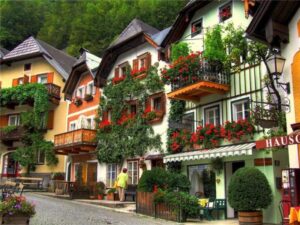
Austria’s residential real estate market has returned to growth after a prolonged period of price declines, according to data from Statistik Austria.
According to the statistical agency, prices for houses and apartments in Austria rose by an average of 2.6% in 2025, following declines of 2.6% in 2024 and 2.3% in 2023. Thus, the market showed positive annual growth for the first time in two years.
The recovery accelerated in the second half of 2025. In the fourth quarter, housing prices rose by 3.5% year-over-year and by 0.8% compared to the previous quarter. New housing prices increased by 3.1% over the year, while existing housing prices rose by 3.6%.
The return to growth is linked to the gradual stabilization of the mortgage market, reduced uncertainty following a period of high interest rates, and a decline in new construction supply. After a sharp rise in borrowing costs in 2022–2024, some buyers postponed their purchases, but demand began to gradually return in 2025.
However, the recovery remains uneven. According to Global Property Guide estimates, prices continued to decline in certain regions, particularly in expensive Alpine and metropolitan locations. In Vienna, the average property price in 2025 was estimated at approximately EUR 779,000, but the annual trend was negative—around -6.6%. In Tyrol, the decline was estimated at -13.7%, and in Salzburg at -9.1%. At the same time, Carinthia, Styria, and Upper Austria showed growth.
For investors, Austria remains one of the most stable markets in Europe, but returns require more precise calculation. High prices in Vienna, Salzburg, and Tyrol limit the potential for rapid growth, while more affordable regions may appear more attractive against the backdrop of recovering demand.
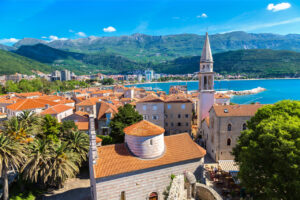
According to Serbian Economist, foreign demand for real estate in Montenegro is becoming more diversified: citizens of Serbia and the U.S. are stepping up their activity, while the share of Russian buyers is gradually decreasing, as evidenced by market data and surveys of local experts.
Just a few years ago, Russian buyers were one of the key groups of foreign investors in Montenegrin real estate, especially along the coast—in Budva, Tivat, Kotor, Herceg Novi, and Bar. However, after 2022, their activity began to decline due to sanctions, issues with bank transfers, capital movement restrictions, uncertainty regarding residency status, and changes in the geopolitical landscape.
Against this backdrop, the importance of buyers from Serbia is growing. For Serbian citizens, Montenegro remains a familiar and accessible market: there is no language barrier, strong family and business ties, and the coast is traditionally viewed as a destination for vacationing, purchasing a second home, and renting. Serbian buyers are particularly active in the segment of apartments for seasonal living and properties that can be rented out to tourists.
American demand has also become more noticeable. Buyers from the U.S. are attracted by relatively lower prices compared to EU and Mediterranean markets, the possibility of obtaining a residence permit through real estate, the development of tourism infrastructure, and the growing recognition of Montenegro as a European destination for relocation, remote work, and investment.
According to market surveys, the most active foreign real estate buyers in Montenegro currently include citizens of Serbia, Turkey, the U.S., Russia, and Germany. However, activity among Russian and German buyers has declined significantly.
Ukrainian buyers also maintain a presence in the Montenegrin market, although their role is not dominant. For Ukrainian citizens, Montenegro remains a logical destination for relocation, purchasing a home for residence, seasonal vacations, and investments. According to market participants, Ukrainians are more likely to consider real estate in coastal cities and in Podgorica, focusing on both personal residence and the possibility of renting out the property. Market estimates indicate that in 2024–25, Ukrainian citizens accounted for approximately 10% of foreign real estate purchases in Montenegro.
Real estate prices in Montenegro continue to depend heavily on location. On average across the market, new residential real estate in 2026 is estimated at approximately 2,200 euros per square meter, but prices are significantly higher along the coast. In popular coastal cities, standard apartments typically sell in the range of €1,700–3,500 per square meter, while in more liquid and tourist-oriented locations, prices range from €3,000 to €5,000 per square meter.
In Tivat, especially near Porto Montenegro, apartment prices often range from €3,500 to €5,500 per square meter, and premium properties can cost even more. In Budva, new-build properties are typically priced at around 3,000–4,200 euros per square meter, while completed properties are priced at around 2,800–3,800 euros per square meter. In Kotor, prices for high-quality properties can approach €3,500–4,000 per square meter, and may be higher in certain coastal and historic locations.
Inland areas and parts of Podgorica remain more affordable than the coast. In the capital, the average price in recent years has approached 2,000 euros per square meter, while in less touristy cities and northern regions, properties can be found at significantly lower prices.
For local residents, the growth in foreign demand has a double-edged effect. On the one hand, it supports construction, employment, services, rentals, and tax revenues. On the other hand, it drives up housing prices, especially in coastal cities, where the purchasing power of the local population is significantly lower than that of foreign investors.
https://t.me/relocationrs/2905
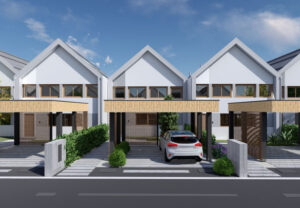
Slovenia is experiencing a new surge in housing prices, putting increased pressure on buyers in one of the region’s most expensive and scarce real estate markets. According to data from Slovenia’s national statistics office and industry reports, real estate prices in the country have resumed active growth following a period of more moderate trends. Price increases are particularly noticeable in Ljubljana, along the coast, and in the most sought-after urban areas, where housing supply remains limited.
Official Slovenian statistics show that in 2025, housing prices rose by 5.8% compared to the previous year. At the same time, the number of transactions involving existing apartments in Ljubljana increased by approximately a quarter, indicating a return of buyer activity to the most liquid segment of the market.
According to market data, the median price of existing apartments in Slovenia in 2025 exceeded EUR 3,000 per square meter for the first time, reaching approximately EUR 3,200 per square meter. In Ljubljana, the median price rose to EUR 5,050 per square meter, and in the coastal region, to EUR 4,810 per square meter.
Eurostat also recorded an acceleration in price growth in early 2026. In the fourth quarter of 2025, Slovenia still showed a quarterly price decline of 1.1%, but in the very next housing market report, the country was among the EU leaders in quarterly growth: prices rose by 5.1%, one of the highest rates in the European Union.
The main reason for the growth is a chronic supply shortage. The Slovenian market suffers from limited new housing construction, complex planning procedures, high land costs, and a concentration of demand in Ljubljana, along the coast, and in tourist destinations. In a separate report, the OECD noted that Slovenia’s housing problems are linked to strong demand and insufficient supply, as well as rising construction and financial costs.
For buyers, this means a further decline in housing affordability. Slovenia has long been considered one of the most expensive real estate markets among the countries of the former Yugoslavia, and new data confirms that the gap between household incomes and apartment prices continues to widen. This is particularly true for young families and first-time homebuyers.
The housing price index in Ukraine for January–March 2026 stands at 117.2%, compared to 111.2% for the same period in 2025, according to the State Statistics Service (SSS).
According to its data, in the primary market, prices for housing accelerated their growth to 17.3% in the first quarter of 2026, compared to 14.8% in the first quarter of last year. At the same time, apartments in the primary market rose in price by 17.3%, and single-family homes by 16.4%.
In the secondary market, prices accelerated their growth to 17.1% in January–March 2026, compared to 9.3% during the same period in 2025. Specifically, apartment prices rose by 17.9%, while house prices rose by 15.4%.
According to the statistics agency, compared to the previous quarter, housing prices rose by 6.1%, with a 4.8% increase in the primary market and a 6.6% increase in the secondary market.
In the first quarter, apartment prices in the primary market rose by 4.2% compared to the previous quarter, while house prices rose by 7.5%. In the secondary market, prices rose by 5.9% and 7.8%, respectively, the State Statistics Service noted.
The State Statistics Service also compared current price figures with the annual averages for 2019. Thus, in the first quarter of 2026, prices for housing rose by 132.3%.
According to the State Statistics Service, housing prices rose by 12.8% in 2025 and by 12.7% in 2024.
As reported, an updated methodology for the state statistical survey “Changes in Housing Market Prices” has been in effect since the first quarter of 2026, which the State Statistics Service approved to comply with the requirements of European Commission (EU) Regulation 2025/1182 of June 17, 2025.
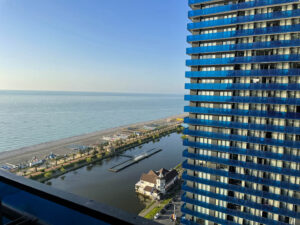
Foreign buyers have become the main driver of growth in Batumi’s residential real estate market: in April 2026, their share of apartment transactions reached 47%, approaching half of the total market. This confirms that Georgia’s largest Black Sea resort is increasingly transforming from a local housing market into an international investment hub.
According to data from the Recov.ge platform, 1,292 apartments were sold in Batumi in April 2026, which is 12.3% more than in April 2025, when 1,165 transactions were recorded. The total market volume for the month grew by 27.4% and reached $85 million.
This growth was accompanied by a noticeable increase in the price per square meter. The weighted average price in new Batumi developments rose by 11.3% year-over-year to $1,351 per square meter. Prices in the primary market rose by 15.2%, and in the secondary market by 9.4%. At the same time, demand is concentrated specifically in new and modern projects: sales in new developments rose by 12.3%, while interest in the existing housing stock declined by 5.4%.
The key driver of growth is foreign capital. Non-residents accounted for 90% of the net increase in the number of transactions in April. Leo Chikava, Head of Research and Data Analysis at Colliers Georgia, notes that the share of foreign buyers has remained stable in the range of 44–47% in recent months, and during certain periods, foreign buyers have already surpassed local buyers in terms of activity.
Batumi differs significantly from Tbilisi in terms of demand structure. In the Georgian capital, domestic buyers remain the main driving force of the market: according to Galt & Taggart, in a January survey of developers, Georgian buyers accounted for about 77% of primary sales in Tbilisi. In Batumi, the situation is reversed: foreign demand is much more significant, and the share of foreign buyers in the surveyed projects reached 52%.
Among the most active foreign buyers in Batumi are citizens of Israel, Russia, and EU countries, as well as buyers from Ukraine, Belarus, and other post-Soviet states. According to Global Property Guide, citing Galt & Taggart, in 2025, buyers from the EU and Israel each accounted for 13% of sales in the surveyed projects in Batumi, while buyers from Ukraine, Russia, and Belarus together accounted for 11%. The exact share of Ukrainians is not disclosed in this report.
In 2025, the Batumi market had already surpassed the $1 billion mark in total value of apartments sold, and the number of transactions reached 17,053, which is 14.7% more than the previous year.
For foreign buyers, Batumi remains attractive due to a combination of a relatively low entry price, its seaside location, a high proportion of new projects, rental potential, and a relatively lenient real estate purchase regime. Against this backdrop, the city competes not only with Tbilisi but also with resort markets in Turkey, Montenegro, Bulgaria, and Cyprus.
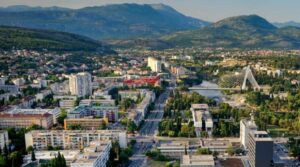
According to Serbian Economist, Montenegro has significantly tightened payment rules for real estate transactions: deals worth more than EUR 10,000 must now be processed through the country’s banking system. The new requirements are aimed at strengthening control over the origin of funds, combating money laundering, and increasing transparency in the real estate market.
The law applies to real estate transactions worth more than EUR10,000.
The key requirement is that payment for the transaction must be made from or to a bank account opened in Montenegro. At least one of the parties to the transaction must have an account with a Montenegrin bank. This means that the buyer can transfer funds from a foreign bank directly to the seller’s account in Montenegro, provided the seller has such an account.
If payment was made before the contract was signed, the notary will have to request a bank statement confirming the transfer. A simple statement by the parties that the payment has already been made will not be sufficient. This strengthens the role of notaries and banks as participants in ensuring the integrity of the transaction.
In effect, Montenegro is closing the door on informal payments in the real estate market, which has actively attracted foreign buyers in recent years. Violations are subject to fines ranging from EUR 3,000 to EUR 20,000.
For foreign buyers, the new rules mean they must verify the banking aspects of the transaction in advance. If the seller is a resident of Montenegro and has a local bank account, the buyer will generally be able to pay for the property via a SWIFT transfer from their foreign account. However, in more complex cases—for example, if the seller is a non-resident, the transaction involves a legal entity, or the parties wish to manage payments through the buyer’s account—it may be necessary to open an account at a Montenegrin bank.
In such cases, banks may request documents regarding the source of funds: proof of income, sale of assets, investment documents, or other sources of capital. This aligns with the general logic of European financial compliance, although Montenegro is not yet an EU member.
For the Montenegrin real estate market, the effect will be twofold. On the one hand, the new rules may complicate and slow down transactions, especially for non-residents who are accustomed to more flexible payment schemes. On the other hand, increased transparency may strengthen the confidence of banks, notaries, and foreign investors in the market, particularly against the backdrop of expectations regarding Montenegro’s accession to the EU.
Montenegro remains one of the most popular real estate markets on the Adriatic for foreign buyers. Demand is driven by buyers from Europe, Turkey, Russia, Ukraine, Israel, and the Balkans.
https://t.me/relocationrs/2843



