

According to the results of the first half of 2025, Poland remains Ukraine’s main trading partner in terms of export volumes. According to research by Active Group and Experts Club, exports to Poland amounted to US$2.45 billion.
Turkey ranks second with USD 1.71 billion, and Italy ranks third with USD 1.17 billion. Other major partners include: Germany ($1.09 billion), Spain ($976 million), the Netherlands ($919 million), China ($847 million), Egypt ($776 million), Romania ($679 million), and Hungary ($652 million).
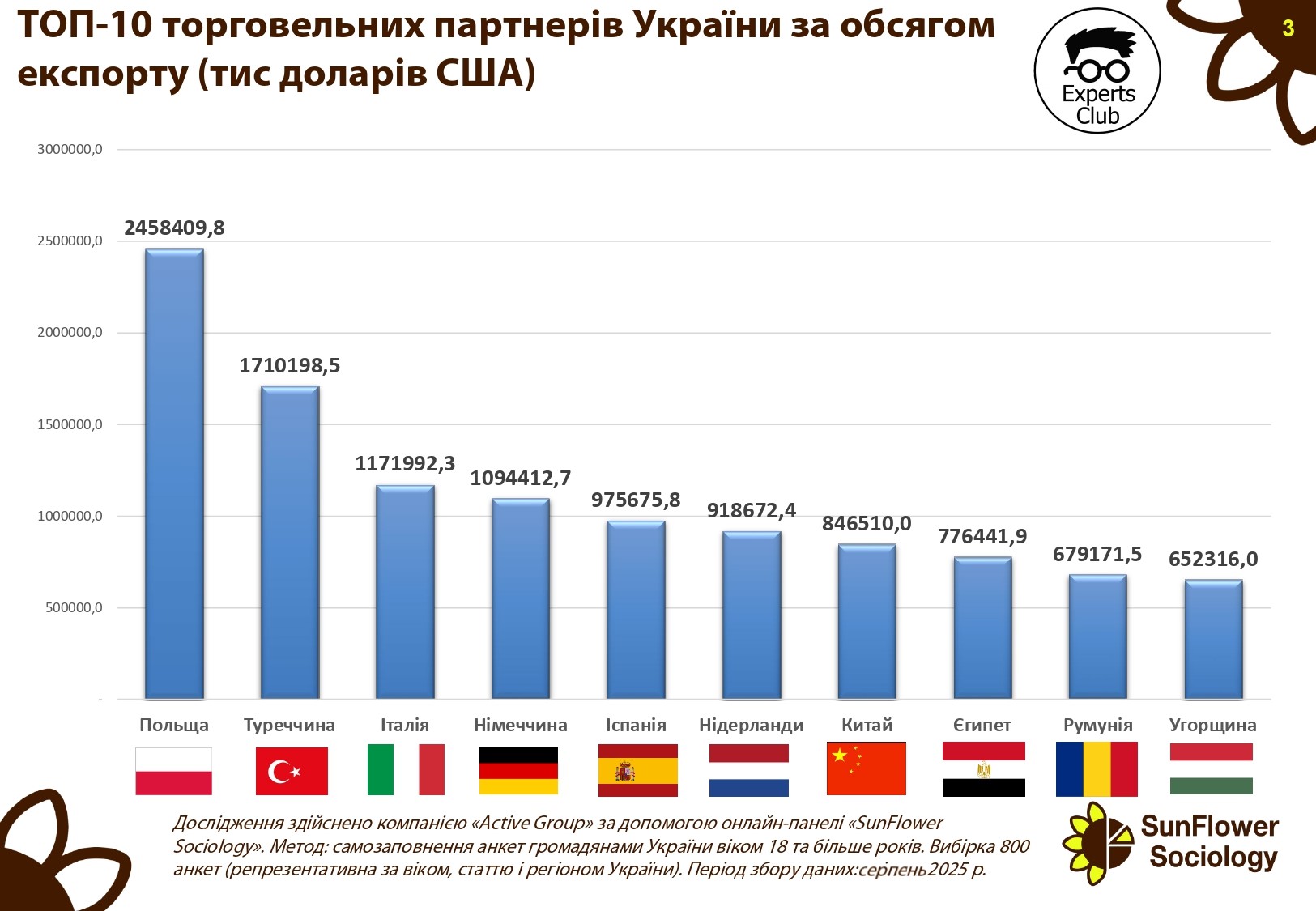
“The structure of Ukraine’s exports shows a clear focus on European Union countries. Poland, Italy, Germany, Spain, and the Netherlands together account for more than half of total exports. This indicates Ukraine’s strategic integration into the European economic space,” emphasized Maksim Urakin, founder of Experts Club and economist.
He also noted that Turkey remains a critically important partner for Ukrainian agricultural and metallurgical exports, while China and Egypt are key markets for agricultural products, particularly grains.
“The presence of trading partners such as Egypt and China diversifies Ukrainian exports,” Urakin added.
CHINA, ECONOMY, EGYPT, EXPERTS CLUB, EXPORTS, GERMANY, HUNGARY, ITALY, POLAND, ROMANIA, TRADE, TURKEY, UKRAINE, МАКСИМ УРАКИН

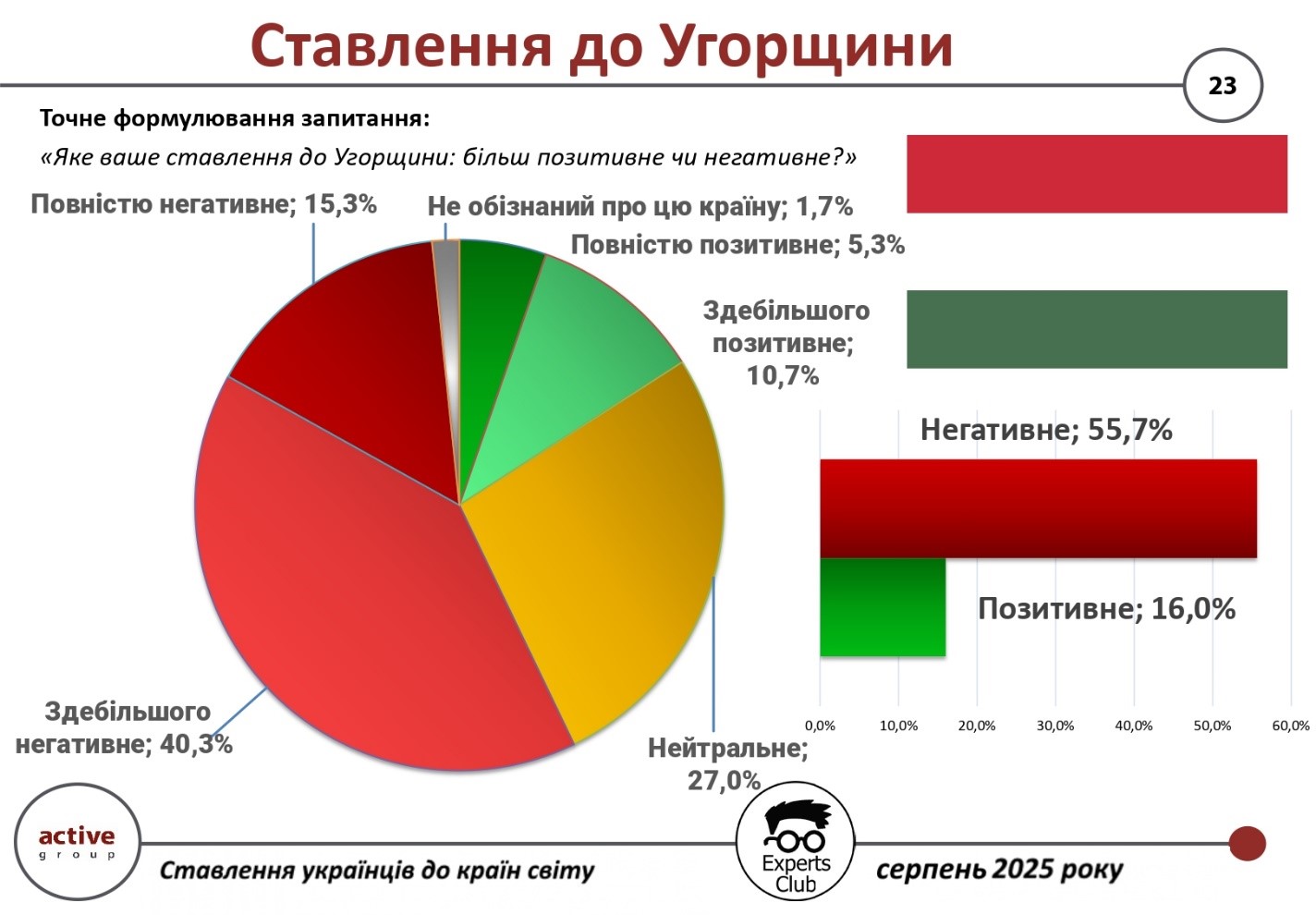
The attitude of Ukrainians towards Hungary is one of the most critical among all EU countries. This is evidenced by the results of an all-Ukrainian survey conducted by Active Group in cooperation with the Experts Club information and analytical centerin August 2025.
According to the survey, 55.7% of Ukrainian citizens have a negative attitude towards Hungary (40.3% – mostly negative, 15.3% – completely negative). Only 16.0% of respondents expressed a positive attitude (10.7% – mostly positive, 5.3% – completely positive). Another 27.0% of respondents took a neutral position, and 1.7% said they did not know the country well enough to form their own opinion.
“Ukrainians perceive Hungary ambiguously due to a number of political factors. This directly affects the level of trust in society. Nevertheless, if we look at the economic component, in the first half of 2025, the volume of trade between Ukraine and Hungary exceeded $1.52 billion, of which exports from Ukraine amounted to $652 million and imports to almost $874 million. The negative balance of more than $221 million indicates a certain asymmetry in relations, but at the same time demonstrates that Hungary remains a prominent partner in our market,” said Maksym Urakin, founder of Experts Club.
In his turn, Active Group co-founder Oleksandr Poznyi emphasized that the sociological results do not mean complete rejection of cooperation.
“More than half of the citizens do demonstrate a critical attitude towards Hungary, but a quarter of respondents remain neutral, and one in six Ukrainians assesses Hungary positively. This means that there is still potential for restoring trust at the level of interpersonal contacts, cultural ties, and business relations. In the future, these factors may become the basis for mitigating the current negative assessments,” he added.
The survey was part of a broader study of international sympathies and antipathies of Ukrainians in the context of the current geopolitical situation.
The full video can be viewed here:
https://www.youtube.com/watch?v=YgC9TPnMoMI&t
You can subscribe to the Experts Club YouTube channel here:
https://www.youtube.com/@ExpertsClub
ACTIVE GROUP, DIPLOMACY, EXPERTS CLUB, HUNGARY, Poznyi, SOCIOLOGY, TRADE, URAKIN

Consulting firm Deloitte has released the 14th edition of its Property Index 2025 report on European housing markets. The study covers 28 countries. Ukraine was not included in this study.
The highest average mortgage rates are in Hungary (9.35%), Poland (7.67%), and Romania (6.89%). Deloitte
The lowest are in Bulgaria (2.83%), Croatia (2.86%), and Turkey (3.01%).
The average rate in Europe is 4.36%, which is slightly lower than last year and reflects the gradual easing of monetary policy in a number of countries.
Deloitte notes that against the backdrop of a “bottleneck” with new projects and sustained demand, the rental segment is strengthening (rates are rising not only in capital cities but also in regional centers). At the same time, high rates and regulatory lags in permits continue to put pressure on property affordability, especially in large agglomerations.
Deloitte Property Index 2025 — a comparative study of European housing markets: prices for new buildings, affordability (in years of gross salary for a 70 m² apartment), rental dynamics, and mortgage rates. Key findings and figures are available on the Deloitte Property Index 2025 report page.

Hungarian Foreign Minister Péter Szijjártó said that Budapest and Belgrade have agreed to speed up the construction of an oil pipeline between the two countries. The 190 km Hungarian section is planned to be completed by the end of 2027, according to the Serbian Economist Telegram channel.
“We have agreed with Serbian Energy Minister Dubravka Jedovic-Handanovic to speed up the construction of the oil pipeline between Hungary and Serbia. The 190 km Hungarian section should be completed by the end of 2027,” he said on social network X, emphasizing the importance of energy cooperation against the backdrop of Ukraine’s attacks on the Druzhba oil pipeline, which supplies oil to Hungary and Slovakia, among other countries.
Why the project is important for these countries and the entire Balkan region
Increased energy security and diversification of routes
The new oil pipeline will reduce Hungary and Serbia’s dependence on traditional routes, especially in the context of instability caused by damage to Druzhba. This increases the reliability of supplies and reduces energy risks.
Regional energy integration
The construction of infrastructure connecting the Balkan and Central European regions helps strengthen economic ties and stimulates the growth of the energy market in the region.
Strategic independence
Independence from single transit routes provides greater flexibility in times of crisis and allows countries to respond more quickly to external challenges.
Economic impact and infrastructure development
The project creates jobs, contributes to the development of transport and energy infrastructure, and attracts investment for both Hungary and Serbia.
Geopolitical stability in the Balkans
The Balkan region has traditionally been at the crossroads of geopolitical interests. The new route strengthens its strategic importance and helps reduce dependence on external factors.
The Hungarian-Serbian oil pipeline project is not just a technical initiative. It serves as the foundation for a new energy architecture in the region, creating a sustainable, independent, and mutually supportive security system, which is particularly relevant in light of current geopolitical realities.
Source: https://t.me/relocationrs
Denmark and Germany have agreed to participate in the new format of arms supplies to Kyiv proposed by US President Donald Trump, while France, Italy, the Czech Republic, and Hungary have refused, Western media reported on Wednesday.
In addition, Bloomberg reported on Wednesday that Europe increasingly feels the need to end its dependence on US weapons.
“Europe is heavily dependent on the US defense industry. However, due to trade tariffs, President Trump’s attitude toward NATO and his lack of commitment to defending the alliance’s countries, European countries will increasingly prioritize investments in their own defense systems,” the agency’s sources said.
According to the European portal Politico, France has refused to participate in the purchase of American weapons for Ukraine. The publication’s sources said that instead, the government intends to focus on increasing its own defense budget, which President Emmanuel Macron promised last weekend to almost double by 2027 compared to the 2017 budget.
In addition, Paris wants to support European manufacturers who previously supplied Ukraine with anti-missile systems and other weapons.
Italy also has no plans to purchase weapons from the US for delivery to Ukraine, but will continue to provide military assistance to Kyiv. Unnamed representatives of the Ministry of Defense told the newspaper La Stampa that there had never been any talks about purchasing American weapons for Kyiv.
In addition, the newspaper notes that Italy does not have the funds to carry out operations of this kind. According to the newspaper’s sources, the problem is so acute that the only purchase from the US planned by Italy for the next ten years is a batch of F-35 fighter jets for its own needs.
The Czech government, in turn, said that military aid to Kyiv would continue, but through participation in other initiatives and purchases from Czech, not American, manufacturers.
Hungarian Foreign Minister Péter Szijjártó said that Budapest does not intend to participate in the purchase of American weapons for Ukraine.
Berlin and Copenhagen have so far given their official consent to purchase weapons from the US. Danish Foreign Minister Lars Rasmussen said he was fully prepared to join the funding.
The Dutch Foreign Ministry, in turn, said it was considering participating in the program. However, despite the government’s positive assessment of the initiative, Amsterdam has not yet confirmed its commitment to direct participation.
According to NATO Secretary General Mark Rutte, Sweden, Norway, and the United Kingdom are also expected to join the funding.
On July 11, Trump announced that US NATO allies would purchase weapons from Washington, which could then be transferred to Ukraine.
During a press conference with Trump on Monday, Rutte called it “logical” that European countries would pay for US arms deliveries to Ukraine.
European diplomacy chief Kaja Kallas said on Tuesday that EU countries would prefer Washington to provide part of its military aid to Ukraine free of charge. “If we pay for these weapons, it means that we, not the US, are providing this military aid,” Callas said at a press conference in Brussels. She stressed that Brussels “would like to see these costs shared.”

On May 1, 2025, Hungary will introduce restrictions on the movement of freight transport throughout the country.
The Embassy of Ukraine in Hungary officially announces that, in connection with the public holiday declared by the Hungarian side, restrictions will be imposed on the movement of trucks and combined transport vehicles with a maximum permissible weight of over 7.5 tons on the territory of Hungary on Thursday, May 1, from 6:00 a.m. to 10:00 p.m.
We recommend that you take this information into account when planning your trips and international transport.



