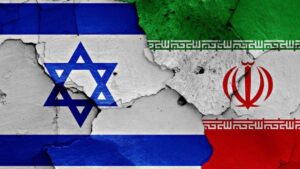
Israel’s strikes on Iran’s gas infrastructure will push up gas prices in Europe, which means they may also rise in Ukraine, according to Andriy Kobolev, former head of the board of Naftogaz Ukraine.
“Israel has begun to destroy Iran’s gas infrastructure with drones… For those wondering what to do about gas purchases for this winter: this will have a significant impact on the balance (and therefore the price) of natural gas in Europe,” he wrote on Facebook on Sunday.
Kobolev explained that Iran had been supplying gas to Turkey, which resold it to the EU, but now, due to Israeli strikes, Iranian gas is at risk of being cut off, and the Turks will not be able to replace it with Russian gas because both gas pipelines are almost fully loaded.
“Therefore, Turkey will be forced to either reduce gas supplies to the EU or increase the share of more expensive LNG. In any case, this will push prices up in the EU. And if Israel continues to attack the Iranian gas sector, part of Russian gas may be redirected to Iran,” the former head of Naftogaz concluded, advising to prepare for such an impact on prices.
As reported, Ukraine was forced to return to significant gas imports from Europe due to Russian strikes on gas infrastructure.
According to the Ukrainian Gas Transmission System Operator (OGTSU), 501 million cubic meters were imported in May (54% via Hungary, 33% via Poland, and 12% via Slovakia), or 16.1 million cubic meters per day. At the same time, former OGTSU board chairman Serhiy Makogon believes that Ukraine needs to import approximately 870 million cubic meters per month, or 29 million cubic meters per day, to achieve last year’s planned gas storage targets in underground gas storage facilities (UGS).
Number of personnel in the armed forces
Air Force and missile defense
Missile and drone arsenal
Intelligence and special forces
Conclusions.
In terms of military power, Iran wins in terms of numbers: soldiers, missiles, drones, and a large fleet. However, Israel has a qualitative advantage: modern fighter jets, missile defense, cyber infrastructure, nuclear capabilities, and innovative technologies. In the event of war, Iran has the resources for a long-term, large-scale campaign, but Israel may be able to deliver a decisive technological blow first, with US support and thanks to its dominance in critical areas.

Israel is closing its diplomatic missions worldwide and consular services will not be provided, the Israeli Embassy in Ukraine said.
“In light of recent events, Israeli missions around the world will be closed and consular services will not be provided,” a statement on the embassy’s website said on Friday.
It is noted that Israelis abroad can use an online form to report their location and current status.
Source: https://new.embassies.gov.il/ukraine/en/announcements/rising-lion-israel-iran-june-2025

Celebrations were held in the capital of Ukraine on the occasion of the 77th anniversary of the declaration of independence of the State of Israel. The event brought together representatives of the diplomatic corps, Ukrainian authorities, the Jewish community, public organizations, artists and friends of Israel from different regions of Ukraine.
Ambassador Extraordinary and Plenipotentiary of the State of Israel to Ukraine Michael Brodsky delivered a welcoming speech.
“Thank you for joining us today to celebrate the 77th anniversary of Israel’s independence,” the Ambassador addressed the guests.
He emphasized the deep historical and mental connection between the Ukrainian and Israeli peoples:
“There are few countries in the world that understand each other better than Israel and Ukraine. On February 24, 2022, from the first day of Russian aggression, the people of Israel supported Ukraine. On October 7, when the horrific terrorist attack on Israel took place, the people of Ukraine unequivocally supported our country. We feel this support and highly appreciate it,” the diplomat emphasized.

The ambassador devoted a special place in his speech to the topic of freedom and the price paid by the peoples of both countries for their independence.
“Our peoples are acutely aware of the high price we have to pay for our independence. We pay for it with the blood of our children and our loved ones. Israelis and Ukrainians live in hope for a speedy end to the war and peaceful life,” Brodsky said.
The ambassador expressed confidence in a common future:
“I am confident that in spite of everything, we will cope with our problems. That despite wars and terror, our countries will remain free and independent,” he said.
The diplomat also mentioned the historical figure of Golda Meir, the fourth Prime Minister of Israel, who was born in Kyiv:
“Recently, we have often recalled Golda Meir. Many of her quotes sound very modern today. I would like to remind you of one of her statements: “Pessimism is a luxury that Jews can never afford.” This fully applies to Ukrainians as well,” Michael Brodsky emphasized.

Israel’s Independence Day (Yom HaAtzmaut) is celebrated according to the Jewish calendar on the 5th of Iyar (May 13, 2025). It was on this day in 1948 that David Ben-Gurion proclaimed the establishment of the independent State of Israel in Tel Aviv after the end of the British Mandate in Palestine. The very next day, the newly created state was attacked by neighboring Arab countries, which marked the beginning of the War of Independence. Since then, Israel has annually celebrated this date as a symbol of victory, survival, and national revival of the Jewish people.
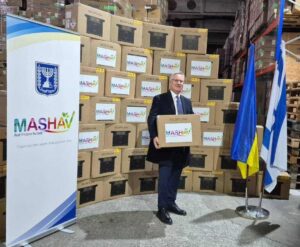
Israel has sent several hundred portable EcoFlow charging stations to Ukraine to help Ukrainians get through the winter and cope with electricity problems, the press service of the Israeli Embassy in Ukraine reported on Thursday.
“The Israeli Embassy in Kyiv and MASHAV (the Center for International Cooperation of the Israeli Foreign Ministry) will hand over portable stations to families in need in different regions of Ukraine,” the embassy’s press service said in a statement. The State of Israel recognized Ukraine’s independence on December 25, 1991. On December 26, 1991, diplomatic relations between Ukraine and the State of Israel were established. In 1993, the Embassy of the State of Israel was opened in Kyiv. Since 2021, Michael Brodsky has been the Ambassador Extraordinary and Plenipotentiary of Israel to Ukraine.

To restore the reclamation system in southern Ukraine, after the destruction of the Kakhovka hydroelectric power station, Israel proposes to focus on the development of wastewater treatment and desalination of sea water
To restore the reclamation system in southern Ukraine, after the destruction of the Kakhovka hydroelectric power station, Israel proposes to focus on the development of wastewater treatment and desalination of sea water. This was announced by Denis Gamzin, designer of the Israeli Water Authority, during the conference “Israeli Water Supply and Agricultural Technologies – Experience for Ukraine” held at the Ukrainian Chamber of Commerce and Industry.
“Israel has turned an environmental threat into a valuable resource. The country, which is located in the desert, reuses about 450 million m3 of treated wastewater, which is half of the water needs of agriculture, and 90% of treated wastewater is used for irrigation. In general, treated wastewater covers 25% of all Israel’s water needs, another 25% is desalinated water and 50% is fresh water,” said Denis Gamzin. According to him, in the next 25 years, the share of treated wastewater in Israel’s agricultural consumption will increase to almost 70%. “Israel is strengthening control over the quality of wastewater treatment and expanding the practice of secondary and tertiary use of treated wastewater,” added Denis Gamzin.
Israel is also actively developing seawater desalination plants. “There are currently three large seawater desalination plants in Israel with a capacity of 400 million m3. In the next 10 years, 4 more plants will be launched, and the processing capacity will increase to 1200 million m3,” said the designer of the Israel Water Authority.
According to Denys Gamzin, Ukraine has a great potential to use treated wastewater and sea water for agricultural purposes, primarily for the needs of agriculture. The large territory allows choosing rational locations for desalination plants, unlike in Israel, where, due to the lack of land, plants are located not near water sources, but where there is free land, sometimes in the center of the country.
Yonatan Tsadka, Director of the Department of Economic Affairs for Asia and Eurasia at the Israeli Ministry of Foreign Affairs, noted that modern water treatment technologies have emerged thanks to Israel’s policy of developing innovations. According to him, Israel is focused on innovative areas, especially in the circumstances in which Israel found itself. “There are national plans that allow the entire population to focus on creating breakthrough technologies that will be very important in the future. One of the driving factors is climate change. In this area, Israel has a certain advantage, and new challenges strengthen our resilience. Now we are facing the issues of migration of foreign workers and changes in supply chains,” said Yonatan Tsadka.
Vitaliy Holovnya, Deputy Minister of Agrarian Policy and Food, noted that the issue of efficient use of water resources and the search for new sources of water for irrigation is important for Ukraine. “This is a topical issue in connection with climate change and the loss of the Kakhovka hydroelectric power plant in terms of irrigation and water supply. Implementation of projects following the example of Israeli ones will help solve food security issues,” said Vitaliy Holovnya.
Gennadiy Chyzhykov, President of the Ukrainian Chamber of Commerce and Industry, noted that Israel has shown one of the best results during the war. “This country’s experience will be very useful for Ukraine,” he said.
Israeli Ambassador to Ukraine Michael Brodsky said that the Watec Israel conference will be held in Jerusalem on September 16-19, 2024. “This is a unique opportunity to see different technologies that have been working in different countries for many years and can be useful for Ukraine,” said Michael Brodsky.
According to the State Agency of Ukraine for the Development of Land Reclamation, Fisheries and Food Programs of Ukraine, the destruction of the Kakhovka HPP left 94% of irrigation systems in Kherson, 74% in Zaporizhzhia and 30% in Dnipropetrovs’k regions without a source of irrigation for a long time. In total, more than 350 irrigation pumping stations and about 1.1 thousand kilometers of reclamation canals cannot be used. (source: https://agronews.ua/news/stalo-vidomo-skilky-znadobytsya-chasu-na-vidnovlennya-systemy-zroshennya/)
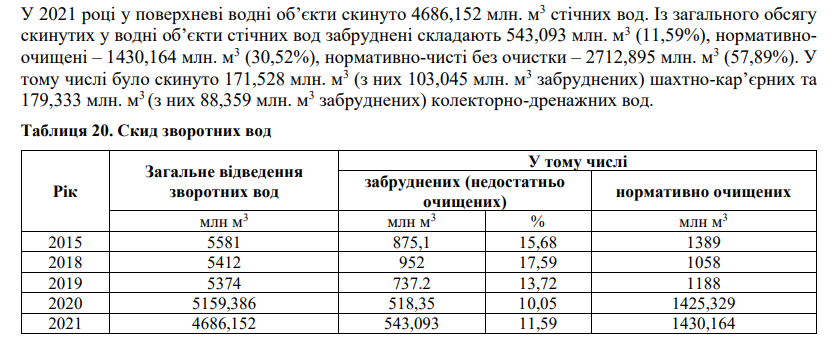
According to the Ministry of Ecology and Natural Resources of Ukraine, in 2021, the volume of discharged wastewater amounted to 4.686 billion m3, of which 58% was normatively clean, 30% normatively treated and 12% polluted. (source: https://eu4waterdata.eu/images/pdf/library/Ukraine_5th_reporting_cycle_UKR_2022_final.pdf)