

Foreign workers, entrepreneurs, and digital nomads legally residing in Portugal can receive government financial support of more than EUR5,000 when relocating to inland areas of the country under the Emprego Interior MAIS program, according to data from the Portuguese Institute for Employment and Vocational Training (IEFP).
The program is available to workers who relocate to specific inland municipalities in Portugal to take a job, move their existing professional activities there, start their own business, or continue working remotely.
The base payment in 2026 is EUR 3,759.91 for workers with permanent employment contracts, as well as for those who create their own job or start a company. For fixed-term employment contracts lasting at least 12 months, the base payment is EUR 2,685.65.
In addition, the government pays 20% of the base amount for each family member moving with the recipient, as well as up to EUR805.70 for the transportation of personal belongings.
For example, an employee with a permanent contract who is relocating with one family member can receive EUR 5,317.59: EUR 3,759.91 in basic assistance, EUR 751.98 in family allowance, and EUR 805.70 for moving expenses. Therefore, the actual amount of assistance may exceed 5,000 EUR, and for larger families, it may be even higher.
EU citizens, citizens of the European Economic Area, and Swiss citizens, as well as third-country nationals legally residing in Portugal, are eligible for this assistance. The IEFP specifically notes that the program also applies to foreigners with temporary protection status. Thus, provided they meet the other conditions, Ukrainians residing in Portugal with the appropriate legal status may also take advantage of the program.
To receive support, you must relocate your permanent residence to an inland region of Portugal for at least 12 months. If you are starting a new job, the move must take place within 180 days before or after you begin working or start your own business. The salary under an employment contract must not be lower than the national minimum wage.
If the contract is for a fixed term, its duration must be at least 12 months. The program also allows applicants to open a small company with up to 10 employees or to create their own job. If the applicant establishes a commercial company, they must own more than 50% of its capital and voting rights.
A separate category is provided for foreign digital nomads. Foreign nationals who legally reside in Portugal, work remotely for an employer or client outside the country, and relocate to an inland region are eligible for assistance. For them, professional activities must have begun after January 1, 2022, and their income must be at least equal to Portugal’s minimum wage.
Payment is made in two stages. The first 60% of the approved amount is transferred after the application is accepted and the required documents are submitted; the remaining 40% is paid in the 13th month after starting work, establishing a business, or relocating the workplace.
Applications are submitted through the government portal iefponline. As of August 2026, the application period is open and will continue until the program’s funding is exhausted. The application must be submitted no later than 180 days after the start of the employment contract, the establishment of a business, or the relocation of the workplace.
The Emprego Interior MAIS program is part of Portugal’s policy to attract workers and entrepreneurs to the country’s inland regions, which are facing population outflow and labor shortages. It does not automatically apply to any move to Portugal—the new place of residence and, depending on the situation, the place of work must be located within a municipality or parish included by the IEFP in the list of inland areas.
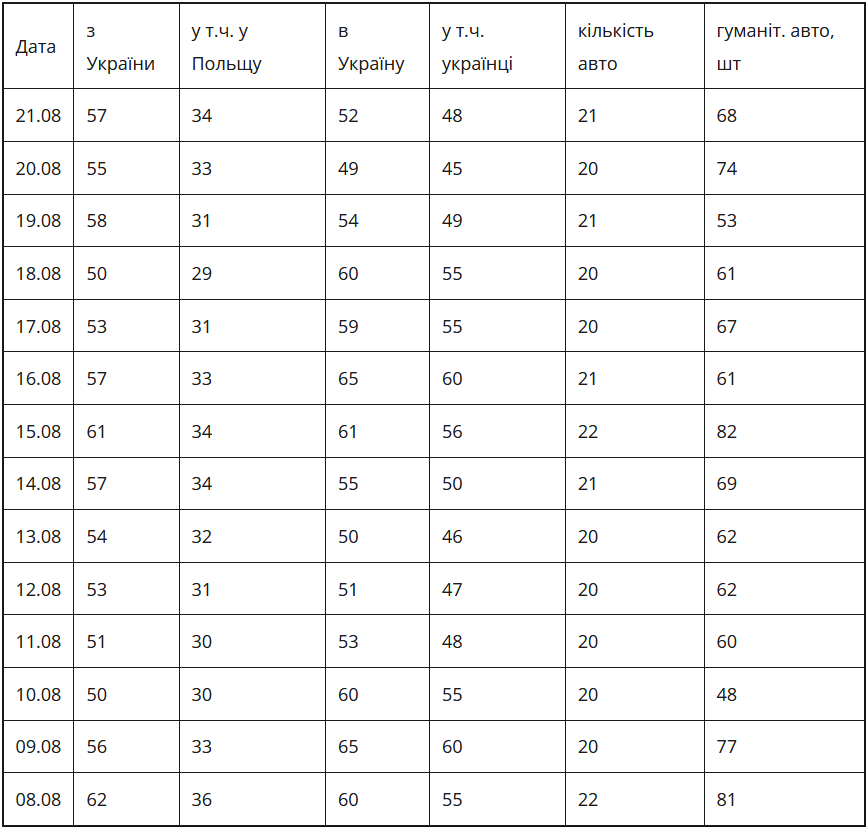
Passenger traffic across Ukraine’s western border during the week of August 15–21 increased by 1.8%—to 791,000 — a record high since the start of Russia’s full-scale aggression, excluding the first few days of the conflict, according to daily statistics from the State Border Guard Service monitored by the Interfax-Ukraine news agency.
The previous record was set in mid-August 2025 at 778,000, but last year during this same week, passenger traffic had already begun to gradually decline.
According to data from the State Border Guard Service, the number of outbound border crossings this week increased to 391,000 from 383,000 the week before, while inbound crossings rose to 400,000 from 394,000.
The number of vehicles passing through checkpoints also increased slightly—to 145,000 from 143,000 last week—as did the number of vehicles carrying humanitarian cargo—to 466 from 459—but these figures are not record-breaking.
The heaviest outbound traffic was recorded on Saturday (61,000 per day), and the heaviest inbound traffic on Sunday (65,000), while the lightest outbound traffic was on Tuesday (50,000), and the lightest inbound traffic on Thursday (45,000).
According to the State Border Guard Service, as of 9:00 p.m. on Saturday, the largest number of passenger cars were waiting to cross the border with Poland at the “Krakovets” border crossing point (BCP)—100, “Ustyluh”—60, and “Shehyni”—50. Shorter lines were observed at the “Hrushev” checkpoint (40 vehicles), the “Nyzhankovychi” checkpoint (20), and the “Rava-Ruska” checkpoint (15).
In addition, 15 buses had accumulated at the “Krakovets” checkpoint, 5 at the “Smelnitsa” checkpoint, and 90 pedestrians were also waiting in line at the “Shehyni” checkpoint, which is very rare.
At the border with Slovakia, there was a line of 25 vehicles at the “Maly Berezny” border crossing point and 10 at the “Uzhhorod” border crossing point.
At the border with Hungary, 30 passenger cars were waiting to cross at the “Luzhanka” checkpoint, 25 at the “Tisa” checkpoint, and another 20 at the “Vylok” checkpoint.
At the border with Romania, 20 vehicles had accumulated at the “Dyakivtsi” checkpoint and another 10 at the “Porubne” checkpoint.
Last year, passenger traffic across the border this week had already decreased by 1.3% compared to the peak figure—to 768,000—with outbound traffic exceeding inbound traffic by 2,000.
It remained at this level during the last week of August but then dropped sharply in the first half of September with the start of the new school year.
As reported, starting May 10, 2022, the outflow of refugees from Ukraine—which began with the start of the war—turned into an inflow that lasted until September 23, 2022, totaling 409,000 people. However, starting in late September—possibly influenced by news of mobilization in Russia and “pseudo-referendums” in the occupied territories, followed by massive shelling of energy infrastructure—the number of people leaving exceeded the number of those entering. In total, from the end of September 2022 until the first anniversary of the full-scale war, this figure reached 223,000 people.
In the second year of the full-scale war, the number of border crossings for departure from Ukraine, according to the State Border Guard Service, exceeded the number of crossings for entry by 25,000; in the third year—by 187,000; in the fourth year—by 221,000; and by 77,000 since the start of the fifth year—64,000 of which occurred since the beginning of summer.
In its July inflation report, the National Bank maintained its estimate of last year’s migration from Ukraine at 0.3 million people due to the deterioration of the security situation at the end of the year and the easing of exit rules for young people, but noted that in 2024 this figure will be less than 0.5 million. The NBU continues to forecast a net outflow of 0.2 million in 2026,
while net returns, according to its forecast, will begin in 2027 and amount to about 0.1 million people, increasing to 0.5 million people in 2028.
According to UNHCR data, the number of Ukrainian refugees in Europe as of June 30, 2026, stood at 5.159 million, and globally at 5.687 million, compared to 5.213 million and 5.687 million, respectively, as of April 30.
In Ukraine itself, according to the latest UN data for July 2026, there are 3.80 million internally displaced persons (IDPs), compared to 3.70 million in January of this year and 3.34 million in July 2025.
Crossings at Ukraine’s western border, in thousands:
BORDER, MIGRATION, PASSENGER TRAFFIC, State Border Guard Service of Ukraine, UKRAINE

Poland’s Deputy Minister of the Interior, Maciej Duszkiewicz, highlighted the contribution of Ukrainians to the functioning of the Polish economy. He made this statement during an appearance on Polsat News.
Polsat News reports that Duszczyk believes that in many cases, the absence of Ukrainians is noticeable. “If it weren’t for Ukrainian citizens, we’d be waiting 10 minutes for the bus instead of five. After all, they fill the gaps in the Polish labor market. That’s why a certain part of the Polish economy depends on refugees from Ukraine. Generally speaking, these are Ukrainians living in Poland, and we need to reiterate this more and more often, because if a situation were to arise where one day all Ukrainians united and refused to go to work, the Polish economy would grind to a halt,” he said.
He also criticized the Law and Justice (PiS) party’s proposal to deport unemployed men of draft age from Ukraine. In this context, the figure of 3,000 people has been mentioned in public discussions. “Three thousand is a small group. Let me remind you that 900,000 people have been mobilized in Ukraine, so this is no help at all. In fact, those who aren’t working in Poland are either caring for their disabled children or are people who were wounded on the front lines and are undergoing rehabilitation in Poland,” he said.
When asked whether refugees will begin returning to Ukraine once the war ends, Dushchyk replied that “this is a process we’ve observed in other countries, and it’s very easy to predict.”
“Sometimes, those who say, ‘I’m staying,’ end up leaving because something happens. And those who say, ‘I’ll leave as soon as the war ends,’ end up staying. Of course, these trends change with each passing month, as the roots they put down in the host society—in this case, Polish society—grow deeper and deeper. “If someone has enrolled their children in school, they’re learning Polish; if a person is working in the labor market, the likelihood that they’ll return to Ukraine without a strong incentive to do so is practically very low,” he noted.

As of August 5, the European Union has changed the conditions for granting temporary protection to certain Ukrainian citizens subject to military service. New applicants will be required to confirm that they have complied with the requirements of Ukrainian law, have been exempted from military service, or have legally left the territory of Ukraine.
The relevant provisions are contained in EU Council Implementing Decision No. 2026/1912, adopted on July 30 and published in the Official Journal of the European Union on August 4, 2026. The decision entered into force the day after its publication.
The new restriction applies only to individuals who apply for temporary protection after the decision enters into force. Ukrainians who have already been granted this status in an EU country retain their rights, and the new rules do not apply to them.
To obtain temporary protection, a new applicant must confirm compliance with their military obligations in Ukraine. Evidence may include a passport with a stamp confirming lawful departure from the country, or a paper or electronic document confirming exemption from service or the fulfillment of relevant obligations. The decision will depend on the availability of documents confirming the legality of departure and the applicant’s status under Ukrainian law.
At the same time, the Council of the EU has extended temporary protection for Ukrainian citizens for another year—until March 4, 2028. Previously, the program was set to expire on March 4, 2027.
The Council of the EU explained that the new condition was introduced to simultaneously ensure protection for displaced persons and address Ukraine’s defense needs. EU member states agreed that, going forward, temporary protection should be granted only to new applicants who are fulfilling their military obligations in Ukraine.
Temporary protection grants Ukrainians the right to reside in EU countries, as well as access to the labor market, medical care, social security, housing, and education for their children.
According to the Council of the EU, as of the end of May 2026, approximately 4.38 million people who had left Ukraine after the start of the full-scale war were benefiting from temporary protection in the European Union.

Dmytro Lubinets, the Verkhovna Rada Commissioner for Human Rights, reported that 8.4 million Ukrainian citizens are currently abroad.
“More than 8.4 million of our citizens are currently outside Ukraine. It is our duty to ensure that each of them knows: Ukraine remembers them and is ready to protect their rights,” Lubinets wrote on Telegram on Tuesday.

Net migration to Germany fell to 235,000 people in 2025, compared with 663,000 in 2023, according to a study by the German Economic Institute (IW) published on July 28, 2026. Excluding the pandemic period, this is the lowest figure since 2010. Experts at the Experts Club Information and Analytical Center attribute the decline to several factors: a decrease in the number of refugees, the departure of workers from Central and Eastern European countries, a decline in migration from the Western Balkans, and an increase in emigration by German citizens themselves.
The largest net inflow from a single country in 2025 came from Ukrainian citizens, amounting to 89,000 people. A year earlier, the figure was 116,000. Ukrainians have a special status because they are admitted to Germany mainly under the EU’s temporary protection mechanism rather than through the standard asylum procedure. Further developments will depend primarily on the course of the war and the conditions of Ukrainians’ stay in Germany.
By the end of 2025, approximately 1.41 million Ukrainian citizens were listed in Germany’s Central Register of Foreigners. They became the second-largest foreign group after Turkish citizens.
The number of initial asylum applications fell from 329,000 in 2023 to 113,000 in 2025.
The inflow from Syria declined particularly sharply: the number of initial applications fell from 103,000 to 23,000. Over the same period, the number of applicants from Afghanistan decreased from 51,000 to 24,000, while the number from Turkey fell from 61,000 to 12,000.
At the end of 2025, the largest groups of people registered in Germany as being in need of protection remained citizens of Ukraine, at approximately 1.164 million; Syria, at 669,000; and Afghanistan, at 321,000.
IW links the decline in Syrian migration primarily to the change in the situation in Syria following the fall of Bashar al-Assad’s regime in 2024, as well as to the tightening of German and EU migration policies.
Another important change was the reversal of migration from the new EU member states.
In 2023, Germany recorded a net inflow of approximately 42,000 citizens from these countries. In 2024, 35,000 more people left Germany than arrived, while in 2025 the net outflow reached 45,000 people.
This group includes, in particular, citizens of Poland, Romania, Bulgaria, Serbia, Hungary, Croatia, and other countries that joined the EU from 2004 onward. Economists explain migrants’ return by the narrowing gap in wages and living standards, growing demand for workers in their own countries, and the overall ageing of the population of Central and Eastern Europe.
At the end of 2025, approximately 904,000 Romanian citizens and 840,000 Polish citizens were registered in Germany. Over the year, the number of Polish citizens declined by approximately 25,000, while the total number of EU citizens fell by 75,000.
In recent years, citizens of Albania, Bosnia and Herzegovina, Kosovo, Montenegro, North Macedonia, and Serbia have been actively recruited into the German labour market, including under special rules for the Western Balkans. However, their net migration has been steadily declining since 2022. In 2025, it amounted to approximately 39,000 people. IW warns that the potential for further recruitment of workers from the Balkans is also limited: the populations of most countries in the region are shrinking, while their own labour markets are facing staff shortages.
Against the backdrop of the overall decline, there are also opposing trends. Net migration of Vietnamese citizens increased from 10,000 people in 2023 to 19,000 in 2025.
At the same time, the number of residence permits issued to citizens of non-European countries for employment purposes increased by 33,000, or 13.6%, between 2023 and 2025. The number of permits related to education also rose by 33,000, or 15.3%. Thus, the inflow of students and skilled workers is currently declining significantly more slowly than humanitarian and intra-European migration.
The net outflow of German citizens increased from 74,000 people in 2023 to 97,000 in 2025. IW notes that negative migration among German citizens occurs regularly. However, growth of approximately 30% over two years may be an alarming signal, especially if qualified specialists are leaving the country.
At the same time, part of the statistics may relate to previously naturalised migrants who return to their countries of origin after obtaining German citizenship. It is difficult to assess the structure of this outflow precisely because the final destination country is not recorded for many of those leaving.
According to the Central Register of Foreigners, approximately 14.07 million foreign nationals were living in Germany at the end of 2025.
The largest groups were:
Approximately 5 million foreigners, or 35%, were citizens of EU member states. Another 4.6 million held the citizenship of other European countries, while approximately 4.5 million represented countries in Asia, Africa, the Americas, and other regions.
If not only foreign citizens but also migrants who obtained German citizenship and their direct descendants are taken into account, Germany had approximately 21.8 million people with an immigration history in 2025, representing 26.3% of the population. The largest groups by country of birth were people from Poland and Turkey, at approximately 1.5 million each; Ukraine, at 1.3 million; and Russia and Syria, at approximately 1 million each.
The decline in migration is occurring simultaneously with the mass retirement of the baby-boomer generation. According to a separate IW forecast, by 2036 the gap between older workers leaving the labour market and young people reaching working age could reach 4.3 million people. Economists consider a return to a mass inflow of workers from Eastern Europe unlikely. Germany will have to recruit specialists and workers with medium and lower levels of formal qualifications more actively from Asia, Africa, Latin America, and other regions.
IW proposes accelerating visa procedures, reducing the tax and social burden on workers, and extending simplified labour migration mechanisms similar to the existing rules for the Western Balkans to new countries. Thus, this is not about the complete cessation of migration but about a change in its structure. Germany is receiving fewer refugees and workers from neighbouring European countries, while the economy’s need for foreign labour continues to grow because of the ageing population.



