

More than half of all notaries in Ukraine are concentrated in Kyiv and the country’s four largest regions, according to an Experts Club analysis based on data from the Unified Register of Notaries.
As of the end of August 2026, there were 6,156 notaries in Ukraine. Of these, 3,162, or about 51.4%, were registered only in Kyiv and the Kharkiv, Dnipropetrovsk, Lviv and Odesa regions.
Kyiv remains the absolute leader, with 1,365 notaries. Thus, the capital accounts for more than 22% of all specialists in the country, meaning that in practice every fifth Ukrainian notary is based there.
There are 460 notaries registered in the Kharkiv region, 457 in the Dnipropetrovsk region, 449 in the Lviv region, and 431 in the Odesa region.
According to Experts Club, this structure reflects the high concentration of demand for notarial services in the country’s largest economic and business centers, where real estate transactions, corporate deals, inheritance cases and other legally significant transactions are concentrated.
At the same time, the highest growth rates over the past year were recorded not in major centers, but in frontline regions with a low comparison base.
In the Luhansk region, the number of notaries increased from 4 to 22, or 5.5 times. In the Kherson region, it rose from 33 to 84, or 2.5 times. In the Donetsk region, the figure increased from 48 to 63, and in the Zaporizhzhia region, from 114 to 147.
One of the reasons for this dynamic was changes to the rules governing the work of private notaries. Since June 2025, specialists whose workplaces are located in territories of possible or active hostilities have been allowed to change the address of their workplace within their region while retaining the notarial district specified in their registration certificate.
Thus, the formal increase in the number of notaries in frontline regions partly reflects not the emergence of new demand, but the adaptation of professional infrastructure to wartime conditions and the relocation of specialists.
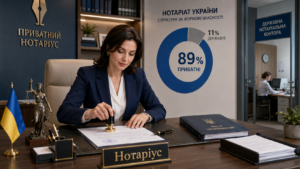
Ukraine continues to see a structural shift of notarial services toward the private sector: as of the end of August 2026, 5,484 out of 6,156 notaries included in the Unified Register of Notaries were working privately.
Thus, the share of private notaries reached about 89%, or almost nine out of ten professionals, according to an Experts Club analysis based on Opendatabot data.
There were 652 notaries working in state notary offices, accounting for about 10.6% of the total number, while another 20 professionals worked in state notarial archives.
Over the past year, the number of private notaries increased by 345 people. At the same time, the number of notaries in state institutions decreased by 34.
As a result, the entire net increase in the register was provided by the private sector. The total number of notaries increased by 311 people over the year, or by approximately 5%, to 6,156.
According to Experts Club, this dynamic indicates a further shift of the Ukrainian notarial services market toward the private model. The state segment is gradually shrinking both in absolute terms and as a share of the total number of professionals.
At the same time, the increase in the register does not mean a similar influx of new personnel. Of the total increase, only 40 notaries were new, while the majority were professionals who renewed their certificates. Another 104 notaries stopped working during the year.
A notable feature of the profession remains the significant predominance of women: they account for 82% of all notaries in Ukraine. Over the year, the number of women in the register increased by 250, while the number of men increased by 61.
Source: Opendatabot, data from the Unified Register of Notaries as of the end of August 2026.

Greece is gradually introducing new rules designed to speed up the sale, gifting, and inheritance of real estate, as well as to reduce the number of documents that owners must obtain on their own from government agencies. Some of the provisions are already in effect, while the full implementation of the rest will require additional decisions by government agencies.
One of the key innovations will be the “single window” principle. Notaries will independently obtain, through government digital systems, tax and insurance certificates, electronic property passports, cadastral extracts, and documents required for filing tax returns. This should reduce the number of times sellers and buyers need to contact various government agencies.
However, the “single window” system is not yet fully operational. The date of its practical launch, technical specifications, and the list of available operations must be determined by a joint decision of the relevant ministries.
The law also eliminates the requirement to attach a topographic plan to contracts for properties located in areas where cadastral surveying has already been completed. This provision takes effect upon the law’s publication.
Heirs are permitted to pay inheritance, gift, or property transfer tax on assets received from their parents directly from the proceeds of the property’s sale. Previously, the requirement to pay the tax before the transaction was finalized could force owners to seek additional financing or renounce the inheritance. Between 2013 and 2019, approximately 180,000 renunciations of inherited property were registered in the country.
Certain changes pertain to real estate seized for tax debts. Following the adoption of a supplementary resolution by the Independent State Revenue Service, notaries will be able to conduct the sale of such properties, withholding a portion of the proceeds to settle the debt. Once the specified amount is transferred, the tax lien will be lifted.
In addition, the state will restrict the assertion of rights to private land plots when correcting initial entries in the National Cadastre. Specifically, claims may not be asserted against certain properties whose ownership is confirmed by old purchase agreements, government land allocation deeds, or documents granting plots to resettlers and farmers.
The reform may make the Greek real estate market more accessible to foreign buyers, as it reduces the administrative burden and lowers the risk of transaction delays due to the lack of certain certificates. However, investors should note that some of the measures are being introduced gradually, and verification of a property’s legal status and cadastral records remains mandatory.

Women predominate in the profession, but men have more work
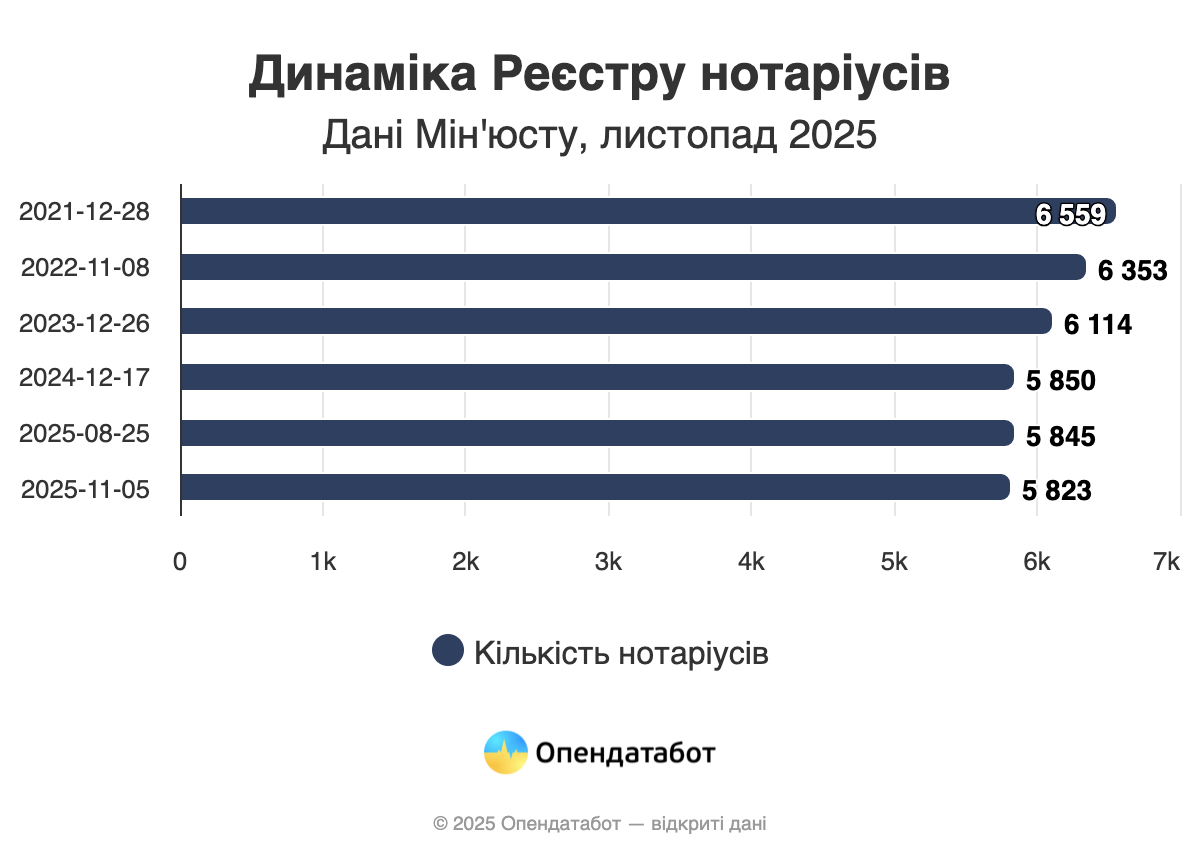
According to the Ministry of Justice of Ukraine, more than 5,800 active notaries are currently listed in the Register. The number of notaries has decreased by 11% since the start of the full-scale war. 82% of notaries in the Register are women, but men have a heavier workload. A notary from Lviv region used a record 24,600 forms this year. 63 practicing notaries have been working for over 29 years. One in five Ukrainian notaries works in Kyiv.
There are currently 5,823 practicing notaries listed in the Register of Notaries. Since the start of the full-scale war, the number of notaries has decreased by 11%. At the same time, 63 practicing notaries have been working for over 29 years — since 1996.
It should be noted that the Register is constantly updated: some specialists are added, some are removed. You can find, check, and select a notary on the Notary Register page in OpenDataBot. In addition, for each specialist, you can check the number and validity of their license, as well as see their workload — based on the number of notarial forms used year after year.
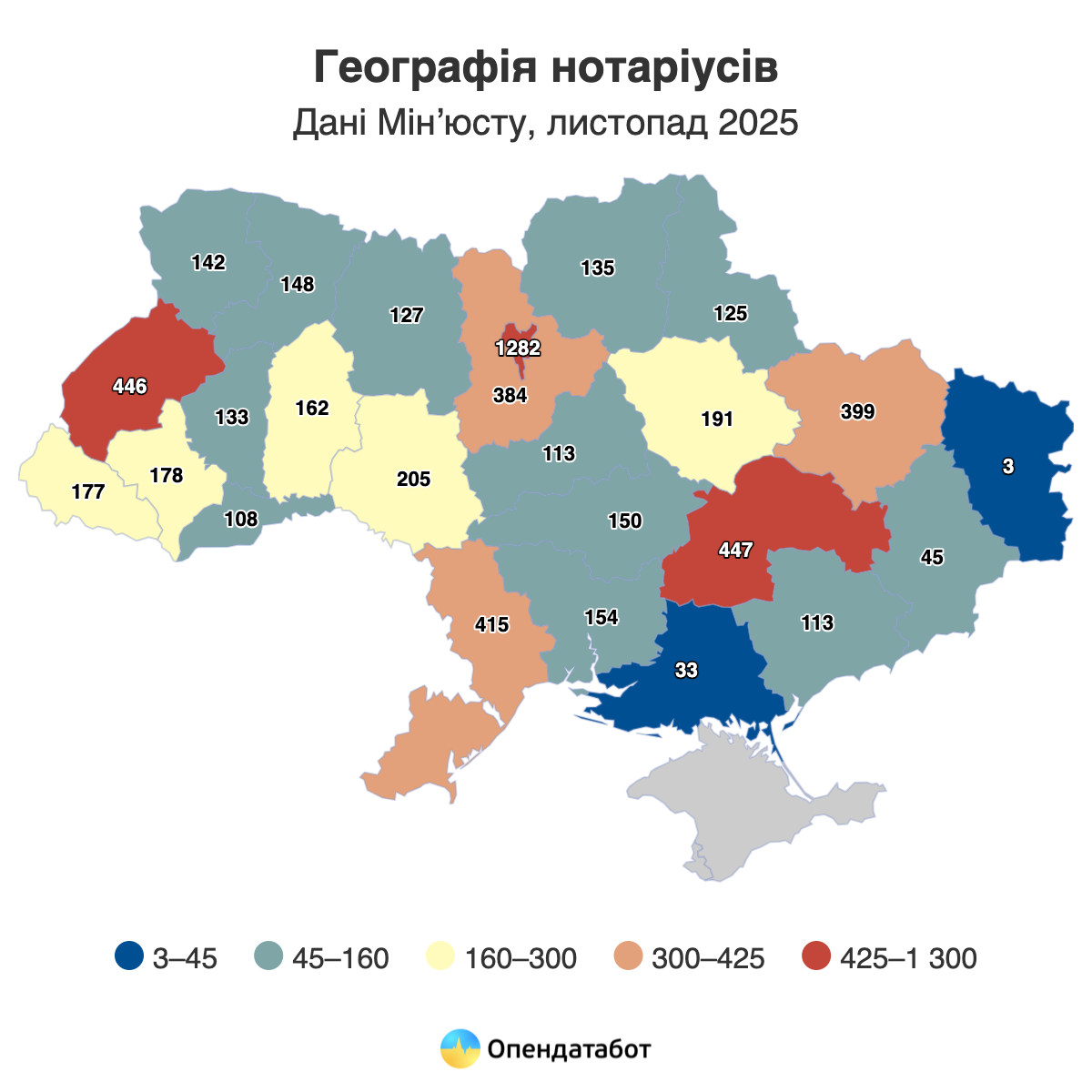
The highest concentration of notaries is traditionally in the capital — 1,282, meaning that one in five Ukrainian notaries works in Kyiv. This is followed by Dnipropetrovsk and Lviv regions — 447 and 446 respectively, as well as Odesa (415) and Kharkiv (399) regions.
Women significantly dominate the profession, accounting for 82% of practitioners. At the same time, men have more work: 702 notarial forms per year for women versus 992 for men. On average, one notary uses more than 60 forms per month.
The busiest specialists are in the Cherkasy region, where one notary uses 1,287 forms per year. High figures are also seen in the Zhytomyr and Khmelnytsky regions — 1,054 each, in Vinnytsia — 1,043, and in Ivano-Frankivsk — 959.
This year’s absolute record belongs to a notary from Lviv region, who used 24,606 forms this year — that is, about 78 forms per day, working without days off. This is a record for the entire country.
https://opendatabot.ua/analytics/notary-2025-11

The Cabinet of Ministers of Ukraine has approved the form and the rules for presenting reports on the signed real estate sale and purchase contracts and payment of obligatory pension insurance tax by notaries. “Notaries quarterly, until the 20th day of the month following the reporting quarter, are required to submit a report on the signed immovable property sale and purchase contracts and payment of the compulsory pension insurance tax to the Pension Fund authorities at the location of the notary public office or private notary’s workplace using the approved form,” the press service of the Ministry of Social Policy said, citing a government decision.
According to the decision, real estate purchase and sale contracts are endorsed by notaries with documentary evidence of the payment of the levy on transactions on purchase and sale of real estate.
When endorsing sales contracts, a notary shall verify the payment of the fee by the buyer and demand the respective documents.
“The form of the report on the signed immovable property sale and purchase contracts contains information on the number of concluded real estate purchase and sale contract, the value of the property and the amount of the compulsory pension insurance tax paid,” the press service said. The implementation of the resolution makes it possible to improve control over the payment of the tax and ensure the completeness of revenues sent to the national budget



