

As of late September–early October, agricultural exports from Ukraine—amid Russia’s ongoing blockade of Black Sea ports—amount to up to 50% of the potential volume, Minister of Agrarian Policy and Food Taras Vysotsky told reporters on Friday.
“Without access to deep-water Black Sea ports, we can export about half of our produce—the portion that has been grown and is intended for export. When we talk about the consequences, this means we are unable to export approximately 30 million metric tons of agricultural products worth about $30 billion during the current marketing year,” he noted.
The minister clarified that in September, 2.4 million metric tons were exported—46% of what was supposed to be exported—including 1.4 million metric tons of grains (38%), 444,000 metric tons of oilseeds (83%), oil—311,000 metric tons, or 64%, and meal—280,000 metric tons, or 46% of the potential required exports.
“This 46% figure has, in fact, remained unchanged since September 20. In other words, we are achieving what we predicted: that 45–50% is the objective maximum given the current logistics channels,” Vysotsky concluded.
According to him, 41%—or 993,000 metric tons—was exported by rail, which is in line with forecasts; 54%—or 1.3 million metric tons—via the Danube; and 5%—or 120,000 metric tons—by road.
“In September, we saw an increase in both rail and Danube shipments compared to August,” the minister added.
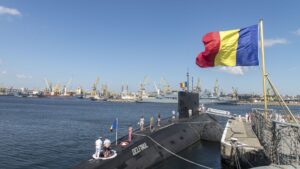
The Romanian Navy has begun testing the new Black Talon drone countermeasure system at the military port of Constanța on the Black Sea. The system, developed as part of a long-standing collaboration with the U.S. Navy, is scheduled to enter operational service by the end of October 2026.
Black Talon is designed to detect, track, and monitor unmanned aerial vehicles near critical port infrastructure. According to the Romanian military, the system includes a high-performance 3D radar, electro-optical equipment, and passive electromagnetic radiation detection devices. The system provides a 360-degree field of view and can target detected objects.
The threat detection radius is approximately 10 km. One of the primary countermeasures is electronic jamming—Black Talon is capable of disrupting the communication channel between a drone and its operator, allowing the threat to be neutralized without necessarily destroying the drone physically.
Currently, Romanian military personnel are undergoing training to operate the new equipment. Following Constanta, plans are in place to equip the military ports of Mangalia, Tulcea, and Braila with similar systems. The U.S. side is to provide three more systems. Thus, protection will cover Romania’s military ports on both the Black Sea and the Danube, particularly near the Ukrainian border.
At the same time, the Romanian Navy is preparing to deploy the Sentinel system to monitor threats from the sea and underwater. It will use sonar capable of detecting unmanned underwater vehicles, combat divers, and mini-submarines. According to Navy officials, Black Talon and Sentinel can be integrated to form a comprehensive surveillance system covering the air, surface, and underwater spaces around the military ports.
The commander of the Constanta military port, Rear Admiral Ciprian Mandaki, announced on September 16 that the program has been implemented jointly with the U.S. Navy for several years and has now entered the operational phase. Black Talon is primarily intended to protect critical military infrastructure from aerial drones.
The強化 of security in Constanța follows a serious incident on June 5, 2026, when a maritime drone was detected in the civilian section of the port, near Pier No. 78. At approximately 10:30 a.m., the drone self-detonated. There were no casualties, as the area had already been cordoned off by Romanian intelligence services, the coast guard, and the military. The Romanian Ministry of Defense officially reported that the drone did not belong to the Romanian military and was of a type used in the war in Ukraine. The investigation into the incident was handed over to the prosecutor’s office.
Following this incident, Romanian authorities ordered the acceleration of measures to protect port infrastructure. At the same time, the Black Talon program itself had been launched earlier and was being developed as part of Romania’s cooperation with the United States in the field of maritime security.
For Ukraine, the strengthening of security at Romanian ports is of particular importance due to the proximity of Constanța and the Danube ports to the Ukrainian border and their role in the region’s Black Sea and Danube transportation infrastructure.

Ukraine’s agricultural exports in August 2026 are expected to total approximately 1.33 million metric tons, which is 54% less than in July and could mark the lowest August figure since the full-scale war began, according to brokerage firm Spike Brokers.
“Expected August exports will be 68% lower than the average August export volume for 2022–2025—4.19 million metric tons—and 64% lower than the previous August low during the full-scale war—3.71 million metric tons in 2025,” the company noted.
According to the brokers, 641,900 metric tons of agricultural products were exported via all modes of transport in the first half of August, compared to 2.889 million metric tons for the entire month of July.
The share of maritime transport in total exports fell from 86.5% in July to 51.4% in the first 15 days of August, while the share of rail transport rose from 11.2% to 38.5%.
At the same time, the increase in the share of rail transport does not indicate a resumption of grain shipments: grain exports by rail fell by 68% compared to July and by 77% compared to the same period last year.
So far in August, 250,000 metric tons have been shipped by rail through western border crossings, which is 126% more than in the corresponding period of July, while shipments to the ports of Greater Odesa totaled only 53,200 metric tons—a decrease of 94.5%.
“The increase in land-based shipments offset only about 15% of the loss in seaport traffic; even when combined with the increase in exports via Izmail, the offset does not exceed 19%,” the report states.
The volume of grain railcars transported through western border crossings during the first 18 days of August increased 2.3-fold—to 160.6 railcars per day, compared to 71.3 railcars in July. The Romanian route had the highest volume—49.1 cars per day, followed by Poland—47.9 cars, Slovakia—34.8 cars, and Hungary—28.8 cars.
As of August 19, there were 9,524 thousand railcars en route to the border, which is 21% more than at the end of July; specifically, the number of grain railcars rose to 979 from 369.
The Izmail route is also increasing its shipments, but cannot compensate for the loss of maritime exports: grain exports via Izmail rose from 10 thousand to 38.8 thousand metric tons, while shipments to the ports of Greater Odesa fell by more than 0.9 million metric tons.
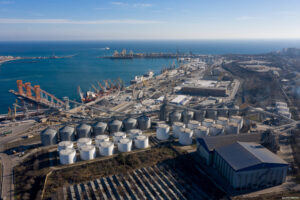
From August 1–13, Ukraine exported 790,700 metric tons of agricultural products, compared to 1.849 million metric tons during the same period in July—a decrease of 57.2%, according to the brokerage firm Spike Brokers.
According to the firm, the value of exports fell by 37.3% to $478.8 million, compared to $763.8 million during the corresponding period in July.
“The main factor limiting August’s pace is concentrated in the grain segment. At the same time, the geography of logistics is changing: the flow through seaports is significantly lower than in July, while road crossings and western rail corridors are operating at a higher intensity,” the report notes.
From August 1–13, 130,100 metric tons of agricultural products were exported via road border crossings, compared to 119,500 metric tons during the corresponding 13 days in July—an increase of 8.9%. Exports via Hungary saw the largest increase—32.9%—followed by Slovakia (28%), Romania (14.1%), and Poland (3.7%). The flow through Moldova was close to July’s level, declining by approximately 1.9%.
At the same time, as of August 12, 435,800 metric tons of grain cargo had been transported by rail, which is 46.9% less than during the corresponding period in July and 52.1% less than in August 2025. The average daily load for the first 11 days of August was 31.3 thousand metric tons—38% lower than in July and 49% less than a year ago.
The export component of grain rail shipments fell by 72% compared to July, to 201.7 thousand metric tons. Of this volume, 63% passed through border crossings, and 29% went through the ports of Odesa. During the reporting period, only 75,200 metric tons of grain were transported through the ports of Odesa, compared to 656,400 metric tons during the corresponding period in July (-88.5%).
At the same time, the average daily throughput of grain railcars through western border crossings during the first 11 days of August rose to 139.6 railcars, compared to 71.3 railcars in July—an increase of 96%.
According to Spike Brokers, the main growth came from the Romanian and Polish routes—up to 44.7 and 44.4 railcars per day, respectively. Transit to Slovakia increased to 26.9 railcars per day, while transit to Hungary decreased to 23.6 railcars.
As of August 12, there were 8,718 thousand railcars at border crossings, compared to 7,858 thousand previously. In particular, the number of grain cars rose from 369 to 693, or by 87.8%.
Railway exports of vegetable oil totaled 41.5 thousand metric tons, which is 0.9% more than the corresponding July figure, with 89% of the volume passing through land border crossings.
Spike Brokers notes that the sea-rail corridor remains the weakest link in the current logistics chain. As of August 13, the average daily unloading rate bound for the ports of Greater Odesa had dropped to 146 railcars, while 262 grain cars were en route to the ports. There were 1.32 thousand grain cars heading toward the Danube ports.

Railway grain shipments to the ports of Greater Odesa during the first five days of August fell by 84.3% compared to the same period in July—to 40.8 thousand metric tons, according to the brokerage firm Spike Brokers.
According to its data, the total volume of agricultural exports from Ukraine for August 1–6 amounted to 312,900 metric tons, compared to 784,500 metric tons for the same period in July, a decrease of 60.1%. At the same time, export revenue decreased by 38.4%—to $201.5 million from $326.9 million.
The sharpest decline was seen in grains: wheat exports for the first six days of August totaled 93.2 thousand metric tons, compared to 294.9 thousand metric tons in early July, while corn exports totaled 33.5 thousand metric tons, compared to 293.7 thousand metric tons, respectively.
At the same time, a seasonal flow of rapeseed totaling 27,900 metric tons appeared in the structure of August exports, while shipments of soybean meal rose to 25,700 metric tons from 18,600 metric tons during the corresponding period in July. Sunflower oil exports fell to 30.7 thousand metric tons from 52.1 thousand metric tons.
During the first five days of August, a total of 182 thousand metric tons of grain and milled products were transported by rail, which is 44.1% less than during the same period in July.
“Data from Ukrainian Railways (UZ) for the first five days of the month show a sharp decline in rail grain shipments to seaports, while land-based rail crossings and road exports are operating at a relatively higher level,” the report states.
As for overland logistics channels, from August 1–6, 59,600 metric tons of agricultural products were exported through road border crossings, compared to 53,600 metric tons during the same period in July (an increase of 11.3%).
According to Spike Brokers, the average daily throughput of grain and meal shipments through border crossings during the first five days of August was 142 railcars, compared to 139 railcars in July.
Volumes increased the most on the Romanian route—to 31.2 railcars per day, or 29.3 railcars more than in July. Poland increased its shipments to 27.4 railcars per day (+13.8). In contrast, Hungary reduced this figure to 23 railcars per day (-15.9), and Slovakia to 14.2 railcars per day (-2.7). The backlog of grain railcars heading toward the border rose from 369 to 521 railcars, or by 41.2%.
“In contrast to the slower overall pace of agricultural exports, the road transport channel began August with greater activity than in July. However, its absolute capacity remains insufficient to compensate for the reduction in large-tonnage grain flows through seaports,” the report states.
An increase in activity was also recorded on the Danube route: the number of grain cars in transit rose to 1,296 (+155), and the average daily unloading rate increased to 157 cars (+106).
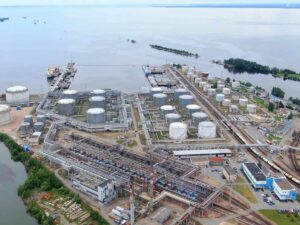
PJSC “Zaporizhkox,” one of Ukraine’s largest producers of coke and coke-chemical products and a member of the Metinvest Group, reduced its blast furnace coke production by 2.97% in January–July of this year compared to the same period last year, down to 497,750 metric tons.
According to the company, 63.4 thousand metric tons of coke were produced in July, compared to 74.9 thousand metric tons the previous month and 78.9 thousand metric tons in July 2025.
“Among the main factors that contributed to the decline in production volumes in July 2026 compared to the same period in 2025 were a decrease in coal concentrate shipments due to the blockade of Ukrainian Black Sea ports caused by the aggressor country’s constant attacks on international merchant vessels, particularly those carrying raw materials for the Ukrainian metallurgical industry,” the press release explains.
As previously reported, in 2025, “Zaporizhkox” increased its output by 2.7% compared to 2024—to 898,300 metric tons, while in 2024, output rose by 2.1% to 874,700 metric tons from 856,800 metric tons in 2023.
“Zaporizhkox” operates a full technological cycle for the processing of coke-chemical products.
Metinvest is a vertically integrated mining and metallurgical group of companies. Its major shareholders are the SCM Group (71.24%) and Smart Holding (23.76%). Metinvest Holding LLC is the management company of the Metinvest Group.



