

As of August 25, Ukrainian farmers had threshed 6.76 million hectares, or 58% of the projected area, and harvested 31.73 million metric tons of grain from the new crop, according to the press service of the Ministry of Agrarian Policy and Food.
Wheat was harvested from 5 million hectares, yielding 24.61 million metric tons, with an average yield of 49.2 centners per hectare; barley was harvested from 1.46 million hectares, yielding 6.33 million metric tons, with an average yield of 43.4 centners per hectare. Peas were harvested from 297,000 hectares, yielding 786,900 metric tons, with a yield of 26.5 ts/ha.
Farmers in the Odesa, Kirovohrad, and Dnipropetrovsk regions currently lead in terms of the gross harvest volume of grain and legume crops.
In the Odesa region, 4.82 million metric tons were harvested from an area of 1.19 million hectares, specifically: 3.22 million metric tons of wheat, 1.31 million metric tons of barley, and 285,000 metric tons of peas.
In the Kirovohrad region, 2.42 million metric tons have been harvested from an area of 556,000 hectares: 1.92 million metric tons of wheat, 412,000 metric tons of barley, and 82,000 metric tons of peas.
In Dnipropetrovsk Oblast—2.63 million metric tons from an area of 634,000 hectares: wheat—2.02 million metric tons, barley—568,000 metric tons, and peas—37,000 metric tons.
The highest grain yields are currently recorded in the Khmelnytskyi (70.8 ts/ha), Sumy (60.1 ts/ha), and Vinnytsia (59.7 ts/ha) regions.
The rapeseed harvest is nearly complete—1.32 million hectares have been threshed, or 99% of the projected area, yielding 3.79 million metric tons of seed with an average yield of 28.6 centners per hectare.
In some regions, the harvest of buckwheat and millet has begun. For buckwheat, 0.65 thousand hectares have been threshed, yielding 0.9 thousand metric tons at a yield of 13.8 centners per hectare; for millet, 3.6 thousand hectares have been harvested, yielding 7.84 thousand metric tons at a yield of 21.8 centners per hectare.

Prices for food and feed wheat in Ukraine remained unchanged over the week—$195 and $185 per metric ton, respectively, on a CPT Odessa basis, according to the brokerage firm Spike Brokers.
“Ukrainian wheat exports in August are estimated at 500,000 metric tons, compared to the usual 2 million metric tons for this month. Russian wheat exports in August are expected to reach 2 million metric tons, compared to 4.5 million metric tons last year. The flow of Ukrainian wheat to Constanta has begun to increase but remains limited for now. Efforts are being made to compensate for the shortage of Ukrainian wheat on the global market through other exporters,” the report states.
The price of corn also remained unchanged at $190 per metric ton on a CPT Odessa basis and $220 per metric ton on an FCA Chop basis.
According to brokers, the price of sunflower seeds also remained unchanged at $440 per metric ton (including VAT) on a CPT mill basis.
At the same time, rapeseed prices at the western border rose by $5—to $550 per metric ton on an FCA Chop basis. The price of rapeseed on a CPT port basis was $500 per metric ton, and on a CPT mill basis—$485 per metric ton.
Soybean prices also remained unchanged: GMO soybeans were priced at $420 per metric ton on a CPT port basis, $435 on an FCA Chop basis, and $425 on a CPT plant basis, while non-GMO soybeans were priced at $440 per metric ton on a CPT port basis and $470 on an FCA Chop basis.
According to Spike Brokers, global corn prices rose over the week, but Ukrainian prices remained unchanged due to physical export constraints. At the same time, the highest premium in the soybean market remains in the non-GMO segment along the western border.
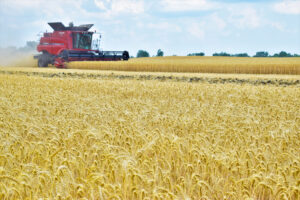
The agricultural holding company “Astarta” has completed the harvest of early grain crops and winter rapeseed across an area of 54,000 hectares, yielding approximately 256,000 metric tons, the company reported.
According to the report, the agricultural holding harvested over 210,000 metric tons of wheat and 43,000 metric tons of winter rapeseed.
The average yield of winter wheat at Astarta was 5.4 metric tons per hectare, and that of winter rapeseed was 3.1 metric tons per hectare. The highest yields were recorded at Khmilnytske LLC in the Vinnytsia region—7.7 metric tons per hectare of winter wheat and 3.8 metric tons per hectare of winter rapeseed.
Andriy Zagorulko, Director of the Agricultural Holding’s Department of Crop Production, Logistics, and Mechanization, noted that the season was challenging due to unfavorable weather conditions and diseases affecting winter rapeseed.
Astarta has already begun preparing the soil for the winter crop planting season.
Astarta is a vertically integrated agribusiness holding company operating in seven regions of Ukraine and is the country’s largest sugar producer. The company’s portfolio includes five sugar refineries, agricultural enterprises with a land bank of 214,000 hectares (including 129,000 hectares in the Poltava region, 42,000 hectares in the Khmelnytskyi region, and 16,000 hectares in the Vinnytsia region), and dairy farms with 30,000 head of cattle. The holding company also operates a soybean processing plant and a bioenergy complex in the Poltava region, as well as a network of six grain elevators.
Astarta’s net profit for 2025 fell 4.2-fold to $19.94 million, while consolidated revenue decreased by 23% to $472 million.

As of August 18, Ukrainian farmers had threshed 6.6 million hectares, or 56% of the projected area, and harvested over 30.8 million metric tons of grain from the new harvest, with an average yield of 46.8 centners per hectare, according to the press service of the Ministry of Agrarian Policy and Food.
As of the same date in 2025, 6.18 million hectares had been threshed, the statement noted.
Wheat was threshed from 4,855.25 thousand hectares, yielding 23,822.36 thousand metric tons, with an average yield of 49.1 centners per hectare. Barley was threshed from 1,437.17 thousand hectares, yielding 6,239.99 thousand metric tons, with an average yield of 44 centners per hectare. Peas have been harvested from 295,66 thousand hectares, with 779,02 thousand metric tons collected and an average yield of 26.3 centners per hectare. Millet has been harvested from 1.2 thousand hectares, with 2.7 thousand metric tons collected and an average yield of 22.5 centners per hectare.
In terms of harvest volumes of early grain and legume crops, the Odesa, Kirovohrad, and Mykolaiv regions are currently leading.
In Odesa Oblast, 4,819.70 thousand metric tons were harvested from an area of 1,188.8 thousand hectares (wheat—3,223.30 thousand metric tons; barley—1,311.50 thousand metric tons; peas—284.90 thousand metric tons).
In the Kirovohrad region, 2,418.30 thousand metric tons were harvested from an area of 555.7 thousand hectares (wheat—1,923.80 thousand metric tons; barley—412.50 thousand metric tons; peas—82.0 thousand metric tons).
In the Mykolaiv region, 2,326,10 thousand metric tons were harvested from an area of 653.8 thousand hectares (wheat – 1,631,80 thousand metric tons, barley – 587.5 thousand metric tons, peas – 106.80 thousand metric tons).
The highest grain yields are currently being recorded in the Khmelnytskyi (69.9 centners per hectare), Sumy (59.8 centners per hectare), and Vinnytsia (59.5 centners per hectare) regions.
Rapeseed has already been threshed from 1,318.64 thousand hectares, yielding 3.7 million metric tons of seeds with an average yield of 28.5 centners per hectare.

On the Ukrainian grain and oilseed market, prices showed mixed trends over the week: wheat remained at the previous level, sunflower seed prices fell significantly, while rapeseed prices for export rose, according to the brokerage firm Spike Brokers.
According to data from analysts published on their Telegram channel, wheat with 11.5% protein on CPT Odessa terms was priced at $195 per metric ton, while feed wheat was priced at $185 per metric ton. On FCA Chop terms, wheat traded mainly at EUR180–185/metric ton for loading onto a European train.
The price of corn on CPT Odessa terms fell by $5 per metric ton over the week to $190 per metric ton, while on FCA Chop terms it remained at $220 per metric ton. The new October–March crop was trading at EUR188–193 per metric ton FCA Chop at the western border.
The price of sunflower seeds on CPT mill terms fell by $110 per metric ton over the week to $440 per metric ton. According to the broker, the market continues to transition to pricing for the new crop, and the external rise in prices for soybean oil and crude oil has not yet been reflected in Ukrainian raw material prices.
In the rapeseed market, the price on CPT port terms remained at $500 per metric ton, while on FCA Chop terms it rose by $5 per metric ton to $550 per metric ton. At the same time, the price of rapeseed for domestic processing fell by $15/metric ton to $485/metric ton. Thus, the difference between the FCA Chop export price and the price for domestic processing is $65/metric ton.
As of August 10, Ukraine had harvested 3.22 million metric tons of rapeseed from 1.191 million hectares—or 89% of the planted area—with a yield of 2.71 metric tons per hectare. Current pricing is determined by the distribution of supply among the western border, ports, and domestic processing.
The price of GMO soybeans on CPT port terms was $420 per metric ton, FCA Chop – $435 per metric ton, and non-GMO soybeans – $440 per metric ton and $470 per metric ton, respectively. The price of GMO soybeans for domestic processing rose by $5 per metric ton over the week, reaching $425 per metric ton.
“Thus, sunflower seeds are adjusting to the purchase price of the new crop; competition is intensifying in rapeseed between FCA Chop and processing; and soybeans are receiving an external boost from the CBOT and Chinese demand, which is not yet being strongly reflected in the Ukrainian physical market,” analysts note.

The “Agrain” Group of Companies has begun sowing winter rapeseed for the 2027 harvest, for which it has allocated over 18,000 hectares this season, the company’s press service reported.
The farms in the Chernihiv cluster were the first to begin planting—work there started in early August. In the Odesa and Kharkiv clusters, they are waiting for sufficient productive moisture to accumulate in the soil.
“We only plant when there is sufficient moisture in the topsoil. We constantly monitor weather conditions and adjust the pace of work depending on the situation in each region. Our goal is to complete sowing within the optimal timeframe, ensure uniform emergence, and create the right conditions for plant development before winter sets in,” the press service quotes Chief Agronomist Taras Korniyenko as saying.
“Agrain” is engaged in the cultivation and storage of grain and oilseed crops, as well as livestock farming. Prior to the full-scale Russian invasion, the agricultural holding comprised 11 agricultural enterprises; that number has now grown to 13. The group of companies cultivates approximately 110,000 hectares in the Zhytomyr, Kharkiv, Chernihiv, Odesa, and Cherkasy regions.
The group includes two large grain elevators and two mini-elevators, with a combined capacity of 320,000 metric tons. The agricultural division comprises nine enterprises. Four enterprises are engaged in livestock farming. The beef cattle herd numbers 5,500 head, and the dairy herd numbers 1,750 head, including over 800 milking cows.
The holding company is owned by SAS Investcompagnie (France).
AGRICULTURAL HOLDING, GRAIN, HARVEST, planting season, RAPESEED



