

“Nova Poshta” has opened Nova Books—a specially designed book area in its branches featuring business literature for professional and personal development; the pilot program is currently operating at one of its Kyiv branches, the company’s press office reported.
According to the press release, books on economics and business are displayed in a separate showcase with a specially equipped self-service checkout counter. The Nova Books collection is based on business and economics literature selected based on recommendations from Nova Poshta’s Corporate University, as well as the company’s co-owners’ favorite books from their personal libraries.
“We are currently testing this format in Kyiv and are already seeing high demand: in just the first two days, customers purchased about 20 copies of business literature. Among the bestsellers are Donald Norman’s *The Design of Everyday Things* and James Clear’s *Atomic Habits: An Easy and Proven Way to Build Good Habits and Break Bad Ones” by James Clear,” noted Ivan Bilokonny, head of the new product development department at Nova Poshta.
You can purchase your favorite book from the display or online by scanning its barcode on a tablet and paying for the purchase. The purchase takes place without involving clerks or waiting in line. The book service Megogo Books is a partner in the pilot project and is responsible for providing the product selection and distribution.
“Since Megogo Books began operations, we’ve been collaborating with Nova Poshta to bridge the gap between readers and books through fulfillment and fast delivery. For us, Nova Books is a logical extension of this collaboration in a new format and an opportunity to move beyond the digital space,” said Kateryna Kotvitska, Content Director at Megogo Books.
It is reported that Nova Books will soon begin operations at two more locations in Kyiv and will open at 10 locations in the capital by the end of the year, with plans to expand to other regions thereafter. Thanks to Nova Poshta’s extensive network, the project creates a new opportunity for customers and publishers: readers gain access to high-quality books just a short walk from home, while publishers gain a new, convenient distribution channel.
As previously reported, as of July 13, 2026, the company’s network comprised 54,700 service points: 16,800 branches and 37,900 parcel lockers throughout Ukraine.
Nova Poshta’s core business remains the express delivery of documents, parcels, and palletized bulky cargo.
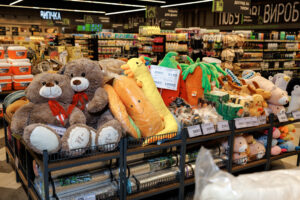
The Novus supermarket chain opened its first store in Ivano-Frankivsk, which became the chain’s 100th location in Ukraine, the company’s press office reported.
“We are gradually expanding into new cities and plan to continue this trend. Ivano-Frankivsk has become an important milestone in our growth, but it certainly won’t be the last. We strive to be closer to our customers in various regions of Ukraine,” reads the Novus press release.
According to the report, the new 1,900-square-meter supermarket opened in the “Arsen” shopping center. The product range includes over 17,000 items. The store also features products from its own “Master of Taste” brand. The store has eight regular checkout lanes and eight self-checkout lanes.
As previously reported, in August, Novus opened two supermarkets in Lviv at once.
In June 2026, the Antimonopoly Committee of Ukraine authorized Novus-Ukraine LLC to lease a number of assets from the Eurotek Group, which had closed its “Fresh,” “Arsen,” “Soyuz,” and “Kvartal” supermarket chains.
Novus is a supermarket chain with 100% Lithuanian capital that has been operating since 2008 and is developed by BT Invest (Lithuania). As of mid-2026, the company has 173 locations and is represented in Kyiv, the Kyiv region, and a number of other regions of Ukraine. The founder and beneficial owner of the group is Lithuanian entrepreneur Raimondas Tūmenas. The company operates a supermarket chain as well as “Mi Market” convenience stores.
According to the YouControl analytics system, Novus’s revenue in 2025 totaled 34.69 billion UAH, which is 19.55% more than in 2024.
Fozzy Group, one of Ukraine’s largest commercial and industrial groups, will lay off some employees from the holding company’s office divisions, the “Silpo” supermarket chain, and its logistics division starting November 1, 2026, due to mounting business losses resulting from Russian attacks.
As the group announced on LinkedIn, employees were informed of the organizational changes during internal meetings. Similar changes had previously taken place at the MAUDAU marketplace, as well as within the IT teams at TEMABIT Software Development and E-commerce & Ecosystem.
“Unfortunately, this means we will have to part ways with some of our colleagues from the holding company’s office teams, the Silpo chain, and the logistics division. Similar changes had already taken place at MAUDAU and within the IT teams at TEMABIT Software Development and E-commerce & Ecosystem. This is a necessary decision stemming from the fact that the war is increasingly affecting our work,” the Fozzy Group statement reads.
Between August 1 and September 25 alone, Russian attacks destroyed or damaged more than 20 of the group’s facilities, including distribution centers, supermarkets, and production facilities.
The company notes that the attacks resulted in the loss of part of its infrastructure and inventory, while ensuring the uninterrupted operation of the business is becoming more difficult and expensive. Fozzy Group is reassessing its priorities, suspending some projects and tasks, abandoning others, and seeking new solutions for the rest.
At the same time, the group continues to open stores, restore damaged facilities, and reorganize its logistics. To support these efforts, Fozzy Group is continuing to hire employees for supermarkets, warehouses, and production facilities throughout Ukraine.
“Our goal right now is to keep the business strong enough to serve our customers and have the resources to rebuild what the war continues to destroy,” the company emphasized.
Fozzy Group is one of Ukraine’s largest commercial and industrial groups and operates more than 825 retail outlets. It includes the Silpo, Fora, Fozzy, Thrash!, “Belaya Romashka,” and E-ZOO chains, as well as logistics, manufacturing, IT, and other assets.
The group’s key retail asset is Silpo-Food LLC. According to data from the YouControl system, the company’s revenue in 2025 amounted to approximately 106.8 billion UAH, up from roughly 93 billion UAH in 2024. At the same time, net financial results remained under pressure from high operating costs, logistics expenses, energy costs, and the consequences of the war.
Another major asset of the group is the “Fora” store chain, operated through Fora LLC. Its annual revenue already exceeds 30 billion UAH, making the company one of the largest operators in the Ukrainian grocery retail sector.
The combined scale of Fozzy Group’s business is significantly larger than the figures for individual legal entities, as the holding company unites dozens of companies in retail, manufacturing, logistics, the restaurant business, e-commerce, and IT. According to publicly available corporate data, the group has traditionally estimated its workforce at approximately 50,000 employees, making it one of Ukraine’s largest private employers.
Fozzy Group is owned by Ukrainian businessmen Vladimir Kostelman, Oleg Sotnikov, and Roman Chigir. The group was founded in 1997 and is now one of the largest players in the Ukrainian grocery retail sector.

The Book.ua bookstore chain has opened a new location in Kyiv at 5 Spaska Street; the bookstore in Podil is currently operating in test mode, the company’s press office reported.
“We’re getting to know the new location, fine-tuning all our processes, and preparing for the official opening. But we don’t want to wait for the ‘perfect moment.’ The books are already on the shelves, the coffee is brewing, the team is on site—and we really want to finally see you here,” the chain noted on Facebook.
As previously reported, a Russian attack on August 28 destroyed the warehouse shared by Readeat, Book.ua, and a number of publishers in Sviatopetrivskyi, from which books were shipped throughout Ukraine.
Book.ua has been operating since 2023 and runs an online bookstore as well as bookstore-cafés: seven in Kyiv and one in Khmelnytskyi.

McDonald’s Ukraine Ltd., which operates the McDonald’s fast-food restaurant chain in Ukraine, has opened its first restaurant in Bukovel, in the village of Polianytsia, according to the company’s press office.
This is the 10th restaurant in the chain to open this year.
The restaurant, with an area of nearly 477 square meters, has about 280 seats. All of McDonald’s modern service channels will be available at the restaurant. Customers will be able to place orders at self-service kiosks in the dining area, use “McDrive,” or place orders in advance via the “Mobile Ordering” service in the McDonald’s app. The dining area is open daily from 7:00 a.m. to 11:00 p.m., and “McDrive” is open from 5:00 a.m. to 11:30 p.m.
As previously reported, all McDonald’s restaurants in Ukraine operate in compliance with enhanced safety protocols: during an air raid alert, the restaurant temporarily suspends operations so that employees and guests can proceed to the nearest shelter, and resumes service once the all-clear is given. Employees receive their full wages regardless of the time spent in the shelter during their shift.
The first McDonald’s restaurant in Ukraine opened on May 24, 1997, in Kyiv. Today, McDonald’s employs nearly 11,000 Ukrainians and operates 131 restaurants in 44 locations. Since the start of the full-scale invasion, the company has opened 43 new locations.
According to data from the OpenDataBot analytics system, McDonald’s in Ukraine generated 21.3 billion UAH in revenue in 2025, which was 26.6% higher than the figure for the same period last year. Net profit increased by 21.3% to 1.567 billion UAH. Last year, the company paid 3.5 billion UAH in taxes to the state budget.
McDonald’s in Ukraine is a founding partner and the largest corporate partner of the charity organization “Ronald McDonald House Ukraine.”
MCD Europe Limited (London, United Kingdom) is listed as the owner of the foreign direct investment entity “McDonald’s Ukraine Ltd.” with a 100% stake.

In Ukraine, 107,400 sole proprietors in the retail sector operate outside of brick-and-mortar stores, including those engaged in online sales, according to data from Opendatabot as of early September 2026 and its analysis by the Experts Club analytical center.
This category accounts for about 16% of all 659,090 sole proprietors operating in the Ukrainian retail sector.
The largest group remains entrepreneurs selling in non-specialized stores—about 208,000, or 32% of the total.
Another 159,900 sole proprietors, or 24%, operate in markets and from retail stalls.
In specialty stores, 82,800 entrepreneurs sell various categories of goods. Another 47,600 sole proprietors specialize in the sale of food, beverages, and tobacco products.
Overall, 659,090 entrepreneurs are currently active in the retail sector in Ukraine. After a decline in the number of sole proprietors in 2025, the segment returned to growth: during the first eight months of 2026, the number of new registrations exceeded the number of closures by 8,200.
The data was published by Opendatabot on September 11, 2026, based on the Unified State Register.
Original source: Opendatabot – Structure of Sole Proprietorships in Retail



