
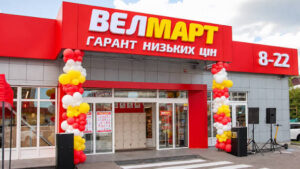
The “Velmart” discount hypermarket chain has restructured its supply chains and increased the share of direct shipments from manufacturers to stores to 53%, its press service reported.
“As of September, deliveries to the chain cover more than 11,000 SKUs, supplied by over 570 partner suppliers. In September, the share of direct deliveries from manufacturers in the total value of goods received rose to about 53%, while in August this figure stood at 12%,” the chain’s press release states.
According to the report, local producers supply goods to their own regions without shipping them to a distribution center. This approach reduces the burden on interregional transportation routes and allows for faster delivery of goods to stores.
In addition, “Velmart” prioritizes the supply of everyday consumer goods: dairy products, deli items, meat, baked goods, groceries, vegetables, fruits, sugar, salt, and flour. If Ukrainian-produced goods are out of stock, the chain seeks alternatives manufactured in Poland or Romania.
The “Velmart” chain is part of the multi-brand holding company Retail Group. It has 34 stores in 18 cities across Ukraine. It develops 10 private-label brands and operates seven full-cycle production facilities: meat and fish products (chilled and smoked), prepared foods, baked goods, and confectionery.
The company is also expanding the Graan Café chain of modern food courts within “Velmart” supermarkets and its “Pukhnastye Sprawy” line of pet products.
According to data from the YouControl analytics system, based on 2025 results, Foodcom LLC, which operates the “Velmart” chain, increased its net revenue by 18.7% to 23.6 billion UAH and its net profit by a factor of 3.2 to 378.6 million UAH.
Retail Group JSC is listed as the owner of Foodcom LLC, with Roman Lunin as the ultimate beneficiary.

Oil prices are rising sharply on Wednesday afternoon, with the price of Brent crude surpassing the $95-per-barrel mark during trading for the first time since early June.
As of 1:31 p.m., the price of September Brent futures on the London-based ICE Futures exchange rose by $2.83 (3.11%) to $93.84 per barrel. Earlier in the session, prices reached $95.47 per barrel.
WTI crude oil futures for September delivery on the New York Mercantile Exchange (NYMEX) electronic trading platform have risen by $2.69 (3.19%) to $87.03 per barrel.
Both grades are trading at six-week highs amid fears of new disruptions to oil supplies from the Middle East.
The U.S. and Iran continue to exchange blows, with the U.S. military attacking targets in Iran for the 11th consecutive night. Last night, the U.S. military attacked the Iranian port cities of Chabahar and Konarek, located on the coast of the Gulf of Oman, as well as the major industrial center of Tabriz.
In addition, the Yemeni Houthis have announced a blockade of Saudi Arabian ports and are threatening to attack tankers carrying Saudi oil in the Bab el-Mandeb Strait. This strait is a key point on one of the two main routes through which Saudi Arabia exports oil to Asia; the other runs through the Strait of Hormuz.
“We believe that the price of oil will fluctuate between $80 and $90 per barrel depending on the news,” said Jay Hatfield, CEO of Infrastructure Capital Management. “If the Red Sea is indeed closed, prices will jump above $100 per barrel, but we are not seeing that happen yet.”
Meanwhile, the American Petroleum Institute (API) reported yesterday that U.S. inventories rose by 2.6 million barrels last week. Analysts surveyed by Trading Economics had expected a decline of 1.5 million barrels.
The API receives data from refinery operators, oil storage facilities, and pipeline operators on a voluntary basis. Data from the U.S. Department of Energy on oil inventories, which is more important to the market, will be released on Wednesday at 5:30 p.m. local time.
Brent, MIDDLE EAST, OIL, SUPPLY, WTI

According to Experts.news, the gap between what buyers most often want to purchase and what sellers are offering is widening in the Ukrainian housing market, as noted in the NBU’s June Financial Stability Report.
According to the regulator, the average size of a purchased apartment remains at 48 square meters, and that of a house at about 70 square meters. At the same time, the supply continues to be dominated by more spacious apartments: their average size exceeds 65 square meters.
The discrepancy is also evident in the age of the properties. Buyers more often choose older and, consequently, more affordable apartments. In Kyiv, the median age of purchased apartments has risen to 33 years, and in the western regions, to 39 years. In real estate listings, by contrast, nearly two-thirds of apartments are offered in buildings constructed less than 15 years ago.
The NBU notes that such discrepancies between supply and demand are holding back market activity. Buyers are more interested in smaller and cheaper housing, while sellers and developers more often offer newer and more spacious properties.
This trend is also significant for developers. In the western regions and the suburbs of Kyiv, budget-friendly projects are more common, while business-class projects predominate in the capital. However, demand during wartime indicates that the average buyer is more often looking for a compact and more affordable option.
In the second half of 2025, residential construction picked up: in most regions, the planned floor area of apartment buildings where construction had begun increased significantly. Across Ukraine as a whole, this figure rose by one and a half times over the year, and in Kyiv—by more than double.
However, the NBU notes that developers continue to finance the completion of existing complexes and new projects largely with their own funds. Banks are reluctant to lend to the construction sector due to high risks.
The main takeaway for the market: further recovery in sales will depend not only on household income but also on how closely supply aligns with actual demand—in terms of square footage, price, age of the property, and level of risk for the buyer.

Zaporizhstal Iron and Steel Works has begun supplying rolled steel to Metinvest’s pipe plant in Romania, Metinvest Tubular Iasi, which became part of the group at the end of 2025.
According to a press release on Thursday, since the beginning of 2026, the company has shipped 22,000 tons of hot-rolled structural steel certified to the European standard EN 10025. In total, up to 180,000 tons of rolled steel are planned to be supplied to the pipe plant this year.
“Zaporizhstal’s rolled products are in demand among European and Ukrainian pipe manufacturers: every year, up to 80% of our metal products are shipped for the manufacture of straight-seam pipes and profiles. We are pleased to welcome Romanian pipe manufacturers to the Metinvest Group and to establish a new format of cooperation to strengthen the economic partnership between Ukraine and Europe,” said Taras Shevchenko, acting CEO of Zaporizhstal, whose words are quoted in the report.
It is specified that hot-rolled products made of mild structural steels are in high demand in the pipe industry due to their mechanical properties, which ensure the reliability and strength of finished products. Such products can withstand significant loads, including impact loads, operate under pressure, weld well, and maintain stable performance characteristics.
“Zaporizhstal’s rolled products are used to manufacture round, profile, and rectangular welded pipes that comply with European standards EN 10219 and EN 10217 and are used in geothermal engineering, energy, construction, and fire extinguishing systems, among others. Zaporizhstal steel pipes have proven to fully meet high requirements during testing, so we are establishing long-term mutually beneficial cooperation with Zaporizhstal metallurgists,” said Cosmin Toma, CEO of Metinvest Tubular Iasi, as quoted by the company’s press service.
The largest consumers of pipes produced by Metinvest Tubular Yassy are the domestic market of Romania, as well as companies from Hungary, the Czech Republic, Poland, Slovakia, and other European countries.
As reported, Zaporizhstal produced 3.5 million tons of pig iron, 3.2 million tons of steel, and 2.8 million tons of rolled products in 2025.
Zaporizhstal is a joint venture of the Metinvest Group, whose main shareholders are System Capital Management (71.24%) and Smart Steel Limited (23.76%). Metinvest Holding LLC is the managing company of the Metinvest Group.
METINVEST, PLANT, ROLLED PRODUCTS, ROMANIA, SUPPLY, ZAPORIZHSTAL

In January of this year, ferrous metal scrap trading companies reduced their procurement of ferrous metal scrap by 18.5% to 97,100 tons from 149,000 tons.
According to data from the Ukrainian Association of Secondary Metals (UAVtormet), scrap collectors reduced their supplies of scrap to Ukrainian metallurgical plants by 26.7% compared to the same period last year, to 92.5 thousand tons from 126.2 thousand tons. At the same time, steel production during the same period decreased by 16.4% to 511 thousand tons from 611 thousand tons.
According to UAVtormet estimates, in the first month of the scrap export ban, more than 20-25% of companies in the industry partially suspended their operations, and another 12-15% completely stopped their activities. Experts predict that by April-May of this year, about 4-4.5 thousand workers in the scrap collection industry will lose their jobs.
As reported, according to data from the State Customs Service, Ukrainian scrap collection companies increased their exports of ferrous metal scrap by 45.3% in 2025 compared to the previous year, to 448,700 tons, and in monetary terms by 44.5%, to $131.9 million. In 2024, exports of these products increased by 60.7% in physical terms and by 73.2% in monetary terms.
Due to such a sharp increase in exports, the Cabinet of Ministers introduced a zero quota for exports of these products for 2026, whereas previously there was an export duty of EUR 180/ton, which, at the same time, was not paid when exporting to the EU, with which Ukraine has a free trade zone.
According to customs data, in January this year, Ukraine reduced exports of ferrous metal scrap by 40.7% compared to January last year, to 9.3 thousand tons, and compared to the December 2025 figure of 68.5 thousand tons, the decline was sevenfold. In monetary terms, scrap exports in January decreased by 38% compared to January 2025, to $2.73 million.

Activity in the housing market in Ukraine has remained virtually unchanged for about a year and a half, with one of the key restraining factors being the mismatch between the type of housing most often put up for sale and what buyers are looking for, according to the National Bank of Ukraine’s (NBU) financial stability report for December 2025.
The regulator notes that the number of housing purchase and sale transactions in the first nine months of 2025 was only 7% higher than in the same period last year. According to the NBU’s assessment, advertisements more often feature large and new apartments, which are more expensive, while buyers often focus on more affordable options.
The NBU also indicates that the market is most active in Kyiv, Kyiv, Dnipropetrovsk, and Kharkiv regions, which account for 39% of transactions in the first three quarters of 2025. Two-thirds of transactions involve apartments; the average area of an apartment purchased is 48 square meters, and that of a house is 70 square meters. The median age of purchased housing in Ukraine is estimated at 45 years, and in Kyiv at 20 years.



