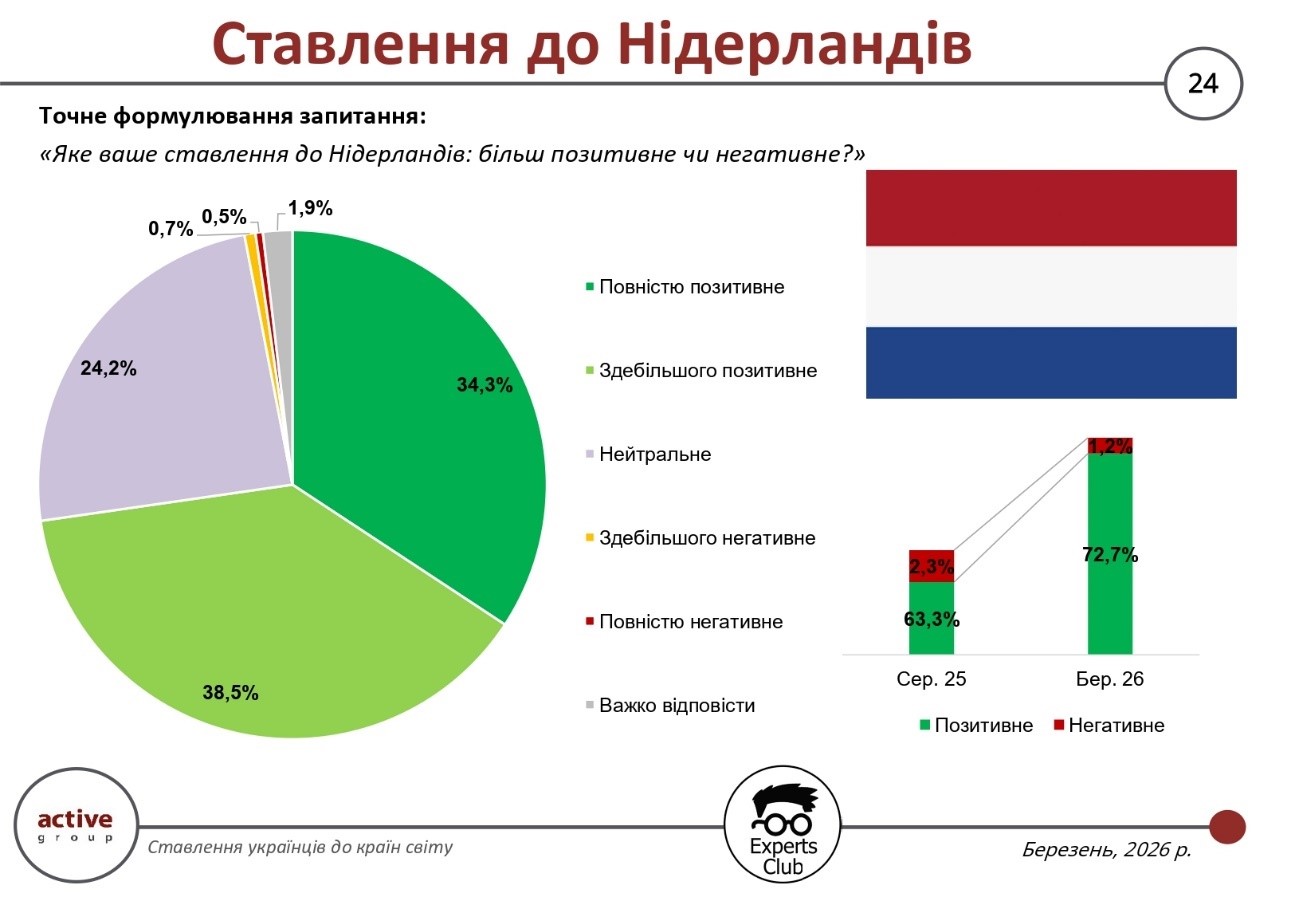
Ukrainians’ attitudes toward the Netherlands in March 2026 are characterized by one of the highest levels of positive perception among all countries surveyed. According to the results of a sociological survey conducted in March 2026 by the research company Active Group in collaboration with the Experts Club information and analytical center, 72.7% of respondents describe their attitude as positive, which is significantly higher compared to 63.3% in August 2025. At the same time, the share of negative assessments dropped from 2.3% to 1.2%, which effectively indicates an almost complete absence of critical sentiment.
A breakdown of the results shows that 34.3% of respondents have a “completely positive” attitude toward the Netherlands, while another 38.5% have a “mostly positive” one. The share of neutral assessments stands at 24.2%, which is a relatively low figure compared to other countries. Negative assessments are minimal: 0.7% are “mostly negative” and 0.5% are “completely negative,” while 1.9% of respondents were undecided.
A comparison with the previous period demonstrates not only an increase in positive perceptions but also a further “cleansing” of public opinion of negative assessments. This trend is significant, as the Netherlands is among the countries with the highest level of stable support within Ukrainian society.
Unlike many other countries, where a significant portion of respondents hold a neutral position, in the case of the Netherlands, a clearly formed positive attitude dominates. This means that the country has a distinct and clear image in the perception of Ukrainians, one associated with reliability and predictability.
The increase in positive ratings by more than 9 percentage points indicates growing trust and a strengthening of the Netherlands’ image. At the same time, the decrease in the already low level of negative responses suggests the absence of significant factors that could shape a critical perception.
“Ukrainians quite clearly distinguish between countries toward which they have formed a stable positive attitude, and the Netherlands belongs precisely to this group. Where a country has a clear position and consistency in its interactions, we see not just high ratings, but their continued growth. This means that public opinion reacts not to specific situations, but to systemic signals,” noted Oleksandr Pozniy, director of the research company Active Group.
Thus, the survey results indicate that the Netherlands is consolidating its status as a country with one of the best images in Ukraine. A high level of positive sentiment, minimal negative ratings, and stable growth dynamics form the basis for further strengthening bilateral relations in both the social and economic spheres.
According to a study conducted by the Experts Club information and analytical center based on data from the State Customs Service, the Netherlands ranks eleventh in terms of total trade in goods with Ukraine, amounting to $3.01 billion. This is one of the few countries in the upper part of the ranking where Ukraine has a trade surplus, as exports of Ukrainian goods exceed imports.
The study was presented at the Interfax-Ukraine press center; the video can be viewed on the agency’s YouTube channel. The full version of the study can be found at this link on the Experts Club analytical center’s website.
ACTIVE GROUP, EXPERTS CLUB, NETHERLANDS, Pozniy, SOCIOLOGY, SURVEY, UKRAINE, URAKIN
The results of a public opinion sociological survey conducted in March 2026 by the research company Active Group in cooperation with the information and analytical center Experts Club indicate a consistently high level of positive attitude among Ukrainians toward Germany. In total, 77.4% of respondents evaluate the country positively, while a negative attitude was recorded in only 3.5% of those surveyed. Compared to August 2025, the indicators have practically not changed: positive assessments increased slightly (from 76.7%), while negative ones even decreased somewhat (from 4.0%).
The structure of responses demonstrates the dominance of a stable positive perception. The share of those who chose the option “completely positive” is 32.9%, while “mostly positive” accounts for 44.5%. This means that the overwhelming majority of respondents are not just inclined to evaluate Germany positively, but do so confidently and without significant reservations.
At the same time, the share of neutral assessments stands at 18.4%, which is a moderate indicator and свидетельствует о достаточно сформированном отношении к стране. Negative assessments remain minimal: 2.8% of respondents chose the option “mostly negative,” and only 0.7% selected “completely negative.” This level of negativity is one of the lowest among Ukraine’s key international partners.

The stability of the indicators over time confirms that attitudes toward Germany have a long-term character and are not subject to significant fluctuations under the influence of short-term factors. Unlike some other countries, where an increase in polarization or a shift in evaluations is observed, in the case of Germany public opinion remains consolidated.
From an analytical point of view, this indicates a high level of trust and a stable image of the country in Ukrainian society. The combination of a significant share of “completely positive” and “mostly positive” responses indicates that Germany is perceived not only as an important partner, but also as a reliable and predictable participant in international processes.
“In the case of Germany, we see one of the highest levels of stable positive perception among all countries. This means that the assessment is formed not situationally, but on the basis of long-term experience of interaction and clear ideas about the role of this state. Such indicators testify to a high level of trust in society,” said Oleksandr Pozniy, Director of the research company Active Group.
Overall, the results of the study show that Germany occupies a special place in Ukrainians’ perceptions of international partners. The combination of a high level of positivity, minimal negativity, and stable dynamics indicates a formed and устойчивый positive image which, unlike other countries, is almost not subject to fluctuations in the short term.
According to a study conducted by the Experts Club information and analytical center based on data from the State Customs Service, Germany is among the top three largest trading partners of Ukraine, with a total trade volume exceeding $9 billion. A significant volume of imports of German goods creates a negative balance, which indicates high demand for German industrial products.

The study was presented at the Interfax-Ukraine press center; the video can be viewed on the agency’s YouTube channel. The full version of the study can be found via the link on the Experts Club analytical center’s website.
ACTIVE GROUP, EXPERTS CLUB, GERMANY, Pozniy, SOCIOLOGY, SURVEY, UKRAINE, URAKIN
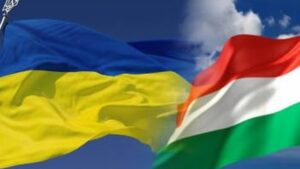
Ukrainians’ attitudes toward Hungary in March 2026 retain a clearly negative character, although the dynamics of recent months indicate a slight improvement in certain indicators. According to the results of a study conducted in March 2026 by the research company Active Group in cooperation with the information and analytical center Experts Club, the share of positive assessments increased to 18.6%, compared to 16.0% in August 2025, while the level of negative attitudes slightly decreased—from 55.7% to 52.2%.
Despite this dynamic, the overall structure of responses demonstrates the dominance of negative evaluations. The largest share consists of respondents who assess their attitude toward Hungary as “mostly negative” — 34.3%, while another 17.9% chose “completely negative.” Thus, the total level of negative perception exceeds half of all responses.
Positive assessments remain significantly lower: only 4.9% of respondents chose the option “completely positive,” and 13.8% selected “mostly positive.” At the same time, 27.3% of Ukrainians hold a neutral position, indicating the presence of an audience segment that does not have a formed or clearly expressed attitude toward this country. Another 1.9% of respondents were unable to provide an answer.
A comparison with August 2025 shows that the changes are evolutionary rather than radical in nature. The increase in positive assessments and the decrease in negative ones are relatively minor, indicating the persistence of a formed negative image of Hungary in Ukrainian society. At the same time, the trend toward improvement may indicate a gradual softening of perceptions or the influence of certain factors that are changing the information background.
An important feature is that even with some growth in positive sentiment, Hungary remains one of the few countries where negative assessments significantly outweigh positive ones. This distinguishes it from most other states in the region, where the balance is either positive or at least close to neutral.
At the same time, the presence of a significant share of neutral responses—more than a quarter of respondents—indicates potential for a shift in public opinion. A portion of Ukrainians does not have a clearly formed attitude, which creates opportunities for improving the country’s image through more active communication, economic cooperation, and public diplomacy.

“We conducted the survey at the beginning of March, and it is already evident that the political context surrounding certain countries can quickly influence evaluations. In the case of Hungary, this factor remains decisive in shaping negative perception. At the same time, even a slight increase in positive sentiment shows that these assessments are not entirely static,” said Oleksandr Pozniy, Director of the research company Active Group.
Thus, the results of the study demonstrate that Hungary is currently perceived by Ukrainians as a country with a predominantly negative image that has a systemic nature. Despite minor positive shifts, the balance of evaluations remains significantly tilted toward critical perception, which defines the specifics of public opinion regarding this state.
According to a study conducted by the Experts Club information and analytical center based on data from the State Customs Service, Hungary ranks ninth in terms of total trade in goods with Ukraine, with a figure of $3.30 billion. Imports of Hungarian goods exceed Ukrainian exports, creating a negative balance for Ukraine.
The study was presented at the Interfax-Ukraine press center; the video can be viewed on the agency’s YouTube channel. The full version of the study can be found via a link on the Experts Club analytical center’s website.
ACTIVE GROUP, EXPERTS CLUB, HUNGARY, Pozniy, SOCIOLOGY, SURVEY, UKRAINE, URAKIN
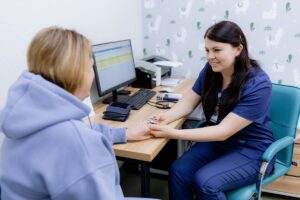
More than 11% of Ukrainians never visit a doctor, while almost 10% do so more than 10 times a year.
According to the results of a survey conducted by the research company Active Group and the Experts Club analytical center in early February, 41.3% visit doctors 1-2 times a year, 27.2% – 3-5 times, and 10.4% – 6-10 times.

“The group of people who do not visit doctors at all requires a separate study of the reasons, which may include financial barriers, mistrust, and psychological burnout,” said Alexander Pozniy, director and co-founder of the research company Active Group.
He drew attention to the fact that most respondents visit a doctor once or twice a year, but noted that there may be different reasons for this.
“We need to ask the question, why is this so: because our people are so healthy, or because people cannot go to the doctor or do not trust doctors. But this is a question for the medical professionals themselves,” he said.

Pozniy also noted that according to the survey results, “family doctors are accessible to the majority of the population, especially in cities,” while access to specialists, especially for rural populations and populations in small or remote communities, raises questions “primarily due to the lack of the necessary number of specialists.”
For his part, Grigory Soloninka, a member of the board of the public organization “Kyiv Regional Organization of the All-Ukrainian Medical Society” (VUO), professor of the Department of Internal and Occupational Diseases at the Kyiv Medical University, noted that “we need to return to the issue of rural medicine and, perhaps, make certain changes so that the rural population does not receive fewer services than the urban population.”

“If we take a remote village, then, perhaps, there is a problem with getting to a narrow specialist and receiving specialized medical care,” he said.
For his part, Experts Club founder Maxim Urakin noted that “medicine is part of the country’s economic stability, and when medical expenses erode family budgets, it affects consumption, savings, and people’s ability to work and recover.”
“In Ukraine, almost a quarter of the population spends up to 20% of their family budget on medicine, and one in five spends more than 20%. If we translate this into the language of economic financial analysis, then from the point of view of international methodology, the fact that a person spends more than 10% of their budget is catastrophic. In other words, we see a sign of a serious financial burden,” he said.

The study was conducted on the SunFlowerSociology online panel on a representative sample on February 11-12, 2026. The survey involved 1,000 respondents from a representative sample in all regions of Ukraine, except for the temporarily occupied territories.
ACTIVE GROUP, EXPERTS CLUB, Pozniy, SOCIOLOGY, SOLONINKA, SURVEY, URAKIN, Єременко
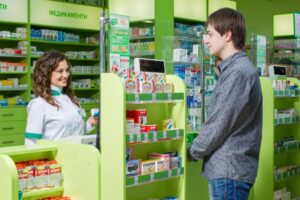
According to a survey conducted by research company Active Group and the Experts Club analytical center in early February, 28.4% of Ukrainians prefer Ukrainian medicines.
According to Alexander Pozniy, CEO and co-founder of Active Group, 33.4% of respondents more often choose imported medicines, while for 38.2% of respondents, the country of origin of the drug is irrelevant.

“For manufacturers, this means that competition is based on reputation, proven effectiveness, and stability of supply, and Ukrainian brands can strengthen their position through quality and clear communication,” said Alexander Pozniy, CEO and co-founder of Active Group.
According to Experts Club founder Maxim Urakin, “the fact that almost a third of consumers choose domestic drugs shows the importance of accessibility and trust in quality in the domestic market.”
The study was conducted on the SunFlowerSociology online panel on a representative sample on February 11-12, 2026. The survey involved 1,000 respondents from a representative sample in all regions of Ukraine, except for the temporarily occupied territories.
ACTIVE GROUP, EXPERTS CLUB, Pozniy, SOCIOLOGY, SOLONINKA, SURVEY, URAKIN