
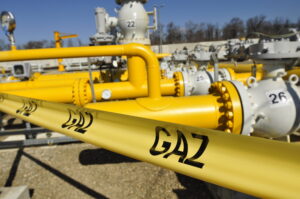
Transgaz, the Romanian gas transmission system operator, has signed a memorandum of understanding with the U.S. company Argent LNG, which provides for the possibility of investing in the construction of a large LNG terminal in Louisiana.
The project will have a capacity of 25 million metric tons of LNG per year, or approximately 35 billion cubic meters of gas. The first deliveries are expected in 2030.
One of the main goals is to establish a long-term supply route for American gas through Romania to Moldova and Ukraine, and further on to Hungary, Austria, the Czech Republic, Slovakia, and Germany.
The project is intended to strengthen the so-called Vertical Gas Corridor, which is gradually becoming one of the key routes for supplying non-Russian gas to Central and Eastern Europe.
The corridor connects the gas transmission systems of Greece, Bulgaria, Romania, Hungary, Slovakia, Ukraine, and Moldova. It can be used to transport both Azerbaijani gas and LNG from the U.S., which arrives via the Revithoussa and Alexandroupolis terminals in Greece.
For the Balkans, the project is significant because it provides the region with another major source of gas and fosters additional competition among supply routes. The more American and other non-Russian LNG that flows through Greece and Romania, the more the gas infrastructure of all of Southeast Europe will change.
Moldova has already tested this route: U.S. LNG was delivered via Greece and then injected into Ukrainian underground storage facilities.
Transgaz also controls 75% of the Moldovan gas transmission system operator Westmoldtransgaz.

Gas Transmission System Operator of Ukraine LLC (TSO of Ukraine) and Romania’s Transgaz have signed an interconnection agreement meeting European rules to start cooperation from January 1, 2020. The Ukrainian operator recalled that the negotiations with the mediation of the European Commission have been going on for three years. Operators of Bulgaria, Greece and Moldova have also been involved in them.
“This means that all suppliers have the opportunity of freely transporting gas with a new supply route – from Southern Europe and Turkey – through Bulgaria and Romania – to Ukraine and further to Moldova. That is, from January 1, at the Isaccea 1-Orlivka 1 interstate point a daily capacity on the Ukraine-Romania route in the amount of 17.8 million cubic meters will be available, as well as 15.8 million cubic meters per day in the opposite direction,” the operator said.
The first auctions for booking capacities at the Isaccea 1-Orlivka 1 point should be held in the coming days.
The operator said that the agreement previously signed between the gas transmission system operators of Ukraine and Romania did not allow gas to be transported in the reverse mode, and also did not provide European rules for interaction, since such an opportunity was blocked by the current contract between Naftogaz Ukrainy and PJSC Gazprom.
In addition, such an agreement creates an additional technical opportunity for Moldova to alternatively import gas for its own needs from Turkey and Greece if Gazprom stops transit to Europe through Ukraine.
“This decision is historic and extremely important, because it allows you to create an additional route for gas imports to Ukraine, primarily to provide gas to Moldovan consumers and border consumers of Ukraine in Odesa region. This will allow winter to pass uninterruptedly, even if the gas transit could be stopped from the Russian Federation,” Director General of TSO of Ukraine Serhiy Makohon said.



