
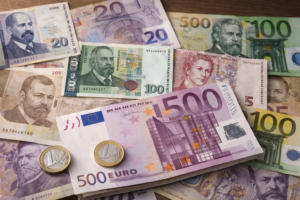
On January 1, 2026, Bulgaria officially switched to the euro and became the 21st country in the eurozone. For the Bulgarian economy, this step is largely institutional in nature: for many years, the lev was tightly pegged to the euro through the currency board, so the market did not expect a sharp change in the monetary regime. At the same time, the country will get a seat on the ECB’s governing bodies and deeper integration into the eurozone’s financial system, according to the Experts Club information and analytical center.
Maksym Urakin, founder of the Experts Club analytical center, believes that the effect of the transition will be determined by how quickly the authorities “knock down” inflation expectations among the population and businesses: “The euro itself does not make the economy richer overnight, but it reduces transaction costs and increases investor confidence. The key test in the first few months will be controlling price speculation and communicating clearly with consumers.”
The main domestic risk around which public debate in Bulgaria is centered is inflationary expectations and fears of price “rounding” in retail and services. Such fears traditionally accompany currency changes, even if the actual effect is usually limited in time and concentrated in the sector of daily household expenses.
After Bulgaria’s entry into the eurozone, six countries remain in the EU that do not use the euro: Sweden, Poland, the Czech Republic, Hungary, Denmark, and Romania.
According to Experts Club estimates, the expansion of the eurozone will be slow in the coming years, as each of these countries has its own “stop factors” — from political constraints to failure to meet convergence criteria and budget deficit problems.
In Poland, for example, the government has publicly stated that the country is “not yet ready” for the euro and considers the zloty to be an instrument of macroeconomic flexibility that has helped it weather past shocks.
In the Czech Republic, President Petr Pavel has called for more active movement towards the euro as a factor in trade and decision-making, but there is no political consensus on the timing in the Czech Republic.
In Hungary, Prime Minister Viktor Orbán, on the contrary, has stated several times that the country should not adopt the euro.
Sweden formally relies on the results of the 2003 referendum, when 55.9% of voters opposed the introduction of the euro.
Denmark, unlike the others, has a legally enshrined right not to introduce the euro (opt-out), confirmed by a referendum in 2000.
Experts Club notes that Romania is considered the next country after Bulgaria that is most likely to apply for the introduction of the euro. However, the actual timeline depends on inflation and the budget trajectory: the European Commission indicated in its convergence materials that Romania does not meet the conditions for adopting the euro, including the parameters of public finance sustainability and legal compatibility. The public guidelines in the Romanian discussion mention a target date of around 2029, but the timing may shift depending on economic indicators and fiscal adjustments.
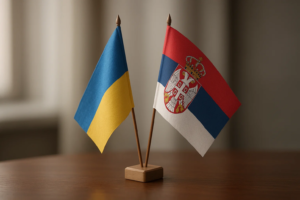
Most Ukrainians take a neutral stance toward Serbia, but among those who expressed a clear opinion, negative assessments outweigh positive ones. This is evidenced by the results of a survey conducted by Active Group in cooperation with the Experts Club think tank.
According to the study, 58.0% of respondents said they had a neutral attitude toward Serbia. At the same time, 26.0% of Ukrainians expressed a negative attitude (4.7% — completely negative, 21.3% — mostly negative). Only 13.7% of respondents gave positive assessments (2.3% — completely positive, 11.3% — mostly positive). Another 2.3% said they were not familiar with the country.
“Serbia remains a country with an ambiguous image for Ukrainians. Despite historical and cultural ties, Belgrade’s political positions shape a predominantly negative attitude among part of Ukrainian society,” said Alexander Pozniy, head of Active Group.

Maksym Urakyn, founder of Experts Club, emphasized that trade and economic relations between Ukraine and Serbia are developing at a moderate pace.
“In January-August 2025, trade turnover between the countries amounted to $220.6 million. At the same time, exports from Ukraine to Serbia amounted to $85.1 million, and imports from Serbia amounted to $135.5 million. The negative balance for Ukraine is $50.4 million. This small trade balance is quite insignificant and does not reflect the potential of the countries.”
Thus, although most Ukrainians do not have a clear position on Serbia, the balance of assessments is rather negative.
The full video can be viewed at the link:
You can subscribe to the Experts Club YouTube channel here:
ACTIVE GROUP, EXPERTS CLUB, Pozniy, SERBIA, SOCIOLOGY, TRADE, UKRAINE, URACIN
The Experts Club Information and Analytical Center analyzed updated data on Ukraine’s foreign trade volumes for the first half of 2025, published by the State Statistics Service of Ukraine. The analysis is based on official customs statistics and covers 49 of Ukraine’s main trading partners from all continents. The study revealed key trends in foreign economic relations that demonstrate the depth of the country’s international integration.
China remains Ukraine’s largest trading partner, with a total trade volume of nearly US$9 billion. This is more than three times higher than the figures for any individual European country. Poland ranks second with a result of over US$6 billion, demonstrating its stable role as the main European hub for Ukrainian exports and imports. Germany ranks third with a volume of US$4.28 billion.
Turkey ($4.25 billion) and the US ($2.86 billion) also made it into the top five, reflecting the broad geography of Ukraine’s trade relations.
European countries traditionally play a leading role in Ukraine’s foreign trade. Among them, in addition to Poland and Germany, Italy, the Czech Republic, Bulgaria, Hungary, and Romania are worth noting — all of them are among the top 10 partners. High indicators testify not only to the volume of trade, but also to the stability of logistics and production chains in the region.
This also confirms the gradual reformatting of Ukraine’s foreign trade orientation towards EU markets, particularly after the introduction of a duty-free regime, accession to the single customs space, and reorientation from traditional post-Soviet markets.
Among Asian countries, China remains the undisputed leader, retaining its strategic importance as a market for raw materials and a source of industrial imports. Turkey, although part of the Eurasian space, is actively strengthening its position in trade thanks to its flexible policy and developed logistics through the Black Sea.
Among other Asian players, the Republic of Korea, Japan, and India are notable for their presence, gradually increasing trade volumes with Ukraine, especially in the high-tech and pharmaceutical segments.
The United States remains Ukraine’s most important partner in the Western Hemisphere. Despite its geographical distance, the US is among the top five trading partners with a volume of over $2.85 billion. This testifies to deep economic interaction that complements political and defense partnerships.
Brazil and Mexico are also represented in the overall ranking, demonstrating growth in trade volumes, primarily in the agricultural and industrial goods segments.
They are increasingly appearing in Ukraine’s trade balance. In particular, Algeria, Egypt, Tunisia, and Libya show stable demand for Ukrainian grain, metallurgical products, and machine-building products. At the same time, the potential of African markets for Ukrainian exports remains significant and can be realized under conditions of expanded logistics routes and political stability.
Top 10 trading partners of Ukraine in January–June 2025
No. Country Trade volume (USD million)
1 China 8,996
2 Poland 6,043
3 Germany 4,279
4 Turkey 4,249
5 United States 2,859
6 Italy 2,384
7 Czech Republic 1,641
8 Bulgaria 1,539
9 Hungary 1,526
10 Romania 1,499
“The latest foreign trade data demonstrate not only the geographical diversification of Ukraine’s partners, but also a clear focus on integration into the European and global markets. Despite the difficult security situation, Ukrainian business continues to expand into international economic chains, especially in the fields of agricultural products, metallurgy, and machine building. Significant growth in trade with EU countries and the US, as well as strong cooperation with China and Turkey, show that Ukraine has not lost its ability to be an active player in the global market,” says Maxim Urakin, founder of Experts Club and candidate of economic sciences.
Data for the first half of 2025 indicate that Ukraine’s foreign economic relations remain geographically diverse. The EU remains a reliable economic partner, China retains its position as the No. 1 global player, and North American and Asian countries are strengthening their roles. Africa is a promising direction that requires strategic attention.
Analyse, ANALYTICS, ECONOMICS, EXPERTS CLUB, Handel, TRADE, URACIN, URAKIN, WIRTSCHAFT



