
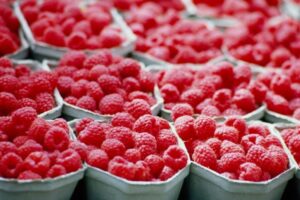
At the end of 2025, Ukraine confirmed its status as the world’s largest exporter of frozen raspberries, and in the 2026 season, the key vector for the development of the fruit and vegetable sector against the backdrop of stagnant domestic consumption will remain the expansion of exports, said Taras Bashtannik, president of the Ukrainian Fruit and Vegetable Association (UFOA).
“We have been the world’s largest raspberry exporter for two years in a row. According to the results of the 2025 season, exports are expected to reach about 80,000 tons, compared to 65,000 tons a year earlier. The potential for growth remains,” he said during the conference “Profitable Agribusiness 2026.”
According to the expert, a similar trend is observed in the blueberry segment, where production is growing by 15-20% annually. Bashtannik emphasized that the domestic blueberry market has reached a consumption “ceiling” of about 10,000 tons, so further development of the industry is only possible through exports. Currently, Ukraine exports about 8-10 thousand tons of this berry, while world leaders such as Chile and Peru supply up to 400 thousand tons to foreign markets, which indicates significant room for replacement of players in the global market.
Detailing the forecasts for the 2026 season, the president of the UPOA stressed that cheap vegetables and fruits should not be expected. He expressed confidence that the world has entered a phase where the opportunities for low-cost production have been exhausted, and Ukraine remains competitive only because of its lower costs compared to EU countries.
The high profitability of certain crops in previous years (sometimes up to 700% above cost—IF-U) is prompting farmers to rapidly expand their acreage without proper analysis. Bashkanik recalled that this has already led to a “slump” in prices for borscht vegetables in 2025. However, in the new season, the risk of overproduction of carrots or beets will remain and will depend on the timing of spring sowing.
According to the expert, the key obstacle to the development of the fruit and vegetable sector will be the shortage of skilled and unskilled workers. As a result, the industry will face the need for either total mechanization or even the involvement of foreign labor.
Bashkanik predicts that fruit and vegetable producers will traditionally experience problems in the 2026 season due to extreme weather conditions, ranging from drought to abnormal rainfall. This will require farmers to increase their investments in irrigation and protection systems.
Given the high cost and long logistics, particularly to Middle Eastern markets, the success of the season will depend not on the volume of the harvest, but on the ability to sell it to foreign markets.
“The issue of overproduction is not about how much we harvested, but whether we were able to sell it. If we work well for export, everything will be fine. Ukraine has an advantage in the diversity of its soil and climate zones, and if you choose the right varieties, you can invest in any crop — from pears to Jerusalem artichokes,” summarized the president of the UPA.
Earlier, the Experts Club information and analytical center released a video dedicated to global raspberry production https://www.youtube.com/shorts/IHaYTp6IbCM
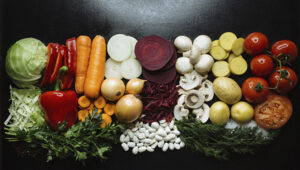
In 2025, Ukraine imported $89.54 million worth of vegetables used in borscht, including carrots, beets, cabbage, and onions, and $164.36 million worth of potatoes.
According to statistics released by the State Customs Service (SCS), Ukraine increased its imports of onions by 2.4 times in 2025, to 43,180 tons. The purchase cost $22.66 million, which is 2.6 times more than the $8.61 million spent in 2024. The top three suppliers of onions to Ukraine were China and Egypt, which accounted for 21.2% and 17.44% of imports, amounting to $4.80 million and $3.95 million, respectively. The Netherlands rounded out the top three with a 16.33% share ($3.70 million).
During this period, Ukraine imported 68.9% more cabbage than last year — 45.66 thousand tons versus 27.03 thousand tons, respectively. The cost of purchasing it increased by 62.3% and amounted to $34.31 million (compared to $21.14 million in 2024). The main suppliers were Poland (27.45% of supplies worth $9.42 million), Macedonia (22.96% worth $7.88 million), and the Netherlands (14.48% worth $4.97 million).
Ukraine increased its imports of carrots, beets, and celery by 4.9 times in 2025, to 48,010 tons (compared to 9,850 tons in 2024). USD 32.57 million was spent on these needs, which is 5.1 times more than in 2024 (USD 6.37 million). Last year, the main suppliers of these root vegetables to Ukraine were Poland, Moldova, and the Netherlands, which accounted for 46.31%, 12.9%, and 11.54% of the imported volume, respectively. In monetary terms, they earned $15.08 million, $4.20 million, and $3.76 million from these supplies, respectively.
As reported, Ukraine imported 138.41 thousand tons of potatoes in 2025, which is 5.3 times more than in 2024. In monetary terms, potato imports increased 4.9 times, to $74.82 million, compared to $15.21 million a year ago.
In total, Ukraine imported 275.26 thousand tons of vegetables for borscht in 2025.
Imports of vegetables for borscht to Ukraine (2025 vs. 2024)
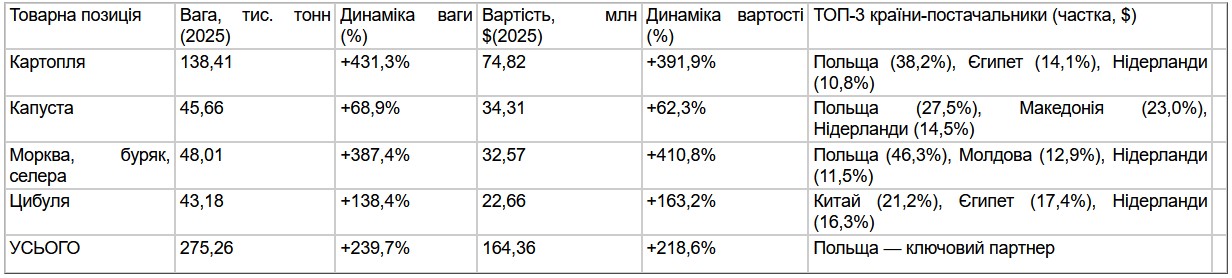
Data: State Customs Service
The National Bank of Ukraine (NBU) has lowered its forecast for the 2025 vegetable harvest by 11.5% to 7.6 million tons, fruit and berry harvest by 11.1% to 1.8 million tons, and potato harvest by 3.4% to 19.4 million tons.
“Weather conditions in the spring of 2025 were unfavorable for harvests. Spring frosts covered a significant part of the country, causing particular damage to winter crops, fruit and berries, and vegetables,” the National Bank said in its updated Inflation Report published this week.
At the same time, compared to last year’s harvest, the National Bank estimates that this year’s vegetable harvest will be 11.5% higher, or 0.8 million tons, and potato harvest will be 10.7% higher, or 1.9 million tons.
However, the situation with fruits and berries is worse, and their harvest will be 12.4%, or 0.2 million tons, less than last year.
The National Bank also lowered its forecasts for vegetable crops in 2026 by 9.1% compared to the previous April Inflation Report, to 8.0 million tons, and for fruit and berries by 4.0%, to 1.9 million tons.
At the same time, the NBU slightly improved its expectations for next year’s potato harvest by 0.7% to 20.0 million tons.
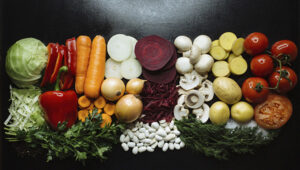
In January-June 2025, Ukraine imported $152.018 million worth of “borsch” vegetables, including potatoes, carrots, beets, cabbage, and onions.
According to statistics released by the State Customs Service (SCS), Ukraine increased its imports of potatoes by 7.9 times to 121.606 thousand tons during this period, purchasing them for $65.145 million, which is 6.9 times more than in the same period in 2024.
It is noted that in the first half of the year, 36.49% of the market of potatoes imported to Ukraine belonged to Poland, which was able to earn $ 23.77 million from its sale. At the same time, Egypt supplied 13.73% of the imported volumes for $ 8.945 million, the Netherlands – 11.66% for $ 7.594 million.
In January-June 2025, Ukraine slightly reduced onion imports by 1.1% to 15.747 thsd tonnes, spending $17.69 mln on the purchase of onions compared to $15.5 mln a year ago.
The top three suppliers of onions to Ukraine were China and Egypt, which accounted for 26.96% and 21.55% of imports, which in monetary terms amounted to $4.769 million and $3.812 million, respectively. The Netherlands closed the top three with a share of 18.85%, supplying this product for $3.335 million.
During this period, Ukraine imported cabbage 2.5 times more than a year ago – 47.252 thousand tons versus 18.969 thousand tons, respectively, spending 2.4 times more on its purchase than in the first half of 2024 – $42.075 million versus $17.804 million. Its main suppliers were Macedonia (33.3% of supplies worth $14.022 million), Poland (24.9% worth $10.481 million) and the Netherlands (13.47% worth $5.668 million).
In January-June 2025, Ukraine increased imports of carrots, beets and celery by 7.9 times compared to the same period last year – up to 43.065 thsd tonnes, spending $27.108 mln against $4.36 mln respectively.
The main suppliers of these goods were Poland, Moldova and the Netherlands, which accounted for 47.04%, 13.53% and 11.93% of the imported volumes, respectively. In monetary terms, these countries earned $12.752 million, $3.667 million and $3.235 million, respectively, from the supply of root crops to Ukraine.

Scientists at the D.K. Zabolotny Institute of Microbiology and Virology of the National Academy of Sciences of Ukraine are creating probiotic preparations for fermenting vegetables. The D.K. Zabolotny Institute of Microbiology and Virology of the National Academy of Sciences of Ukraine is developing probiotic preparations for fermenting vegetables based on strains of the lactic acid bacterium Lactobacillus plantarum, the website of the National Academy of Sciences of Ukraine reported on Tuesday.
At the forum “Innovative Approaches to Industrial and Craft Production: Challenges and Opportunities,” the Institute’s scientists presented fermented beverages based on vegetable juices. Vegetable juices are a source of vitamins and many other nutrients. Fermentation with the lactic acid bacteria Lactobacillus plantarum not only extends the shelf life, but also enriches vegetable juice with biologically active metabolites, reduces carbohydrate content and gives the juice functional properties.
Scientists at the Department of Industrial Microorganism Physiology have produced a beetroot drink – beetroot juice fermented with selected strains of lactic acid bacteria. It is sweet and sour in taste (with a faint beet flavor), contains less carbohydrates and more of certain amino acids, as well as lactic and other organic acids, vitamins B, PP, C, E, minerals, betanin and pectin.
Long-term studies of the biological activity of beetroot juice and clinical trials on volunteers have shown that drinking 50 ml of beetroot juice for two weeks had a positive effect on overall health, improving the functioning of the digestive tract and circulatory system. A positive effect after drinking the juice is observed in dysbiosis, gastritis, hypertension, myocardial dystrophy, hypovitaminosis C and B in wartime and postwar. Today, the Institute’s scientists continue to work on this product: they have improved the composition of the bacterial starter and are studying its biological activity in depth.
fermenting, microbiologists, probiotic preparations, VEGETABLES
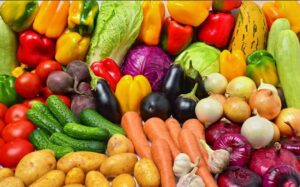
Ukrainian agrarians in 2023 grew 1.45 million tons of vegetable crops, harvested from 88.4 thousand hectares (23.2% of the total sown areas) with an average yield of 163.9 c/ha, the press service of the Ministry of Agrarian Policy and Food of Ukraine reported.
According to the report, in general, Ukraine has grown: 105.4 thousand tons of cabbage, 310.3 thousand tons of cucumbers, 175 thousand tons of tomatoes, 428 thousand tons of onions, 51.7 thousand tons of carrots, 35.3 thousand tons of table beets and 344.3 thousand tons of other vegetables.
According to the Ministry, as of August 9, Ukraine harvested more than half of cucumbers – 51.4%. Agrarians in Vinnytsia and Ivano-Frankivsk have fully completed their harvesting.
A similar situation with onion harvest, which was collected on 51.4% of the area. It has been finished in Ivano-Frankivsk and Kharkiv regions and almost finished in Kherson region.
Potatoes were harvested 711.5 thousand tons with an average yield of 13.9 tons per hectare. The highest yield of potatoes in farms in Khmelnytskyi region – 29 tons per hectare, stated the Ministry of Agrarian Policy.



