
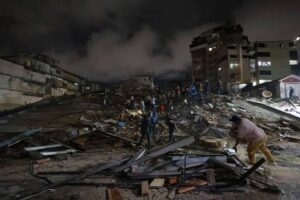
At least 164 people were killed and 971 were injured as a result of two powerful earthquakes in Venezuela that occurred on the evening of June 24, according to international news agencies, including the Associated Press, CNN, and Reuters, citing the country’s acting president, Delcy Rodríguez.
“At least 164 people were killed and 971 were injured after two powerful earthquakes shook Venezuela,” Acting President Delcy Rodríguez said on Thursday, adding that rescue teams are rushing to the hardest-hit areas to free people trapped under the rubble,” the AP reported on its website on Thursday.
The 7.2- and 7.5-magnitude earthquakes, which struck on Wednesday evening, were among the strongest to hit Venezuela in over a century and were felt throughout the region. The country’s main airport sustained damage and was closed, and buildings were evacuated even in such remote areas as the Brazilian Amazon, located approximately 1,700 km from Venezuela’s capital, Caracas.
According to Rodríguez, authorities are deploying rescue teams from other parts of the country to La Guaira state, located on the coast north of Caracas. That state has been hit the hardest.
The acting president noted that they are trying to make the most of daylight hours to speed up rescue efforts for people believed to be trapped under the rubble. “Dozens of buildings have collapsed there… and we are now conducting intensive rescue operations to save lives,” said Rodríguez.
After 6:00 p.m. on June 24, two powerful earthquakes with magnitudes of 7.2 and 7.5 struck Venezuela in quick succession. Many buildings were reported to have collapsed.

Gold and other precious metals rose on Monday amid events in Venezuela, which contributed to increased demand for safe-haven assets.
As reported, on January 3, US special forces conducted a special operation in Venezuela, capturing the country’s president, Nicolas Maduro, and his wife. Maduro will appear before a federal court in Manhattan, New York, on Monday, ABC News reported. He is expected to face drug trafficking charges that could result in multiple life sentences. US President Donald Trump said on Saturday that his country would temporarily take control of Venezuela.
The spot price of gold rose 2.1% during trading to $4,422 per ounce. Gold for February delivery on Comex rose 2.4% to $4,433.3 per ounce.
“Events in Venezuela have spurred demand for defensive assets as investors seek to protect themselves from geopolitical risks,” said KCM Trade analyst Tim Waterer. “Gold and silver were among the main beneficiaries.”
In 2025, gold rose 64%—the most since 1979—amid geopolitical tensions, lower interest rates, and high demand from global central banks. On December 26, the price of the precious metal rose to a record $4,549.71 per ounce.
The price of silver on the spot market rose 3.8% on Monday to $75.33 per ounce. At the end of last year, silver rose 2.5 times in price, which was its best annual performance. The price of the precious metal reached a record high of $83.62 per ounce on December 29.
The spot price of platinum rose 3.7% during trading to $2,220.3 per ounce, and palladium rose 2% to $1,671.7 per ounce.
Earlier, the Experts Club analytical center presented an analysis of the world’s leading gold-producing countries in its video on YouTube channel — https://youtube.com/shorts/DWbzJ1e2tJc?si=BywddHO-JFWFqUFA
Colombia, with the support of Russia and China, has initiated a meeting of the UN Security Council, Reuters reported, citing information from diplomats.
The agency also quotes an excerpt from a letter sent to the UN Security Council by Venezuela’s ambassador to the UN, Samuel Moncada.
” This is a colonial war aimed at destroying our republican form of government, freely chosen by our people, and establishing a puppet government that will allow our natural resources, including the world’s largest oil reserves, to be plundered,” Moncada wrote in a letter to the UN Security Council on Saturday, noting that the US had violated the UN Charter.

Venezuela has declared military aggression by the United States and imposed a state of emergency. The statement was published by Venezuelan Foreign Minister Ivan Gil Pinto.
“The Republic of Venezuela rejects, condemns, and denounces before the international community the extremely serious military aggression committed by the current government of the United States of America against the territory and population of Venezuela in the civilian and military areas of Caracas, the capital of the Republic, and the states of Miranda, Aragua, and La Guaira,“ according to a statement released on Pinto’s Telegram channel on Saturday.
The statement said that the US actions are ”a gross violation of the UN Charter” and threaten peace and stability in Latin America and the Caribbean.
The Venezuelan authorities claim that the real goal of the attack is to establish control over the country’s strategic resources, in particular oil and minerals, as well as an attempt at forced “regime change.” The government stressed that these attempts “will fail,” as before.
Venezuelan President Nicolas Maduro announced the imposition of a “state of external emergency” throughout the country and ordered the implementation of national defense plans. He also ordered the deployment of the State Integrated Defense Command and relevant management bodies in all states and municipalities.
Pinto said that Venezuela would file complaints with the UN Security Council, the UN Secretary-General, and regional international organizations, demanding condemnation of the US actions. The country’s authorities stressed that they reserve the right to self-defense in accordance with Article 51 of the UN Charter.
There have been no official comments from the US government on these allegations yet.
As reported, on the night of January 3, at least seven explosions were heard in Caracas, Venezuela. Eyewitnesses also said they saw planes flying low over the city. CBS News journalist Jennifer
Jacobs, citing sources, said that Donald Trump ordered attacks on targets in Venezuela as part of an intensified campaign against the regime of President Nicolas Maduro.
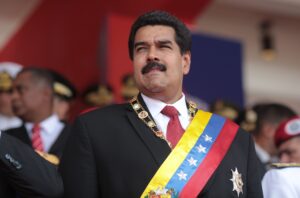
Venezuelan President Nicolás Maduro has announced the deployment (mobilization) of up to 4–4.5 million Bolivarian National Police officers in response to “threats from the US” and the build-up of American military presence in the Caribbean. This was reported by international media outlets, including El País, CBS News, and Al Jazeera.
According to the publications, Maduro’s statement came after the US decided to double the reward for information leading to his arrest and/or conviction to $50 million. The US State Department and the Associated Press/PBS agencies reported on the increase in the reward.
El País and other sources also note that Venezuela’s mobilization was a response to the deployment of US destroyers and other forces near the country’s coast, which has increased tensions in the region. Washington had previously accused Maduro of involvement in international drug trafficking and related crimes; the decision to increase the reward was announced this month.
American and international analytical publications note the growing military and political rhetoric on both sides and warn of the risks of further escalation. At the same time, there is no independent confirmation of the start of a “war” between the US and Venezuela; we are talking about mobilization steps and increased readiness against the backdrop of political confrontation.
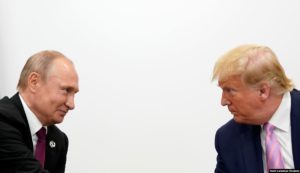
U.S. President Donald Trump and Russian President Vladimir Putin discussed Iran, Ukraine, Syria, and Venezuela at their talks on the sidelines of the G20 summit in Osaka on Friday, the White House said in a report. “They also discussed the situations in Iran, Syria, Venezuela, and Ukraine,” the White House said.
The presidents also exchanged opinions on issues such as bilateral relations and arms control, it said.
The meeting between Trump and Putin continued for almost an hour and a half.



