According to “Serbian Economist”, Serbian President Aleksandar Vučić has effectively announced the start of a new election campaign, stating at a rally of the ruling Serbian Progressive Party in Belgrade that he will resign as head of state in a few weeks. Formally, this appears to be a resignation nearly a year before the end of his term, but politically, it is less about the end of the Vučić era and more about an attempt to relaunch it in a new configuration.
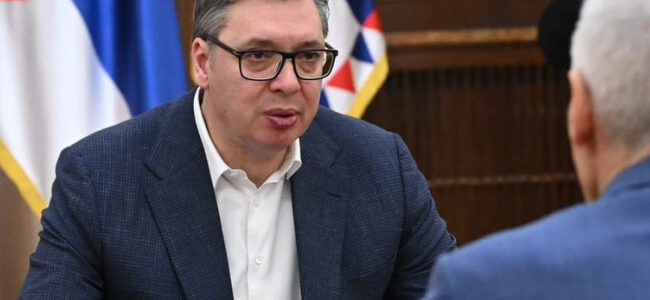
Speaking to supporters at the “Serbia—One Family” rally, Vučić stated that this was likely his last address to such a large gathering of citizens in his capacity as president of the republic. He emphasized that for 14 years he had “served Serbia” in various government positions—as deputy prime minister, prime minister, and president—and thanked his supporters for their backing during periods of political crisis.
The key moment of his speech was the announcement of his upcoming resignation. “These are my last days and last weeks as President of the Republic,” Vučić said, rejecting his opponents’ accusations that he intends to cling to power at any cost. At the same time, he immediately noted that he is not leaving politics: according to him, if the leadership of the Serbian Progressive Party deems it necessary, he will assist the ruling party in the upcoming elections.
It is precisely this combination—resignation plus participation in the campaign—that constitutes the main political message of the statement. Vučić is not simply cutting short his presidential term, but is shifting the crisis of legitimacy into the electoral arena. For him, this is a way to regain the initiative after a year and a half of protests that began following the tragedy at the train station in Novi Sad, where the collapse of a canopy became a symbol of the public’s grievances regarding corruption, the quality of public administration, and oversight of infrastructure projects.
The name Vucic has proposed for the list—“United Serbia”—is also no coincidence. It is intended to pit the ruling party not against individual opposition parties, but against the entire protest movement, primarily the student movement. This name incorporates a tactic typical of Vučić: to present the elections not as a competition of platforms, but as a referendum on stability, national unity, and the government’s ability to protect the country from chaos.
At the same time, Vučić clearly seeks to prevent the protest agenda from becoming the sole framework of the campaign. That is why, in his speech, socioeconomic promises took on almost as much importance as political statements. He promised that in two years, the average salary in Serbia would reach 1,400 euros and the average pension would reach 650 euros; he also announced additional support measures for low-income pensioners.
The economic portion of the speech serves several purposes at once. First, it is intended to steer the campaign back onto a track favorable to the government—growth in incomes, investments, infrastructure, and industrial development. Second, it is aimed at the most loyal segments of the electorate, primarily pensioners and workers in public-sector-dependent industries. Third, it allows Vučić to shift from a defensive stance on the issues of corruption and protests to an offensive agenda focused on “future development.”
Separately, Vučić emphasized technological modernization, energy, and defense. He spoke about robot manufacturing, data centers, gas-fired power plants, hydropower, and even future small- and large-scale nuclear power facilities. This segment is aimed at a different audience—those who see Serbia as a regional industrial and technological hub.
However, the president’s early resignation also carries risks for Vučić. If he does indeed resign in the coming weeks, Serbia will enter a period of accelerated institutional procedures. Presidential elections must be held within a limited timeframe, and holding early parliamentary elections will require a separate decision to dissolve parliament. This means that the government is taking on the responsibility of drastically compressing the political calendar and conducting a campaign amid high levels of polarization.