

Ukrainian universities are joining the European Researchers’ Night initiative, which will take place on September 25 this year. Specifically, Zaporizhzhia Polytechnic National University will host “Science Night 2026” on that day, while Lviv Polytechnic is coordinating a separate European Researchers’ Night 2026–2027 project as part of the Horizon Europe program.
According to Zaporizhzhia Polytechnic, “Science Night 2026” will take place on September 25 on the university campus and will be aimed primarily at schoolchildren, prospective students, and young people. The program includes interactive experiments, scientific demonstrations, a children’s science conference, and international events featuring foreign partners. The event will be held with due consideration for the security situation; the university notes that shelters are available.
A separate international conference as part of “Science Night” is also scheduled for September 25. Researchers from European universities are expected to participate.
In addition, for the first time at this level, Ukraine is represented by a separate project in the European Researchers’ Night program. Lviv Polytechnic has become the coordinator of the international project STEM for Science, Technology, Awareness & Researchers (STEM4STAR), selected for funding under the
European Researchers’ Night and Researchers at Schools 2026–2027 program of Horizon Europe.
According to the university, 241 applications from various European countries were submitted to the competition, and funding was recommended for 49 projects. STEM4STAR received the highest scores from experts across all criteria. The project involves organizing science festivals, European Researchers’ Night events, demonstrations of modern technologies, geospatial games, mapping challenges, mapathons, STEM programs, and startup competitions in Lviv. Some sessions will also take place in schools and colleges across Western Ukraine.
European Researchers’ Night is a pan-European initiative funded by the EU through the Marie Skłodowska-Curie Actions. In 2026, the main event will take place on September 25. According to the European Research Council, over 1 million participants are expected across approximately 40 countries. Universities and research institutions will host open labs, experiments, science shows, discussions, exhibitions, and interactive events for the general public.
The International Soft Skills Summit 2026, dedicated to the development of individuals, teams, and organizations in the era of artificial intelligence, will take place September 12–14 in a hybrid format and will bring together more than 70 Ukrainian and international experts.
According to the event organizers, the first day of the summit will take place in person in Kyiv with an online livestream, while the remaining two days will be held online. More than 5,000 participants are expected to attend.
The summit will also feature the inaugural Soft Skills Summit Awards 2026—a professional award for corporate programs in the areas of leadership development, talent development, team development, corporate culture, and soft skills.
According to the organizers, the Soft Skills Summit program is structured around three levels of development: the individual, the team, and the organization.
On September 12, the program will focus on individual development. On this day in Kyiv, there will be presentations on the main stage, panel discussions, hands-on Soft Skills Hubs, a Mindfulness Zone, an EXPO, Guided Speed Networking, and the awards ceremony for the winners of the Soft Skills Summit Awards 2026.
On September 13, the online program will focus on team development, communication, psychological safety, and modern approaches to leadership.
On September 14, participants will discuss corporate culture, talent and change management, organizational effectiveness, and corporate transformation driven by artificial intelligence.
“Today, a company’s competitive advantage is determined not only by technology. It is determined by people—their ability to think, interact, learn, and lead others through change. That is why we created the Soft Skills Summit—a platform that brings together global expertise and Ukrainian experience to help people, teams, and organizations prepare for the future,” said Ihor Lukianenko and Nataliia Novhorodska, co-founders of UpPro School and the Soft Skills Summit.
The organizers note that the development of soft skills is taking on added significance amid the spread of artificial intelligence technologies and changing labor market demands.
According to a World Economic Forum forecast, by 2030, approximately 39% of the professional skills required for work will have changed. Among the competencies expected to grow in importance the fastest are analytical thinking, resilience, adaptability, creativity, leadership, and social influence.
For Ukraine, the relevance of this issue is also linked to labor shortages, the integration of veterans and internally displaced persons into the labor market, the potential return of Ukrainians from abroad, the need to develop management teams, and the implementation of AI tools in business processes.
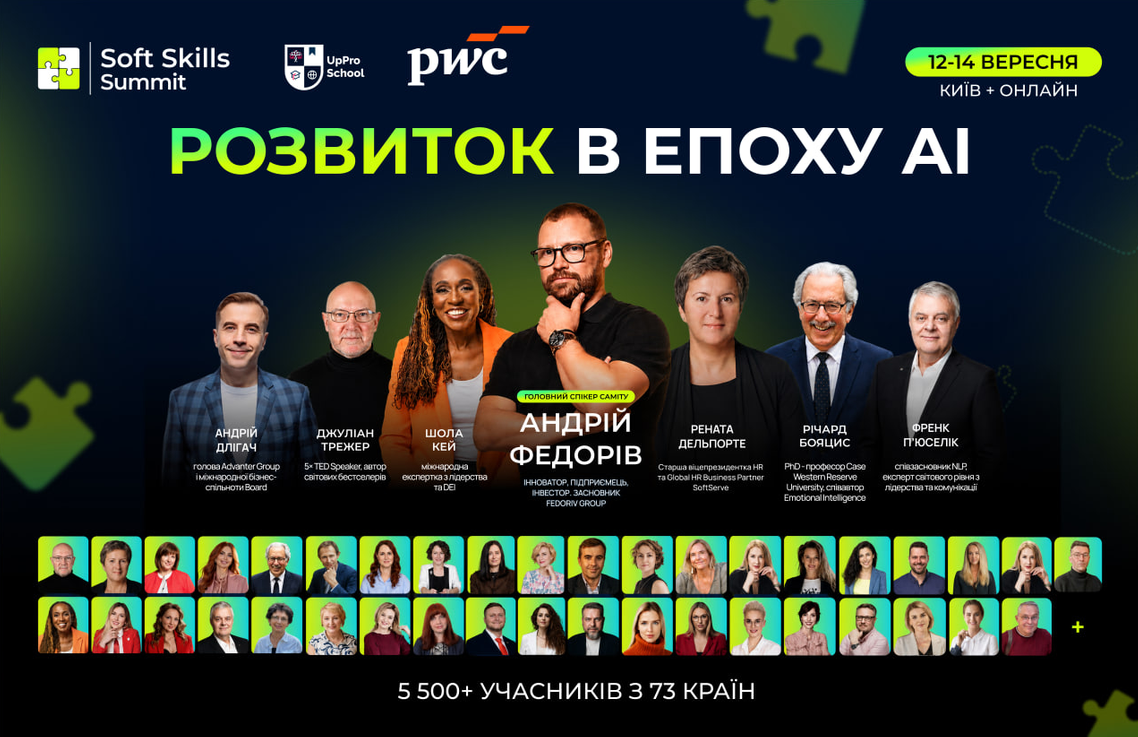
Among the announced speakers for the Soft Skills Summit 2026 are Andriy Fedoriv, founder of Fedoriv Group; Richard E. Boyatzis (U.S.), communications expert and TED speaker Julian Treasure (U.K.), SoftServe Senior Vice President of HR Renta Delporte, Advanter Group Chairman Andriy Dligach, PwC Ukraine Academy Leader Iryna Blinova, business consultant Frank Pucelik (U.S.), Shola Kaye (UK), an expert in communications and People-First culture, and Chen Lizra (Canada), a somatic transformational coach and TED speaker.
The full program and information on participation are available on the Soft Skills Summit 2026 website.
The summit is aimed at business owners, CEOs, team leaders, HR and L&D professionals, business trainers, coaches, psychologists, consultants, and other specialists working in the field of people and organizational development.
As part of the Soft Skills Summit Awards 2026, the best programs will be recognized in five categories: leadership development, talent development, team and corporate culture development, mental health support, and innovation in soft skills training and development.
Projects will be evaluated using a unified methodology developed by the UpPro School Analytical Center in collaboration with the non-governmental organization “Independent Association of Psychology and Coaching” and an independent panel of experts. The organizers state that the main criteria will be the program’s professional value, the quality of its implementation, and its actual impact, regardless of the company’s size.
Detailed information about the award and the terms of participation is available on the Soft Skills Summit Awards 2026 page.
The summit is organized by UpPro School—an international educational center for training and professional development of psychologists, HR and L&D specialists, managers, and other professionals working in the field of people, team, and organizational development. According to the organizers, UpPro School is an accredited CPD provider in the United Kingdom; over 150,000 participants have taken part in the center’s educational events, and more than 8,000 students have completed professional training.
For readers of “Open4business,” the promo code Open4business is available, offering a 10% discount on tickets to the Soft Skills Summit 2026. The promo code is valid through September 11, 2026.
For partnership inquiries, contact Svitlana Chaurova at partnerships@softskills-summit.com.
Open4Business is the official media partner of the event

More than 11,600 preschool institutions will be open in Ukraine starting September 1, including 1,100 operating in a hybrid format and 1,200 offering remote instruction, according to the Ministry of Education and Science.
“As of September 1, 11,622 preschool education institutions will be operating in Ukraine: 9,301 in-person, 1,111 in a hybrid format, and 1,210 remotely. This year, 712,987 children will begin their education at these institutions. All preschools operating in-person or in a hybrid format have access to shelters,” the ministry’s statement reads.
At the same time, it is noted that there has been significant progress in providing shelters for preschools.
For example, while 56.1% of preschools had shelters in 2022, 83% now have shelters either on their premises or within 100 meters.
The ministry reported that in 2026, for the first time, a state subsidy totaling 1 billion hryvnia is allocated for the construction of shelters in preschool education institutions, of which over 972 million hryvnia has been allocated to 18 projects in nine regions.
“In accordance with the Law ‘On the Use of the English Language in Ukraine’ and the Law ‘On Preschool Education,’ starting September 1, 2026, the study of English in older preschool groups (for children aged 5–6) will become a mandatory component of the educational process in all preschool institutions,” the Ministry of Education noted.
The ministry noted that learning English in preschool is primarily a gentle introduction to the language through play, rather than “lessons” in the traditional sense.
Specifically, for children aged 5–6, the optimal class duration is 20–25 minutes, with a change in activities every 5–7 minutes—this helps maintain the children’s attention and interest.

Viktor Mykyta, Deputy Head of the Office of the President of Ukraine and Chair of the Chamber of Regions of the Congress of Local and Regional Authorities, reported on a meeting with heads of regional administrations, during which they discussed the regions’ preparations for the start of the new school year, providing children with hot meals, setting up shelters, ensuring energy independence for educational institutions, and other issues.
“As of now, more than 9,370 educational institutions are ready to provide children with hot lunches. This covers nearly 99% of all students at this level. The state has provided communities with the financial resources needed to achieve this target,” Mykyta wrote on Telegram on Friday following the meeting.
He also reported on work to implement the president’s “Schoolchild’s Package” initiative, which provides funding to families of first-graders to purchase necessary school supplies before the start of the new school year, though he did not specify what stage the initiative is currently in.
The deputy head of the Presidential Office discussed efforts to create energy-independent schools, which involve equipping the largest educational institutions with autonomous power, generation, and heating systems. “Schools will become true havens of resilience, where, in the event of power outages, children will be able to stay warm and have access to electricity for an extended period of time. Last winter, which was particularly harsh, such solutions proved their effectiveness in communities and regions. This is our proven path, and we are moving forward along it,” Mykyta said.

Ukrainian high school student Taras Symak from Kolomyia won a bronze medal at the 22nd International Geography Olympiad (iGeo 2026), which took place August 11–17 in Istanbul.
Taras Symak is a student at the Vasyl Stefanyk Lyceum No. 1 in Kolomyia. He has previously won prizes at several student Olympiads, and in the spring of 2026, he won the regional round of the All-Ukrainian History Olympiad.
This year’s iGeo featured 184 high school students from 50 countries around the world. Each national team could consist of a maximum of four participants, selected based on the results of national Olympiads.
Among the countries whose representatives won awards in Istanbul were Serbia, Belarus, Romania, Mongolia, Turkey, and Iran.
In particular, Serbian high school student Petar Tolimir from Belgrade won a gold medal. The Belarusian participants won gold, silver, and bronze medals. The Romanian team finished the Olympiad with two silver and two bronze medals.
Mongolia achieved a historic result—Amina Ayanbek won the country’s first-ever gold medal at the International Geography Olympiad. Another Mongolian participant received a bronze medal. A representative from the host country, Turkey, took silver, while Iran received bronze.
The International Geography Olympiad is considered the premier international geography competition for high school students aged 16–19 and is held under the auspices of the International Geographical Union.
Unlike traditional subject-based tests, participants are required not only to demonstrate knowledge of geographical facts but also to analyze maps, statistical data, economic and demographic processes, and conduct fieldwork.
The final score is based on three components: 40% from a written exam, 40% from field research, and 20% from a multimedia test using maps, photographs, graphs, and statistics.
The first iGeo took place in 1996 in The Hague with only five countries participating. Over the course of three decades, the Olympiad has become one of the leading international academic competitions for high school students, alongside the Olympiads in mathematics, physics, chemistry, biology, and computer science.
The next, 23rd International Geography Olympiad, is scheduled to take place in 2027 in Jelgava, Latvia.
EDUCATION, GEOGRAPHY, high school student, OLYMPIAD, UKRAINE
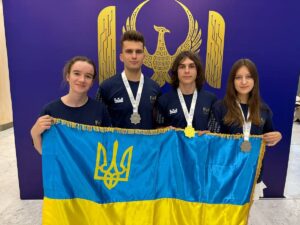
Ukrainian high school students won one gold and two silver medals at the 38th International Olympiad in Informatics (IOI 2026), which took place August 9–16 in Tashkent, Uzbekistan.
A total of 375 students from 97 countries participated in the competition. Over the course of two competition days, participants solved complex algorithmic programming problems.
Vladislav Khalin achieved the best result among Ukraine’s representatives. He scored 398.32 points, placed 16th in the overall individual rankings, and received a gold medal.
Ilya Shevchenko, with a score of 336.44 points, placed 58th and received a silver medal. Daria Perekopskaya brought home another silver medal for Ukraine, scoring 333.01 points and placing 62nd.
The fourth member of the Ukrainian team, Daria Lobas, placed 198th with a score of 219.04 points.
First place in the individual rankings of the 2026 IOI went to Qiwen Xu of China, who scored 498.27 points out of a possible 600.
The International Olympiad in Informatics (IOI) is one of the most prestigious international subject-based Olympiads for high school students. The competition is held annually and is designed to test skills in algorithmic thinking, programming, and solving complex computational problems. Unlike team sports tournaments, the official IOI results are determined primarily on an individual basis.
According to official IOI statistics, Ukrainian high school students have won 110 medals throughout the history of their participation, including 14 gold, 44 silver, and 52 bronze.
The official results of the 2026 IOI have been published by the International Olympiad in Informatics statistical system.
computer science, EDUCATION, high school student, OLYMPIAD, UKRAINE



