
State-owned Oschadbank increased its loan portfolio in the micro, small, and medium-sized enterprise (MSME) segment of the agricultural sector by 24.3% over the first three quarters of 2026, reaching 18.74 billion UAH as of September 30, according to the financial institution’s press service.
Over the first nine months, Oschadbank provided agricultural enterprises with 9.83 billion UAH in new financing. The agricultural sector accounted for 52.4% of the bank’s MSME loan portfolio.
The loan portfolio under partnership programs to support agribusiness stood at 9.07 billion hryvnias as of the end of September. This financing is directed, in particular, toward the purchase of seeds, plant protection products, fertilizers, agricultural machinery, and equipment, as well as the implementation of investment projects.
Overall, Oschadbank’s SME loan portfolio increased by 24% during the period—to 37.5 billion UAH. The volume of new loans to this segment rose by 48% over the first nine months compared to the same period in 2025.
According to the regulator, Oschadbank, with total assets of 515.22 billion UAH as of October 1 of this year, is the second-largest among 59 operating Ukrainian banks. The bank’s total loan portfolio for the first three quarters of the year grew by 13.1%—to 144.98 billion UAH.
agricultural sector, BUSINESS, FINANCING, LENDING, OSCHADBANK
Ukraine’s second-largest mobile operator, VF Ukraine (“Vodafone Ukraine,” VFU), has notified holders of its Eurobonds maturing in February 2027—which have an outstanding amount of $273.66 million—of a financial agreement with the U.S. International Development Finance Corporation (DFC), under which VFU may raise up to $350 million for the early redemption of the bonds.
“The company intends to raise funds under this financial agreement for the purpose of early repayment of the loan and redemption of the bonds (in each case, in full at par value together with all accrued and unpaid interest) on a date prior to the maturity date,” according to VFU’s stock exchange announcement on Monday.
According to the announcement, the company will separately announce the date of the voluntary early repayment and redemption in due course.
Bonds maturing in February 2027 with a coupon rate of 9.625% per annum were issued in the amount of $300 million. Since late May 2025, VFU has been conducting partial redemptions of these bonds in connection with the payment of dividends to its shareholder. Under National Bank restrictions, the volume of such redemptions cannot exceed EUR1 million per month. Following 12 tender offers, bonds totaling $273,659,597.88 remained outstanding. Notably, at the most recent tender, demand for the $2.918 million in bonds offered for redemption at 98% of par amounted to only $450,000.
As previously reported, the DFC’s board of directors approved funding for “Vodafone Ukraine” in mid-September. “To strengthen and modernize critical telecommunications infrastructure amid the ongoing war,” the U.S. corporation stated in a press release, without specifying the amount.
In January–June 2026, Vodafone Ukraine increased its consolidated net profit by 14.2% compared to the same period last year—to 1.9 billion UAH—as revenue grew by 10.6% to 14.9 billion UAH.
The mobile operator’s customer base in the second quarter of 2026 stood at 15.1 million, with the number of contract subscribers rising to 3.3 million.

Agricultural holding company KSG Agro has repaid its Series “B” corporate bonds in full and on time, totaling $1.5 million, using its own foreign currency proceeds, and plans new issuances in U.S. dollars and, for the first time for the group, in euros, with maturities of 12, 18, and 24 months, according to a press release from KSG Agro.
“We are seeing stable demand for reliable investment instruments in the real sector of the Ukrainian economy. Therefore, in 2027, we will expand our line of debt instruments: issuances not only in dollars but also in euros, with various maturities,” the press release quotes Serhiy Kasyanov, chairman of the board of directors of KSG Agro, as saying.
It is noted that Tascombank is the underwriter for the redeemed issue and the planned issues.
The agricultural holding company noted that the issuer of the three-year bonds is KSG “Dnipro” LLC, which is responsible for crop production at KSG Agro. The private placement with a face value of $1.5 million was registered with the National Securities and Stock Market Commission in August 2023 and placed with investors in November 2023 at an annual interest rate of 7%.
In 2025, holders of Series “A” and “B” bonds had the opportunity to redeem their investments as part of the offer, but instead decided to extend their financing of KSG Agro for another year and a half—for a total of $3 million.
The agricultural holding noted that the funding received allowed it to implement innovative production technologies and develop its livestock operations, thanks to which KSG Agro’s operating profit more than doubled in 2025—to $6.4 million—and its EBITDA increased by 74%, to $7.5 million. In the first half of 2026, operating profit increased 3.2-fold to $2.49 million, and EBITDA rose 2.6-fold to $2.75 million.
According to the press release, the funds raised in 2027 from the bond offering will be used to further modernize equipment, renew the breeding herd, and strengthen the farms’ energy independence.
Currently, KSG “Dnipro” Series “A” and “C” bonds with a total value of $3 million remain outstanding. The terms of these issues also provide for the possibility of a tender offer at the discretion of the bondholders.
KSG Agro is a vertically integrated agricultural holding company founded in the early 2000s. Its main areas of activity include swine farming, crop production (growing grains and oilseeds), and the production of renewable bioenergy. Its land bank totals approximately 21,000 hectares.
KSG Agro ranks among the top five pork producers in Ukraine. Its main production complex houses approximately 65,000 head of livestock at any given time. The breeding herd consists of about 4,500 sows. In 2026, the company will replace one-third of its herd with breeding sows of Danish DanBred genetics.
KSG Agro’s shares have been listed on the Warsaw Stock Exchange since 2011.
PrivatBank (Kyiv) and the International Finance Corporation (IFC) have signed a letter of intent to launch a new risk-sharing program with a total portfolio of up to EUR125 million to expand financing for Ukrainian businesses, the state-owned bank’s press service reported.
Under the terms of the potential program, the IFC will cover up to 50% of the credit risk, or up to EUR62.5 million, and the risk-sharing mechanism will be unfunded.
The program will target micro, small, and medium-sized enterprises (MSMEs), as well as larger companies in Ukraine. Particular emphasis will be placed on projects in the areas of renewable energy, energy efficiency, and climate-smart agriculture.
Support is also provided for businesses led by women and young people, enterprises owned by veterans, internally displaced persons, and returnees—or those that employ them—as well as for MSMEs affected by the war.
“This program will enable us to expand access to long-term investment lending and support critically important projects related to energy independence and sustainable development,” said Mikael Björkner, Chairman of the Board of PrivatBank.
The parties signed a letter of intent during the ReBuild Ukraine 2026 international exhibition in Warsaw. The next step will be the finalization and signing of a risk-sharing agreement.
As previously reported, in September 2025, PrivatBank and the IFC launched a $100 million risk-sharing facility and a $20 million trade finance guarantee program.
According to the state-owned bank, as of October 1, 2026, the volume of loans and advances to clients, net of provisions, had increased by 37.2% since the beginning of the year—to 214.61 billion hryvnia.
As of now, Oschadbank has signed loan agreements in the energy sector totaling 11 billion UAH, which is more than 1.5 times the amount for all of 2025, when such agreements totaled 6.77 billion UAH, said Yuriy Katsion, Chairman of the Board of Oschadbank.
“Investors in the energy sector can still be called the biggest optimists in the country today. It is they who, despite all the risks, are investing in the country’s future. Lending trends confirm growing business interest in this sector: while Oschadbank concluded energy sector loan agreements totaling 6.77 billion hryvnias for the entire year of 2025, their volume reached 11 billion hryvnias in 2026,” said Katsion during the first annual forum of the Ukrainian Renewable Energy Association, UKRAINE RENEWABLE ENERGY AGENDA 2027, which took place recently in Kyiv.
According to him, these figures demonstrate the business community’s readiness to invest in the country’s energy independence and implement long-term projects.
As Oschadbank clarified in a press release following the forum, of the total volume of loan agreements concluded by Oschadbank to finance the energy sector in 2026, 8.83 billion UAH went to corporate clients, and another 1.94 billion UAH went to micro, small, and medium-sized businesses. At the same time, half of the agreements in the MSME segment were concluded with the support of government and international programs. For comparison: in 2025, the volume of loan agreements in the energy sector amounted to 5.64 billion UAH for large corporate clients and 1.13 billion UAH for MSMEs.
At the forum, Katsion noted that for certain projects, the payback period can now be as short as three years, which increases the investment attractiveness of the energy sector and encourages businesses to invest more actively in new capacity.
At the same time, he noted that a key factor for continued growth in energy lending will be the reduction of the corporate income tax rate for banks to at least 25%, down from the current 50%.
According to the banker, such a high tax rate critically affects capital adequacy and limits the banking system’s ability to lend to the real economy.
The chairman of Oschadbank’s board identified forecasting medium- and long-term electricity prices as one of the key challenges for further attracting investment; therefore, insurance and hedging instruments for price risks should also become an important area of market development.
At the same time, Katsion noted that the bank has been granted the status of an active electricity consumer and is developing its own energy consumption management system.
As he told reporters on the sidelines, the entire branch network is equipped with inverters and battery systems that provide at least four hours of autonomous operation, and in most cases, up to eight hours.
Automated commercial electricity metering systems (ASKOE) have also been installed in branches and regional offices.
To manage this infrastructure, Oschadbank has established its own control center, which, among other things, tracks hourly electricity prices and determines the optimal times for charging and discharging the battery systems. According to him, this not only ensures the uninterrupted operation of the bank’s network during power outages but also generates economic benefits through optimized energy consumption.
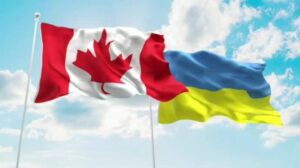
Canadian Prime Minister Mark Carney announced last Friday that his country will contribute 500 million euros to the European Union’s planned 90 billion euro loan for Ukraine, APA reports.
“As for the loan for Ukraine… 500 million euros will be our initial contribution. This is a very important and effective mechanism, and I truly commend the initiative of European Commission President von der Leyen, the members of the Commission, and President Costa in establishing it—using frozen assets to provide Ukraine with much-needed financing,” Carney stated during a joint press conference with European Commission President Ursula von der Leyen and European Council President António Costa.
The Canadian Prime Minister noted that his country’s contribution is an example of the implementation of Canada’s recently announced partnership with the European Union, adding that it is a “positive alliance.”



