

Heating bills were the main reason for the initiation of enforcement proceedings related to utility payments in Ukraine during the first half of 2026. Over the course of six months, 46,186 thousand enforcement proceedings were initiated regarding heating debts. These cases account for 42.5%, or, rounded, 43%, of all new utility debts, according to Opendatabot.
In second place are debts for water supply—19,416 thousand cases, or 17.9%.
Another 12,648 thousand cases, or 11.7%, are related to payments for housing maintenance services. Gas supply accounts for 11,538 thousand cases, or 10.6%, while electricity accounts for 9,947 thousand, or 9.2%.
A total of 7,020 thousand cases were opened due to debts for waste collection, while another 1,806 thousand were related to other types of utility services.
The largest group of debtors consisted of Ukrainians aged 46 to 60—they accounted for 38,119 thousand cases, or 35.1%.
People over 60 accounted for 27,695 thousand cases, or 25.5%, while citizens aged 36 to 45 accounted for 26,076 thousand, or 24%. The share of debtors under 35 was about 15%.
Women were involved in 60,141 thousand new cases, that is, more than half of all cases. The highest number of cases against a single individual in 2026 was recorded for a resident of the Mykolaiv region born in 1952—15 cases, all due to electricity debt.
In total, 108,561 thousand proceedings regarding utility debts were initiated in Ukraine from January through June. Of these, 70,206 thousand—or 65%—remained open and unpaid as of early July.
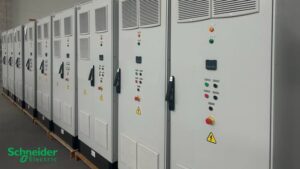
Schneider Electric has implemented a large-scale infrastructure project: 26 Ukrainian cities have received state-of-the-art equipment to improve the energy efficiency and operational reliability of their district heating systems.
Completing the project before the start of the 2025/2026 heating season allowed heating utilities to better prepare for peak loads. Thanks to the equipment provided, the cities were able to navigate the heating season more smoothly, reducing the risk of unscheduled outages and improving the overall efficiency of their systems.
As part of the project, Schneider Electric supplied control cabinets for pumps and blower mechanisms, equipped with state-of-the-art variable-frequency drives, to 26 cities in Ukraine across the Chernihiv, Cherkasy, Lviv, Ivano-Frankivsk, Ternopil, Rivne, Vinnytsia, Khmelnytskyi, Zhytomyr, Odesa, Kirovohrad, Kherson, Sumy, Poltava, and Kyiv regions.
A key element of the project was the implementation of variable-frequency drives to regulate the operation of pumping equipment at heat supply companies, which significantly improved the energy efficiency of the systems, reduced electricity consumption, optimized operating costs, and extended the service life of the equipment.
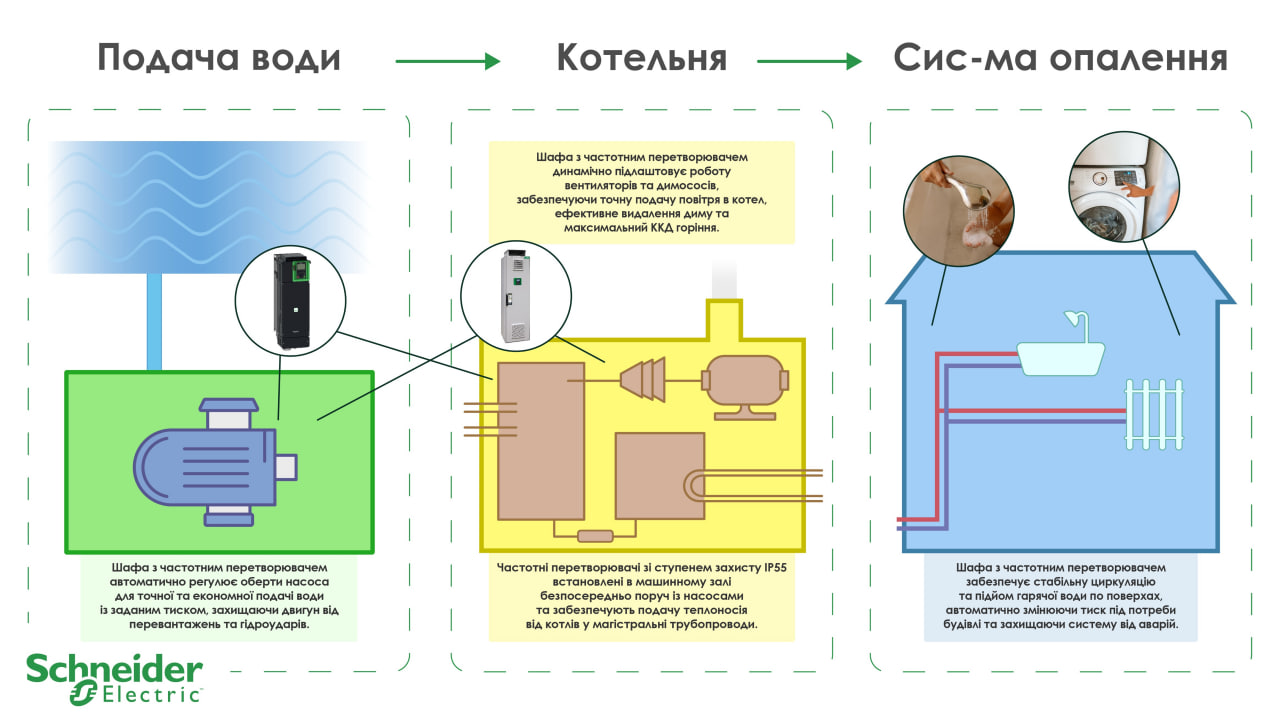
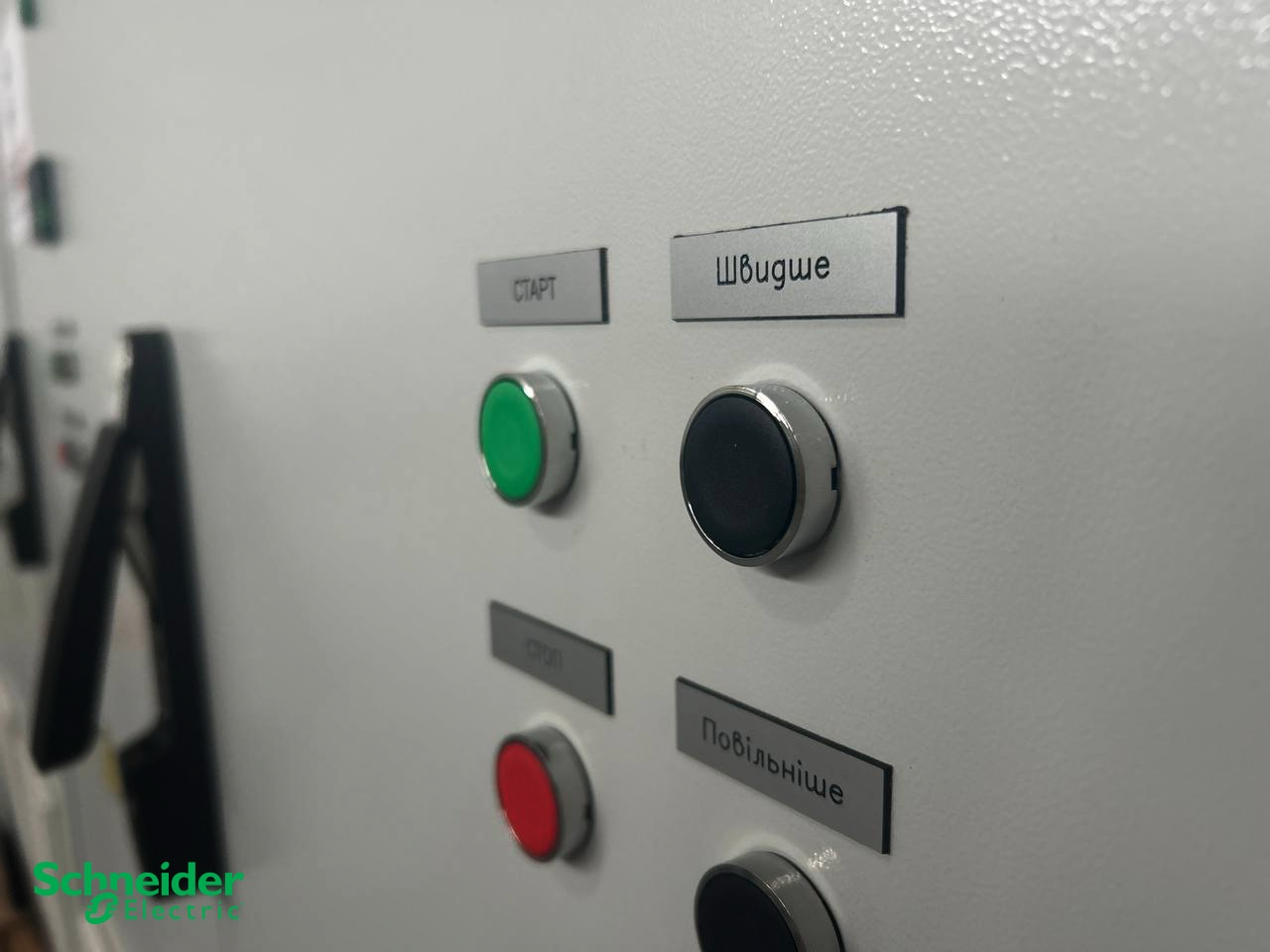
The solutions, based on Schneider Electric technologies, include fully equipped control cabinets for pumping equipment. The cabinets are protected against moisture and dust, allowing them to be installed directly in machine rooms, thereby reducing costs and simplifying installation.
The companies have gained tools for more flexible equipment management, reducing the load on the power grid, and improving the quality of heat supply services for consumers.
“This is not just about supplying equipment, but about a long-term investment in energy efficiency and the stability of heat supply in Ukraine. Already today, we are seeing how the implemented solutions are helping enterprises optimize energy consumption, improve system reliability, and lay the foundation for further modernization of the industry,” said Mykhailo Bubnov, CEO of Schneider Electric Ukraine.
The completed project serves as an example of collaboration aimed at implementing modern energy-efficient technologies and improving the operational efficiency of Ukraine’s utility companies.
Schneider Electric is a global leader in energy technologies that enhances efficiency and promotes sustainable development through the electrification, automation, and digitalization of industry, business, and residential spaces. The company’s technologies enable buildings, data centers, factories, infrastructure, and power grids to function as open, interconnected ecosystems, increasing productivity, resilience, and environmental sustainability. The company’s portfolio includes smart devices, software-defined architectures, artificial intelligence-based systems, digital services, and professional consulting services. With 160,000 employees and 1 million partners in over 100 countries, Schneider Electric consistently ranks among the world’s most sustainable companies.
ENERGY EFFICIENCY, EQUIPMENT, HEATING, MODERNIZATION, Schneider Electric

Ukraine could become a European lion in terms of economic growth, but it must continue with the necessary reforms, emphasized International Monetary Fund Managing Director (IMF) Kristalina Georgieva during a discussion on the project “Ukraine: At the Forefront of the Future,” organized by the Victor Pinchuk Foundation in Davos on the sidelines of the World Economic Forum.
“Electricity and heating are still subsidized… We know why the country does this, but it needs to be eliminated. There is still work to be done in terms of the fiscal situation. We are currently looking at how to make the distribution of the tax burden more equitable. It’s not easy, but it needs to be done,” she said.
“I look back on my country’s history and can tell you that it was very painful. After the euphoria of the disappearance of communism came the harsh reality that economic recovery requires sacrifices. Therefore, this is the number one issue — unfinished business,” the IMF chief emphasized, recalling Bulgaria’s experience.
Georgieva noted that it is also necessary to remove all obstacles to the dynamism of the private sector, and drew particular attention to security and the availability of labor.
According to her, during a meeting with business leaders in Kyiv last week, some of them raised the issue of access to labor, which needs to be resolved, above the issue of security. The IMF chief said that the Fund is ready to assist with practical issues such as the return of Ukrainians home, solving the problem of structural unemployment, and integrating veterans.
She added that it is also incredibly important for Ukraine to complete its accession to the European Union within a reasonable time frame, because this is a magnet for the Ukrainian economy to fully integrate into Europe.
“Third, you must believe in yourself like a lion. So get up in the morning and roar. Confidence matters. And I tell you from my own experience, from Bulgaria’s experience, that it will not be easy. But if you have that confidence and you demonstrate it day after day, if you put aside internal disputes, if you bury corruption for good, of course you will succeed,” Georgieva summed up the tasks.
As for achievements, she noted that during the war, Ukraine managed to achieve better results in reforms than before the war, including eight reviews of the four-year extended financing program launched in the spring of 2023.
As reported, under the EFF program, the Ukrainian government has committed to adopting a roadmap for the gradual liberalization of the gas and electricity markets within six months after the end of martial law, with a time-bound implementation plan for the period after its repeal.
“Such a roadmap is also part of the EU-Ukraine Plan and will cover reforms of special obligations (PSO), plans for a gradual increase in tariffs/tariff methodology, mechanisms for resolving the debt problem, as well as a comprehensive scheme to protect the most vulnerable households,” the program stated.
In turn, the IMF noted in mid-2025 that gas and electricity tariffs for the population cover about half of the market price.
At the end of last year, Ukraine and the IMF reached a staff-level agreement (SLA) on a new four-year program, which could theoretically be reviewed by the Fund’s Board of Directors in February this year, according to Communications Director Julia Kozak.
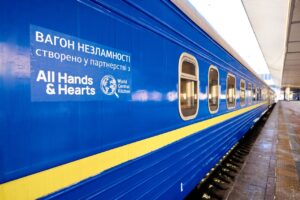
Ukrzaliznytsia has equipped 100 of its own railcars as temporary mobile heating, communication, and leisure centers in response to power outages across the country, the company said in a statement on Tuesday.
“Ukrzaliznytsia, with the help of its partners—All Hands&Hearts, World Central Kitchen, Hachiko Foundation, and White Stork—has equipped 100 of its railcars as temporary mobile heating, communication, and leisure centers,” the company said in a statement on its Telegram channel.
It is noted that the railcars have a full heating system. In addition, they are equipped with chargers from generators and portable power sources, microwaves, refrigerators, and Starlink kits for uninterrupted communication.
Ukrzaliznytsia added that each of the 100 carriages can be used at the request of local authorities as a free mobile hub with a constant autonomous power supply.
Separately, the company noted that the cars have a children’s compartment equipped with play sets, as well as a compartment for a comfortable stay with pets.
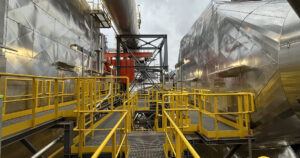
The Kryvyi Rih Mining and Metallurgical Plant PJSC ArcelorMittal Kryvyi Rih (AMKR, Dnipropetrovsk region) has created an autonomous heating system for its coke production facility (CPF) to save energy and improve energy efficiency.
According to information from the primary organization of the Trade Union of Workers in the Metallurgical and Mining Industry of Ukraine (PO PMGU) AMKR on its website, energy specialists have completed a project to create an autonomous heating system at the CCF.
At the same time, with reference to the head of the KHV energy department, Alexander Melnikov, and the head of the steam supply section of the department, Dmitry Khvorostinin, it is specified that previously, heating water for the heating system at KHV was supplied from a neighboring metallurgical production facility. However, in order to use energy resources more rationally and prevent unjustified heat losses, KHV Director Nikolai Galushkin proposed introducing autonomous heating that would operate on the principle of complete self-sufficiency.
Almost everything needed to create an autonomous heating system was found at the enterprise. The largest component of the new system, a storage tank for heating water, had previously been used at the chemical plant.
The heat transfer medium supplied to the heating system was chemically purified water produced at the chemical plant, and it was decided to use low-pressure steam produced in-house to heat it. As a result, a closed-cycle system was created, which is as energy-efficient as possible. Appropriate metering devices were installed to control and regulate the pressure and temperature of the heat transfer fluid.
ArcelorMittal Kryvyi Rih is the largest producer of rolled steel in Ukraine. It specializes in the production of long products, in particular, rebar and wire rod. The company has a full production cycle, with a production capacity of over 6 million tons of steel, more than 5 million tons of rolled products, and over 5.5 million tons of pig iron per year.
ArcelorMittal owns Ukraine’s largest mining and metallurgical complex, ArcelorMittal Kryvyi Rih, and a number of small companies, including ArcelorMittal Beryslav.

According to Eurostat data on material deprivation in the “Housing in Europe – 2025 edition” review, around 9% of the European Union population in 2024 could not afford to heat their homes adequately.
The EU’s statistical office notes that the problem of energy poverty and high utility costs remains significant for millions of households, despite the support measures taken after the 2022–2023 energy crisis.
Low-income households and residents of old, energy-inefficient housing in a number of Eastern and Southern European countries remain particularly vulnerable.



