
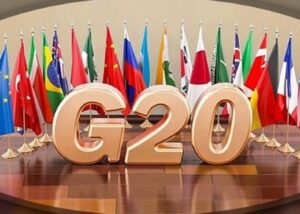
China was the only G20 country that did not support a number of provisions in the final document of the meeting of finance ministers and central bank governors of the “Group of Twenty,” held August 31–September 1, 2026, in Asheville, North Carolina.
As a result, instead of a joint communiqué agreed upon by all participants, the United States, as G20 chair, issued a chair’s statement. The official document from the U.S. Department of the Treasury states that it was endorsed by all G20 members present, except for China, which opposed four sections.
One of the main points of contention was the issue of global trade imbalances. The text, supported by the other countries, calls on nations to abandon non-market policies and practices that exacerbate imbalances. Countries with excessive and persistent external trade surpluses are urged to eliminate factors that constrain domestic consumption and create excessive dependence of economic growth on exports.
U.S. Treasury Secretary Scott Bessent stated after the meeting that China was the only dissenting participant. He called China’s current account surplus the largest and “unsustainable” and stated that a non-market economic model that constantly increases the supply of cheap export goods cannot be sustainable.
China also did not support provisions to expand the International Monetary Fund’s role in monitoring global economic imbalances. The other G20 members advocated for strengthening the IMF’s analysis, including an assessment of non-market policies, the factors driving external trade imbalances, and their impact on other economies.
Another point of contention was the Strait of Hormuz. The G20 statement expressed concern over ongoing disruptions to energy trade and emphasized the need for free, safe, and predictable shipping through the Strait of Hormuz and other key maritime routes. China opposed the entire relevant section of the document.
In addition, Beijing disagreed with the section concerning sovereign debt restructuring and the continued application of the G20’s Comprehensive Framework for Addressing the Debt Problems of Developing Countries. An official document from the U.S. Treasury Department explicitly states that China objected to paragraphs 4, 10, 11, and 13 of the statement.
Despite the lack of full consensus, the remaining 19 G20 members supported the approach to reducing global imbalances. Reuters notes that the issue has effectively turned into a debate over China’s export model, industrial subsidies, and the growing supply of Chinese products to global markets.
These disagreements come amid growing concerns from the U.S., the EU, and several other major economies regarding China’s manufacturing capacity and its expanding trade surplus. Western nations fear that a glut of Chinese industrial goods could intensify pressure on local manufacturers and increase dependence on specific supply chains.
The meeting in Asheville marked the second gathering of G20 finance ministers and central bank governors under the U.S. presidency in 2026. Key topics included economic growth, global imbalances, public debt, digital assets, financial literacy, and the state of the global financial system.
The G20 currently comprises 19 countries: Argentina, Australia, Brazil, the United Kingdom, Germany, India, Indonesia, Italy, Canada, China, Mexico, Russia, Saudi Arabia, the United States, Turkey, France, South Africa, South Korea, and Japan.
In addition, the European Union and the African Union are full members of the G20. Thus, following the African Union’s accession in 2023, the G20 effectively comprises 21 members—19 countries and two regional organizations.
Ukraine ranks 38th among the countries of the world in terms of the absolute amount of government debt, estimated at about $276.2 billion, or 122.6% of projected GDP in 2026, according to an analysis by the Experts Club information and analytical center.
The ranking was compiled on the basis of the International Monetary Fund’s April World Economic Outlook database. The General government gross debt indicator — the gross debt of the general government sector — was used to compare countries.
This approach makes it possible to compare countries using a single methodology, since national definitions of government debt may differ significantly.
According to the IMF estimate, Ukraine’s government debt in 2026 amounts to about $276.2 billion, corresponding to 122.6% of projected GDP. This figure is higher than the often-published data on direct government and government-guaranteed debt because the general government methodology covers a broader public administration sector.
In the global ranking, Ukraine is positioned between Sweden, which ranks 37th with debt of $279.3 billion, and Taiwan, which ranks 39th with $269.2 billion.
In terms of the debt-to-GDP ratio, Ukraine has a significantly higher debt burden than most countries in Central and Eastern Europe.
For comparison, Poland has about $745.5 billion in government debt, or 65.7% of GDP, Romania — $297.8 billion and 61.9% of GDP, Hungary — $211.1 billion and 77.9% of GDP, and Serbia — $47.77 billion and 42.6% of GDP.
The world’s largest government debtors in absolute terms remain the United States — about $40.73 trillion, China — $22.29 trillion, and Japan — $8.95 trillion.
The total government debt of 180 countries for which comparable IMF statistics for 2026 are available amounts to about $119.4 trillion, with the top ten accounting for approximately 81% of this amount.
Experts Club notes that assessing a country’s debt sustainability requires taking into account not only the absolute size of the debt, but also its ratio to GDP and the cost of servicing it.

The International Monetary Fund (IMF) has included in the Extended Fund Facility (EFF) program a new structural benchmark with a deadline of December 31, 2026, which calls for the submission to the Verkhovna Rada of specific rules to combat tax evasion under the simplified tax system.
According to the updated EFF Memorandum of Understanding, the new legislation is intended to address the issues of artificially splitting businesses to maintain preferential limits, manipulative switching between tax regimes, and the use of the simplified system to conceal actual employment relationships and evade taxes on wages and the Unified Social Tax (UST).
At the same time, IMF experts recommended revising the draft of the new Labor Code regarding the definition of employment, noting that the requirement to meet at least five of eight criteria to establish an employment relationship places an excessive burden of proof on regulatory authorities, whereas meeting three criteria is sufficient.
According to the memorandum, the fight against the shadow economy requires additional resources for all tax authorities; therefore, following the appointment of a new head of the State Customs Service (SCS) in April 2026, the government must ensure sufficient funding is available for the re-certification of all customs officials, which is scheduled to begin in mid-2026. In addition, the 2027 budget must provide sufficient funding for the State Customs Service (SCS), the State Tax Service (STS), and the Economic Security Bureau (ESB) to improve their ability to hire and retain qualified personnel.
In the document, the government highlighted the challenges of passing legislation in parliament but noted that it remains committed to eliminating the VAT exemption for sole proprietors, given its importance for combating the shadow economy, mobilizing revenue, EU accession, and attracting donor support. Although the government considers improving tax administration to be extremely important, it sees greater risks in this area than the Fund’s staff does, as administrative reforms could lead to revenue losses if they are not carefully planned and implemented.
As reported, the IMF Executive Board approved the first review of Ukraine’s four-year EFF program early Tuesday morning, allowing for the immediate disbursement of approximately $690 million in the second tranche; however, it noted the failure to meet several performance criteria and cautioned against backsliding on reforms. Taking the first tranche into account, total disbursements under the program—which has a total value of $8.1 billion and was approved in late February of this year—will amount to approximately $2.2 billion.
The updated Memorandum on Ukraine’s Economic and Financial Policies under the Extended Fund Facility (EFF) program with the International Monetary Fund (IMF), following the results of its first review, also includes seven new structural benchmarks, six of which are fiscal.
de-shadowing, IMF, Individual entrepreneurs, simplified system, TAX

In 2027, Ukraine may begin the process of gradually raising electricity and gas rates for households after developing appropriate protection programs.
This is stated in the updated memorandum on Ukraine’s economic and financial policies under the Extended Fund Facility (EFF) program with the International Monetary Fund (IMF), following the results of its first review.
“The government has committed to conducting an assessment by the end of February 2027 of utility support programs aimed at protecting vulnerable households. Once appropriate protection programs have been developed, household tariffs should be gradually increased—this process can begin in 2027,” the document’s authors state.
According to the text of the memorandum, the goal of this process is to meet the needs for recovery and debt reduction in the energy sector, while full price liberalization will eventually be necessary to attract post-war investment.
“The Ukrainian government (IF-U) emphasized that tariff increases should occur only after an assessment and, if necessary, reform of existing social protection systems,” the authors of the document noted, among other things.
It is noted that large-scale quasi-fiscal measures in the energy sector and the existing tariff structure pose serious risks to investment, reconstruction, and the development of a stable energy supply and power grid.
According to preliminary expert estimates—which will be refined during future technical assistance—fixed energy tariffs that are below market rates—in particular, due to moratoriums imposed since the start of the war—cost at least 2.2% of GDP annually in the form of off-target subsidies resulting from the quasi-fiscal activities of state-owned energy enterprises, while targeted transfers for public utilities account for about 0.6% of GDP in the budget.
“Significant fiscal risks arise from fixed utility rates for households, which currently amount to about 55% of comparable supply contracts,” the document states.
As a result, the energy sector is increasingly relying on in-kind contributions, grants, and preferential financing to meet its needs for repairs and imports. For example, Naftogaz took on additional debt to finance repairs and imports, causing its debt to rise by 63% year-over-year in 2025. The government is currently seeking donor support to ensure the timely completion of necessary repair work and the implementation of plans to strengthen resilience, the authors of the document noted.
Montenegro’s economy will demonstrate average annual growth rates of around 3% in 2027–2031, according to an updated forecast by the International Monetary Fund (IMF).
According to data from the Serbian Economist Telegram channel, these rates will be higher than the average figures both for European Union countries and for eurozone states, where more moderate economic growth is expected during the period under review.
Experts note that Montenegro is maintaining its position as one of Europe’s most dynamically developing economies, although it is not yet among the regional leaders in terms of growth rates. In their opinion, in order to accelerate economic development and reduce the gap with the most developed EU countries, the country needs to increase the volume of investment in the manufacturing sector, digital technologies, innovation, and other industries with high added value.
At present, the main drivers of Montenegro’s economy remain tourism, construction, and the services sector. However, economic diversification and the development of industrial production are regarded as key conditions for ensuring sustainable long-term growth and increasing the country’s competitiveness.
The International Monetary Fund forecasts that Ukraine will be one of Europe’s fastest-growing economies in 2027–2031, according to a Euronews analysis based on data from the IMF’s World Economic Outlook. The primary source of the data is the IMF’s World Economic Outlook database, which publishes country-specific forecasts, including real GDP growth figures through 2031.
According to Euronews’ calculations, the IMF expects Ukraine’s economy to grow at an average annual rate of 3.8% from 2027 to 2031. The strongest year in the forecast period is expected to be 2028, when growth could reach about 4.2%. Based on this indicator, Ukraine ranks among the top five European economies expected to grow more than twice as fast as the eurozone.
In the list of Europe’s fastest-growing economies, Ukraine is ranked after Malta and Kosovo. Further down the list are Serbia, with an average annual growth rate of 3.52%, and Moldova, with a forecast of about 3.5%. By comparison, according to the IMF, the eurozone economy is projected to grow by an average of 1.2% per year from 2027 to 2031, while the EU economy as a whole is expected to grow by approximately 1.4%.
The key factor driving Ukraine’s growth is cited as the post-war recovery of its economy and infrastructure. Euronews notes that the IMF’s forecast is effectively a recovery scenario: it assumes a gradual de-escalation of the war and the launch of large-scale investments in reconstruction. According to the report, the estimated cost of reconstruction is approaching $600 billion.
At the same time, the outlook for Ukraine remains one of the most uncertain in Europe. In its June 12, 2026, report on Ukraine, the IMF explicitly noted that the country’s prospects remain “extremely uncertain,” as the war continues to inflict severe damage on the population and the economy. The IMF also indicated that Ukraine’s GDP growth in 2026 could slow to 1.0–1.6% due to the consequences of Russia’s ongoing war against Ukraine and external shocks.
It is precisely this difference between the short-term and medium-term outlooks that is the key element of the forecast. In 2026, the Ukrainian economy remains under pressure from military risks, infrastructure damage, fiscal expenditures, labor shortages, and high dependence on external financing. However, in 2027–2031, provided the security situation improves, recovery could become the main source of growth.
For Ukraine, this forecast implies that the country could become one of Europe’s most dynamic economies—not through typical cyclical growth, but through the effects of post-war reconstruction, investments in infrastructure, construction, energy, logistics, industry, and integration with the EU market.
However, this scenario depends directly on security, international aid, the sustainability of public finances, the pace of reforms, and the ability to attract private capital.
Without a reduction in military risks, growth could turn out to be significantly lower: Euronews notes that under the IMF’s adverse scenario—assuming intense hostilities continue—Ukraine’s growth in 2027 could be only about 1%.
Thus, in the IMF’s projections, Ukraine appears to be one of Europe’s most promising economies for the 2027–2031 period, but this potential remains closely tied to the end of the war, the scale of reconstruction, and the country’s ability to translate international support into long-term economic growth.



