

According to Experts.news, the structure of Ukraine’s dairy exports has changed significantly over the past year: the share of butter and other milk fats in foreign exchange earnings has more than halved, while dry and condensed milk have become the largest export category, according to an analysis by the Union of Dairy Enterprises of Ukraine (UDEU).
In August 2025, butter and other milk fats under commodity code 0405 accounted for 36% of the value of Ukraine’s dairy exports, whereas in August 2026, their share fell to 15%. At the same time, the share of dry and condensed milk increased from 24% to 37%, and that of whey from 5% to 11%.
The change in structure occurred gradually. Butter accounted for 36% in August 2025, falling to 25% in October, to 22% in March 2026, and to 15% in August. At the same time, the share of dry and condensed milk rose from 24% to 24%, then to 35% and 37%, respectively. Thus, the shift in the structure of Ukrainian dairy exports occurred primarily between the fall of 2025 and the spring of 2026.
According to the SMPU’s assessment, one of the factors was the situation on the global market for milk fats. Butter prices were under pressure, and the Global Dairy Trade index fell for nine consecutive auctions at the end of 2025. Since the export structure is calculated in value terms, the decline in butter’s share is linked not only to physical shipment volumes but also to changes in global prices.
At the same time, experts cite the growing role of whey as the most notable structural change. Its share of export revenue more than doubled over the year. By August 2026, dry milk, condensed milk, and whey together accounted for 48% of the value of Ukraine’s dairy exports.
The share of cheeses—which are considered higher-value-added products with potentially higher profit margins—remained virtually unchanged, at about 24% in August 2025 and 25% a year later. Thus, the structure of Ukraine’s dairy exports is shifting increasingly toward commodities and raw materials.
This trend is unfolding against the backdrop of a general deterioration in the dairy industry’s trade balance. According to data published by the Ukrainian Dairy Producers Association (SMPU) on September 2, Ukraine exported $176.9 million worth of dairy products in January–August 2026, which is 20.5% less than during the same period last year. At the same time, imports increased by 24.7% to $247.2 million.
In volume terms, butter exports fell by roughly half over the eight-month period, while shipments of dry milk and condensed milk decreased by 7%. At the same time, exports of fermented milk products rose by 28%, milk whey by 1.1%, and cheese by 0.9%.
As a result, Ukraine shifted from a trade surplus in dairy products to a trade deficit. For January–August 2026, the deficit totaled $70.3 million, whereas a year earlier the surplus had reached $24.1 million. The export-to-import ratio fell from 1.12 to 0.72.
On the import side, cheese remains the largest category, although its share in August fell year-over-year from 82.3% to 76.9%. At the same time, the share of imported milk and cream, whey, and butter increased, intensifying competition for Ukrainian processors in the domestic market.
The Union of Dairy Enterprises of Ukraine (SMPU) brings together Ukrainian milk producers and processors and represents the interests of companies in the industry. The organization was founded in 2001.
Original source: analysis by the Union of Dairy Enterprises of Ukraine on Ua Dairy

In August 2026, Ukrainians purchased 20,600 used passenger cars imported from abroad, which is 9% less than in the same month of 2025, according to a report by “Ukravtoprom” on its Telegram channel.
Compared to July of this year, demand for such cars fell by 8.4%.
Gasoline-powered cars accounted for the largest share of this segment of the auto market in August, increasing their share by 4 percentage points compared to August 2025—to 52%.
Next came diesel cars—as in the previous year, their share stood at 17%, while the share of electric vehicles fell to 17% from 26%; however, they still outpaced hybrids, whose share was 11% (6%). The share of cars with LPG systems remained unchanged at 3%.
The average age of imported used cars was 8.7 years.
The Volkswagen Golf confidently tops the list of the ten most popular imported used models with 875 units. Next are the VW Tiguan—775 units, the Nissan Rogue—707 units, the Audi Q5—695 units, the Skoda Octavia—633 units, the Renault Megane—532 units, the Tesla Model Y—494 units, the Tesla Model 3—480 units, the
Nissan Leaf—454 units, and the Ford Escape—408 units.
As reported with reference to “Ukravtoprom,” in 2025, Ukrainians purchased 274,300 used passenger cars imported from abroad, which is 24% more than in 2024. Following the Volkswagen Golf, the top three most popular models included two Tesla electric vehicles—the Model Y and Model 3.

According to Experts.news, in August 2026, the OKKO Group became the largest importer of diesel fuel into Ukraine, supplying nearly 89,000 metric tons—a 47% increase compared to August of last year, as reported by the A-95 Consulting Group.
Ukrnafta took second place with a volume of nearly 77,000 metric tons. Over the past year, the company increased its imports by 2.4 times.
“Energo Trade JSC” became the third-largest importer, with 55,600 metric tons, although its shipments fell by 44%.
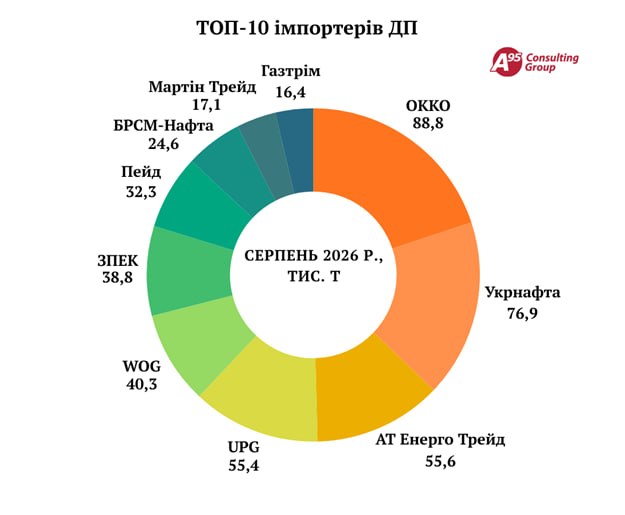
UPG imported 55,400 metric tons, a 3% increase, while WOG imported 40,300 metric tons, a 46% increase compared to last year.
The Western Fuel and Energy Company (ZPEK) also showed significant growth, increasing its imports by a factor of 2.2 to 39,000 metric tons.
According to the “A-95” chart on the third page of the press release, the rest of the top 10 importers for August included “Paid” with 32,300 metric tons, “BRSM-Nafta” with 24,600 metric tons, “Martin Trade” with 17,100 metric tons, and “Gaztrim” with 16,400 metric tons.
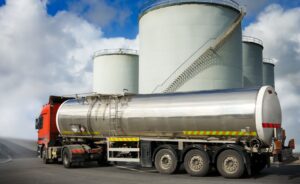
According to Experts.news, Ukraine imported 4.2 million metric tons of diesel fuel in January–August 2026, which is 7% more than during the same period in 2025, the A-95 Consulting Group reported.
However, in August alone, shipments fell by 10% year-over-year to 588,000 metric tons.
The main feature of the market in August was a significant restructuring of logistics. While a year earlier, approximately 50% of imported diesel fuel came via the southern route, in August 2026 that share fell to 33%. At the same time, the share of shipments via the western border rose from 50% to 67%.
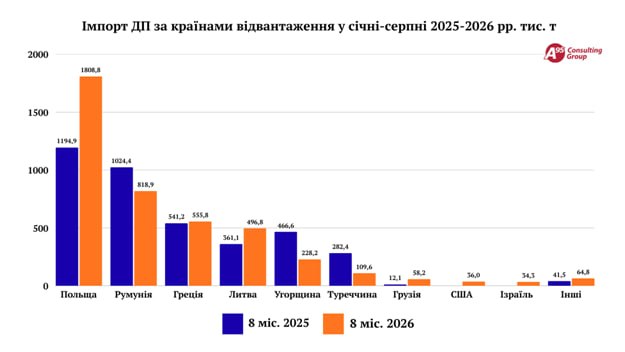
According to Serhiy Kuyun, director of “A-95,” the change in routes is linked both to the price situation on the European market amid the war in Iran and to the increase in military risks, freight costs, and secondary logistics along the southern route.
A-95 expects that the fall will remain a challenging period for the fuel market due to intensified Russian attacks and market turbulence linked to the war in Iran.

In January–July 2026, Ukraine imported 28,300 metric tons of cheese, which is 24.7% more than during the same period last year, while exports of Ukrainian cheese rose by only 1.2%—to 8,200 metric tons.
This is according to data from the State Customs Service, cited by the Association of Milk Producers (AMP) in a publication dated August 26.
Thus, according to calculations based on AMM data, the physical volume of cheese imports was approximately 3.5 times greater than exports, and the difference between imports and exports reached about 20,100 metric tons.
The gap in monetary terms is even more pronounced. The value of cheese imports over the seven-month period totaled $168.8 million, an increase of 17.9%, while exports brought Ukraine $37.4 million, which is only 0.5% more than last year’s figure.
Thus, imports exceeded exports in monetary terms by approximately 4.5 times, and the trade deficit in cheese amounted to about $131.4 million.
The data provided by the APM also shows that the average estimated cost of imported cheese was about $6,000 per metric ton, while that of exported cheese was about $4,600 per metric ton.
At the same time, imports in physical terms are growing significantly faster than their value: the volume increased by 24.7%, while procurement costs rose by 17.9%. This indicates a decrease in the average calculated import value per metric ton by approximately 5% compared to January–July of last year.
For comparison: Ukraine’s total merchandise imports in January–July 2026 amounted to $58.1 billion, while exports totaled $24.1 billion, according to the State Customs Service.
Poland, Germany, and the Netherlands remain the main suppliers of cheese to the Ukrainian market, while Ukrainian products are mainly exported to Moldova, Kazakhstan, and Germany.
Original source: Association of Milk Producers, citing data from the State Customs Service.
In January–July 2026, Ukraine imported $507.5 million worth of tractors, which is 2% more than during the same period last year, when imports totaled $497.8 million, according to data from the State Customs Service.
However, in July alone, tractor imports fell by 5% compared to July 2025 and by 3% compared to June of this year, to $70.6 million.
Germany was the largest supplier of tractors to Ukraine over the seven-month period, accounting for 19.4% of imports, or $98.3 million.
China supplied nearly the same volume—$98 million, or 19.3% of total imports. The United States ranked third with shipments worth $89.6 million, accounting for nearly 17.7%.
Thus, the three largest countries accounted for about 56.4% of all tractor imports into Ukraine during January–July.
Compared to last year, the supplier structure has changed. In January–July 2025, the United States was the largest supplier with $94.1 million in shipments, followed by China with $87.3 million and Germany with $83.9 million.
Over the year, shipments from Germany increased by approximately 17%, and those from China by more than 12%, while imports from the United States decreased by about 5%.
For the full year of 2025, Ukraine imported tractors worth $845.7 million, which was 7.9% higher than in 2024. The main suppliers at that time were also the United States ($179.7 million), Germany ($145 million), and China ($142.8 million).
Thus, in 2026, the growth in tractor imports continued, but its pace slowed noticeably: over the first seven months, the figure increased by only 2%, and by July, a negative year-over-year trend had already been recorded.



