
Indian Foreign Minister Subramaniam Jaishankar stated that India has provided Ukraine with 19 shipments of humanitarian aid, including 160 metric tons of cargo consisting of generators, medicines, and medical equipment.
According to a correspondent for “Interfax-Ukraine,” he made these remarks at a press conference with Ukrainian Foreign Minister Andriy Sibiga on Thursday in Kyiv. Jaishankar noted that he would meet with Ukrainian President Volodymyr Zelenskyy later that day and convey greetings from Prime Minister Narendra Modi.
“To date, we have provided 19 shipments of humanitarian aid, including 160 metric tons of generators, medicines, medical equipment, and other items. Minister Sibiga and I will discuss what further steps can be taken in this regard,” the minister said.
He expressed regret and condolences regarding the death of an Indian citizen two days ago as a result of an attack in Kyiv. Jaishankar noted that, in India’s view, “solutions will not emerge on the battlefield.”
“Every day of the conflict means only more deaths and more destruction. It is clear that the parties involved must find a way forward. But if India can help in any way, we are ready,” the foreign minister emphasized.
He added that this was the focus of today’s conversation with the Ukrainian foreign minister.
The sides also discussed attacks on commercial shipping.
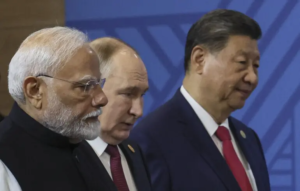
Indian Prime Minister Narendra Modi, during a meeting with Russian President Vladimir Putin in Bishkek on August 31, stated the need to move toward ending hostilities and finding a sustainable peaceful solution.
“Every day of war sets humanity back. We must work to end hostilities,” Modi said during the open part of the bilateral talks. He was referring to the ongoing Russia-Ukraine war. The Indian prime minister has consistently advocated ending it through negotiations and diplomacy. At his previous meeting with Putin at the SCO summit in Tianjin in September 2025, Modi also called for accelerating the end of the conflict and finding a long-term peaceful solution.
Modi and Putin met in Bishkek, the capital of Kyrgyzstan, on the sidelines of the 26th summit of the Shanghai Cooperation Organisation (SCO). The formal meeting of the SCO Council of Heads of State is scheduled for September 1, while on August 31 the leaders are holding bilateral meetings and participating in other summit events.
The SCO was established on June 15, 2001, in Shanghai by Kazakhstan, China, Kyrgyzstan, Russia, Tajikistan and Uzbekistan on the basis of the so-called “Shanghai Five.” India and Pakistan became full members in 2017, Iran in 2023, and Belarus in 2024.
The SCO currently includes 10 states: Belarus, India, Iran, Kazakhstan, China, Kyrgyzstan, Pakistan, Russia, Tajikistan and Uzbekistan. Their combined population exceeds 3.4 billion people, and the organisation’s countries account for about a quarter of global GDP. Afghanistan and Mongolia are observers, while another 15 countries have dialogue partner status, including Azerbaijan, Armenia, Egypt, Turkey, Saudi Arabia and the UAE.
The SCO deals with regional security issues, while the organisation itself officially stresses that it is not a military alliance. Its permanent secretariat is located in Beijing, and the Regional Anti-Terrorist Structure is based in Tashkent.
The summit in Bishkek is taking place in the year of the 25th anniversary of the SCO. The Indian government had previously said that Modi intended to use the forum to promote three New Delhi priorities — security, transport and economic connectivity, and new opportunities for cooperation.
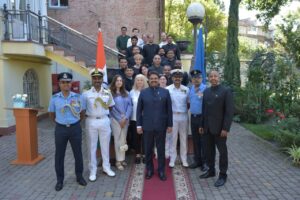
The Indian Embassy in Ukraine held a ceremonial event in Kyiv to mark India’s 80th Independence Day. The celebration took place at India House and was attended by representatives of the Indian community, Ukrainian government agencies, the business sector, the cultural sector, and civil society organizations.
At the ceremony, the recently appointed Indian Ambassador to Ukraine, Anjani Kumar, raised the national flag and read a message from Indian President Draupadi Murmu to those in attendance on the occasion of the holiday.
The event was attended by members of the Indian community living in Ukraine—including students and entrepreneurs—as well as representatives of Ukrainian government agencies, politicians, Indologists, writers, dancers, representatives of cultural and spiritual organizations, and Ukrainian friends of India. The embassy described the guest list as a broad representation of people connected to Indian-Ukrainian cultural and civic relations.
Anjani Kumar was appointed India’s new ambassador to Ukraine by a decision of the Indian Ministry of External Affairs on July 8, 2026. On August 10, Ukraine’s Deputy Minister of Foreign Affairs Oleksandr Mishchenko accepted copies of his credentials from him.
In an address on the eve of Independence Day, President Draupadi Murmu emphasized that India is moving toward its goal of becoming a developed nation by the centennial of its independence, and that development must provide opportunities for all segments of the population. She particularly highlighted the contributions of students, scholars, engineers, doctors, workers, farmers, entrepreneurs, and the Indian diaspora to the nation’s development.
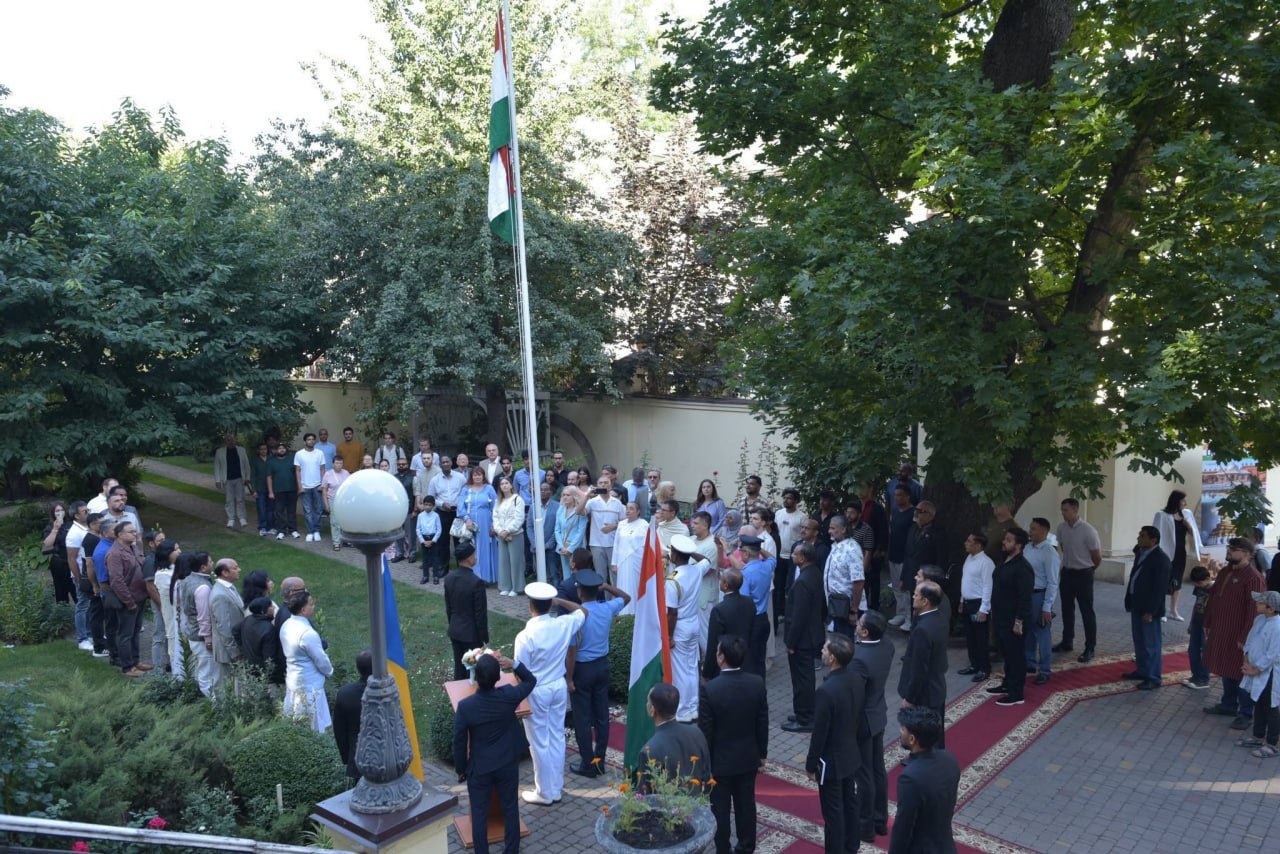
“The true meaning of freedom lies in ensuring that all citizens can seize opportunities to realize their aspirations,” the President of India stated in her address to the nation.
Murmur also highlighted the role of Indians living abroad and diplomatic mission staff in strengthening the country’s international standing. Among the priorities for further development, she cited digitalization, economic growth, expanding opportunities for women and youth, developing modern infrastructure, and preserving cultural heritage.
India gained independence from Great Britain on August 15, 1947. Therefore, in 2026, the country will celebrate its 80th Independence Day, even though 79 years have passed since independence was achieved: the 1947 celebration is considered the first Independence Day. Indian authorities are referring to this year’s celebration specifically as the 80th Independence Day.
The holiday is one of India’s major national holidays. The central ceremony is traditionally held in Delhi, where the prime minister raises the national flag near the Red Fort and delivers an address to the nation.
India was among the first countries to recognize Ukraine’s independence following the collapse of the Soviet Union. Diplomatic relations between the two countries were officially established on January 17, 1992.
The Indian Embassy in Kyiv began operations in May 1992. Prior to that, India had a Consulate General in Odesa, which had been operating since 1962 and was closed in 1999.
The Embassy of Ukraine in New Delhi was opened in February 1993 and became one of the first diplomatic missions of independent Ukraine in Asia. It continues to represent Ukraine’s interests in India and to develop political, economic, cultural, and humanitarian ties between the two countries.
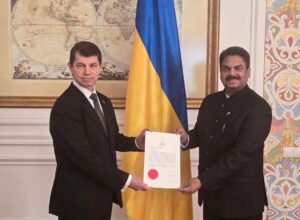
Oleksandr Mishchenko, Ukraine’s Deputy Minister of Foreign Affairs, accepted copies of the credentials from Anjani Kumar, the newly appointed Ambassador of the Republic of India to Ukraine. According to the press service of the Ukrainian Ministry of Foreign Affairs, the parties emphasized the importance of further developing bilateral cooperation and maintaining regular political dialogue at all levels.
The Deputy Minister emphasized Ukraine’s expectations that India play a more active role in promoting the restoration of a just and lasting peace in Ukraine and in holding the aggressor state accountable for the crimes it has committed.
“The parties discussed the agenda for upcoming high-level events, particularly in the context of implementing the agreements reached during Indian Prime Minister Narendra Modi’s visit to Ukraine on August 23, 2024,” the statement reads.
Special attention was paid to the development of interparliamentary cooperation and the further strengthening of collaboration in the humanitarian sphere. The parties also discussed ways to intensify bilateral economic cooperation and restore positive momentum in contacts between business representatives of the two countries.
“Following the meeting, the parties agreed to continue active cooperation and promote the further development of Ukrainian-Indian relations in areas of mutual interest. Oleksandr Mishchenko wished the Ambassador of the Republic of India success in his diplomatic mission in Ukraine and the achievement of significant results for the benefit of both countries and their peoples,” the Ministry of Foreign Affairs added.

Ukrainian IT services company SoftServe announced the completion of its acquisition of the Indian technology services company NewVision Software, which specializes in software development and the modernization of IT infrastructure based on cloud technologies, according to a company press release published on Tuesday.
As part of the deal, more than 700 engineers will join SoftServe. Among others, NewVision Software CEO Kapil Godani and Co-Chairman of the Board Balan Ramaswami will also join the company.
It is noted that NewVision Software will continue to operate under its own brand as a wholly owned subsidiary of SoftServe.
According to Andriy Stitsyuk, SoftServe’s Chief Financial and Operating Officer, an increasing number of the company’s clients are developing large-scale GCCs (Global Capability Centers) in India, where business decisions are made and engineering development takes place.
“Being alongside these teams in the same time zones and work environment allows SoftServe to co-create solutions in real time and respond quickly to new opportunities,” Stitsyuk is quoted as saying in the press release.
“In SoftServe, we have found a partner that shares this vision and combines world-class engineering expertise with a deep commitment to client success. Together, we can offer clients broader capabilities, greater scale, and confidence in implementing AI initiatives, while maintaining the level of partnership and engagement for which our teams are renowned,” said Kapil Godani, CEO of NewVision Software, in the press release.
SoftServe is a global digital engineering and technology consulting firm specializing in AI, data, and cloud solutions. The company was founded in 1993 in Lviv. Approximately 10,000 employees work in 49 offices around the world. Taras Kitsmey, Yaroslav Lyubinets, Oleg Denis, Yuriy Vasylyk, and Taras Verveha are co-owners of the IT services company SoftServe; Harry Propper serves as CEO.
NewVision Software is an IT consulting and technology services company specializing in software development, intelligent managed services, product engineering, and agentic assurance. NewVision Software’s headquarters are located in Pune, India.

Indian citizens became the largest group of foreign real estate buyers in Dubai in 2026, according to data from the DXB Interact platform, as reported by Gulf Today and Khaleej Times.
According to DXB Interact, Indian buyers accounted for 20.59% of total real estate purchases in the emirate as of late February 2026. In a Khaleej Times article citing Harbor Real Estate and DXB Interact, this figure was rounded to 20.6% as of early 2026.
Buyers from the United Kingdom ranked second with a share of 13.26–13.3%, followed by Egyptian citizens in third place with 12.6%. Next came the United States—about 9%, Pakistan—6.9%, Saudi Arabia and Australia—5.7% each, Germany—about 4.2%, France—3.8%, and Canada—about 3%.
Just outside the top ten, according to DXB Interact, are the Netherlands with a 2.83% share, Russia at 2.5%, Morocco at 2.33%, Spain and Kuwait at 2.11% each, Turkey at 2.05%, and Nigeria at 1.89%.
Analysts attribute foreign buyers’ sustained interest in the Dubai market to political stability, the absence of income tax, the possibility of 100% foreign ownership of properties in freehold zones, and long-term residency programs, including the Golden Visa.
Compact apartments remain the most active segment of the market. According to the Khaleej Times, one-bedroom apartments accounted for 34.9% of sales, or 27,590 transactions; studios accounted for 23.4%, or 18,471 transactions; and two-bedroom apartments accounted for 20.7%, or 16,399 transactions. This demand reflects investors’ interest in liquid properties with a lower entry threshold and rental yield potential.
Among Dubai’s districts, Dubai Islands led in apartment sales with 8.4 billion dirhams, followed by Airport City with 7.2 billion dirhams and Business Bay with 6 billion dirhams. In the villas and buildings segment, Al Yalayis 1 took first place with 10.6 billion dirhams, while Me’aisem Second led the land plots segment with 10.1 billion dirhams.
Harbor Real Estate assesses the current situation as a transition of the Dubai market from a phase of rapid growth to a more sustainable cycle. According to the company, demand is increasingly being driven by end buyers and long-term investors, rather than short-term speculators.
An increase in supply could be an additional factor contributing to market stabilization. According to the Khaleej Times, citing a report by Harbor Real Estate, more than 160,000 residential units are scheduled for completion in 2026, although the actual number of units completed is expected to be significantly lower. For comparison: approximately 39,700 units were completed in 2025, and 30,500 in 2024
Regarding the Dubai real estate market, the ranking of foreign buyers shows that demand remains geographically diversified. India and the United Kingdom retain key positions, but buyers from the Middle East, North Africa, North America, Australia, and Europe also play a significant role. This reinforces Dubai’s status as one of the leading international centers for real estate investment.



