

The top three companies in Ukraine by revenue from telecommunications services for the first half of 2026 were, by a wide margin, mobile network operators: Kyivstar PJSC – 24.87 billion UAH, VF Ukraine PJSC (Vodafone-Ukraine brand) – 13.75 billion UAH, and lifecell LLC (lifecell brand) of the DVL Group – 8.88 billion UAH.
According to data from the National Commission for the Regulation of Electronic Communications and Postal Services (NCREC) published on its website, compared to the same period in 2025, revenue growth for Kyivstar was 17.3%, for Vodafone-Ukraine 10.2%, and for lifecell 17.1%.
As previously reported, in 2025, the growth rates for these companies were 20.3%, 13.1%, and 19.1%, respectively.
The top five revenue leaders in the first half of 2026 also included the fixed-line operator PJSC “Ukrtelecom,” which saw its revenue decline by 5.1% compared to the same period in 2025, down to 2.19 billion UAH.
Kyivstar’s “sister” company, LLC “Ukraine Tower Company” (UTC), rounded out the top five in terms of revenue for the first half of this year, increasing its revenue by 21.5% to 1.73 billion UAH.
According to the report, leading the second five in terms of revenue from telecommunications services is the fixed-line operator PJSC “Datagroup” from the DVL Group, which increased its revenue by 35% compared to the same period last year—to 1.21 billion UAH.
Next is the fixed-line operator PrJSC “Farlep-Invest,” controlled by “VF Ukraine,” which increased its revenue by a factor of 1.5 to 0.57 billion UAH and rose from 9th place in 2025 to 7th place this year.
The Radio Broadcasting, Radio Communications, and Television Concern ranks eighth with 0.52 billion UAH, which is 14% more than in the first half of last year, when it ranked 7th.
Ukrainian Network Solutions LLC, the holding company for Vodafone Ukraine, increased its revenue 1.7-fold in the first half of 2026—to 0.49 billion UAH, while “Home-Net” Scientific and Industrial Company LLC ranks 10th, having managed to increase its revenue by 23.8% to 0.44 billion UAH.
According to the regulator’s data, the top three mobile operators also led in terms of capital investments in the telecommunications sector in the first half of 2026: “Kyivstar” reduced its investments by 38% compared to 2025—to 3.24 billion UAH, “Vodafone Ukraine” maintained its level at 3.16 billion UAH, while lifecell increased its investments by 43.9% to 2.62 billion UAH.
“Farlep-Invest” also increased its investments in the first half of 2026 compared to the same period last year—by 20.7%, to 0.61 billion UAH—moving up to 4th place from 5th previously, while YTK fell from 4th to 5th place due to a 23.9% decline in investments—to 0.57 billion UAH.
A 49.8% decrease in investment volumes was also recorded by “Ukrainian Network Solutions”—to 0.20 billion UAH.
“Ukrtelecom” reduced its investments in the first half of 2026 by only 1.5%—to 0.19 billion UAH—while “Datagroup” cut its investments by 22.4%, to 0.09 billion UAH.
In contrast, Home-Net increased this figure 3.9-fold in the first half of 2026—to 0.07 billion UAH—and rose from 17th place last year to 9th this year.
Rounding out the top five in terms of investment volume is Lanet Telecom LLC, which invested 0.04 billion UAH in the telecommunications sector in the first half of 2026, a decrease of approximately 2.5 million UAH compared to the first half of last year.
As previously reported, in the first quarter of 2026, the leaders in terms of revenue were PJSC “Kyivstar” – 12.08 billion UAH, PJSC “Vodafone Ukraine” (TM “Vodafone-Ukraine”) – 6.69 billion UAH, and LLC “lifecell” (TM lifecell) from the DVL Group – 4.18 billion UAH.

The National Securities and Stock Market Commission of Ukraine (NSSMC) sees opportunities for the revival of the municipal bond market in Ukraine, is actively working toward this goal, and supports a bill on preferential taxation of individual income from these instruments, said Commission Chairman Oleksiy Semenyuk.
“I believe this is possible (the revival of the municipal bond market). Moreover, this process is already underway on a fairly large scale,” he said during a discussion on the prospects of the stock market in Ukraine, organized by the Kyiv International Economic Forum last week.
Semenyuk clarified that a meeting is tentatively scheduled for October 2 with representatives of cities with populations of 100,000 or more—which will also include representatives from the Ministry of Finance—to discuss the main issues hindering the progress of this process.
“The main problems there are clear and have been identified… I want to note that I believe in municipal bonds,” emphasized the Commission chairman.
According to him, cities have development budgets, and they currently have significant needs for a rapid transition to energy independence, so bonds are an attractive instrument for them.
Semenyuk believes that municipal bonds could also be of interest to investment funds and local revenue-generating enterprises.
At the same time, Serhiy Fursa, deputy director of securities trading at the investment firm Dragon Capital, expressed doubt that municipal bonds would attract investors under current conditions, when the Ministry of Finance is placing domestic government bonds on the market, the income from which is tax-exempt.
“This would be a good instrument, but, again, we have domestic government bonds and their yields, as well as the need to provide a risk premium. By the way, I don’t quite understand—and this is a question for analysts—how to assess the solvency of cities in Ukraine. At the moment, I don’t really see much demand for this,” the expert noted.
According to him, the main buyers right now are individuals who are focused on returns and tax benefits.
The head of the National Securities and Stock Market Commission (NSSMC) reported that two bills on tax incentives are currently being considered for passage through the Verkhovna Rada. He clarified that the first concerns investment accounts exempt from personal income tax provided the investment term is at least three years, while the second concerns the “5+5” scheme: a 5% personal income tax rate and a 5% military levy instead of the current 18% + 5%. Semenyuk added that discussions regarding the latter bill are ongoing with the Ministry of Finance.
bond, city, INVESTMENT, NSSMC, TAX
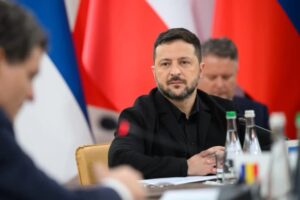
According to “Serbian Economist”, Ukrainian President Volodymyr Zelenskyy visited the Serbian pavilion at the first Carpathian Economic Forum in Bukovel, which is taking place on September 18–19 as part of the summit of the new regional format, the Carpathian Eight (C8). This was reported by the Serbian Chamber of Commerce and Industry.
Serbia is represented at the forum by the Serbian Chamber of Commerce and Industry, the Serbian Development Agency, Expo 2027 Belgrade, as well as Serbian companies, including Mind Park and Millennium Team. The main goal of Serbia’s participation is to present the country’s investment opportunities and establish new contacts with companies, investors, and financial organizations in the region.
The forum itself has become a major business platform: according to the Office of the President of Ukraine, approximately 1,400 people from 25 countries are participating, including representatives of nearly 400 companies from the C8 countries. The forum’s total investment portfolio includes 95 projects valued at over 42.5 billion euros in the energy, industrial, transportation and logistics, technology, agricultural, real estate, and other sectors.
Serbia is particularly interested in projects in the energy, rail and road transportation, logistics, industry, and cross-border trade sectors. At the summit, Aleksandar Vučić stated that trade between Serbia and Ukraine grew by 42% in the first half of 2026.
The new C8 format brings together Serbia, Ukraine, Romania, Poland, Slovakia, the Czech Republic, Austria, and Hungary. Its participants aim to develop infrastructure and energy links, investment projects, and closer integration of the Carpathian and Danube regions.
C8, FORUM, INVESTMENT, SERBIA, UKRAINE

Concorde Capital, an investment firm that has been operating in the Ukrainian market since 2004, plans to lower the entry threshold for investors in its projects and launch retail investment products, according to Ihor Sotnyk, managing director of Concorde Capital’s investment banking department.
“We have already prepared this infrastructure and plan to launch products—including government bonds and other products that will be available to retail investors—and to develop this segment,” he said during a discussion on the prospects of the Ukrainian stock market organized by the Kyiv International Economic Forum last week.
Sotnik noted that the investment group began with joint investment initiatives, “investing in infrastructure, in the app, and in an asset management company.”
“The numbers show that there is money in the domestic market and people are still investing,” he explained, referring to Concorde Capital’s plans to develop such investment products.
The department director added that a successful example was the Encraft project for joint investments in distributed generation and energy storage systems, which managed to attract investors and launch the first phase.
In addition, the investment group launched a mobile app and digital investment platform called “Statock,” which currently lists three projects with a minimum investment threshold of $9,000.
At the same time, the Statock website states that in the third quarter of this year, the company plans to launch an investment module with a minimum investment threshold of just 1,000 UAH for government bonds, stocks, and bonds, as well as ETF funds, featuring savings accounts, automatic reinvestment, and portfolio management.
In addition, the launch of an AI-powered robo-advisor for selecting investment instruments and a PFM (personal financial manager) is scheduled for this quarter, while brokerage services are set to launch in the fourth quarter of this year.
It is noted that Statock is a fintech product of Concorde Capital’s subsidiary IT company, Concorde Fintech LLC, which, together with its partners, develops software for automating the retail investment business in Ukraine.
The investment firm Concorde Capital, founded and led by Ihor Mazepa, states on its website that in more than 20 years of operating in the market, it has secured $4 billion in investments for clients, executed more than 100 deals, and has more than 1,000 corporate clients and more than 100,000 investors involved in investments in real businesses.

At the “Carpathian Eight” summit in Bukovel, JSC “Ukrzaliznytsia” proposed a project to establish, in partnership with investors, a low-cost passenger carrier on routes between Ukraine and the EU using European-standard tracks, with investments in share capital totaling approximately $441 million.
According to the project description posted on the summit’s website, the carrier’s routes will run from western Ukrainian railway hubs—including Uzhhorod, Lviv, and Kovel—to markets in Central and Eastern Europe, specifically Budapest, Bratislava, Warsaw, Vienna, and Berlin.
As part of the project, there are plans to purchase modern trains for European-standard tracks.
It is noted that the project is in the advanced planning stage, and its implementation is expected to take approximately four years.
Ukrzaliznytsia hopes that this project will attract interest from rail and road carriers in Poland, Slovakia, Hungary, and Romania.
As previously reported, in late 2018 and in June 2019, trains operated by the state-owned railway companies MÁV-START of Hungary and ZSSK of Slovakia began running on routes from Mukachevo—where the European gauge track ends—to Budapest and Košice, respectively.
On the same route, starting in March 2024, the Czech private carrier RegioJet has been operating services from Chop to Prague; it also cooperates with Ukrzaliznytsia on services to the Polish city of Przemyśl, which borders Ukraine.
In addition, in October 2023, the Polish company SKPL (Stowarzyszenie Kolejowych Przewozów Lokalnych) became the first to launch passenger service on the standard-gauge route between Warsaw and Rava-Ruska, where passengers transferred to Ukrzaliznytsia trains bound for Lviv or Kolomyia. Starting in December 2024, the state-owned operator PKP Intercity also began operating on this route, and SKPL withdrew from it in September 2025.
Ukrzaliznytsia also has plans to extend the European-gauge track to Chernivtsi and Lviv; prior to the full-scale Russian invasion, the possibility of building a new high-speed rail line between Warsaw and Kyiv was also being considered.
As reported, Ukrainian President Volodymyr Zelenskyy noted that agreements on $1 billion in investments had already been reached during the first Carpathian Economic Forum.
The C8 Summit website lists about 90 projects across eight sectors. The energy sector has the most—33—followed by transportation and logistics with 11, industry and manufacturing with 17, and infrastructure and real estate with 12.
In terms of regions, the largest number of projects is listed in Lviv Oblast—30—followed by 14 in Zakarpattia, 13 in Chernihiv Oblast, 11 in Poltava Oblast, and 3 in Bukovina.
The first inaugural summit of the “Carpathian 8” (Carpathian 8 Summit) is taking place at the Bukovel ski resort in Ivano-Frankivsk Oblast from September 18 to 20.
European gauge, INVESTMENT, TRANSPORTATION, UKRAINE, UKRZALIZNYTSIA
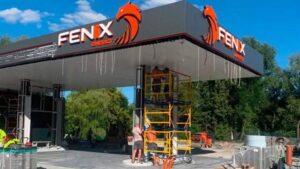
Western Fuel and Energy Company (ZTEK) plans to unveil its own network of FENIX energy gas stations by the end of 2026, which is expected to consist of approximately 20 locations in the initial phase.
Oleg Chykida, CEO and co-owner of ZTEK, announced this in an exclusive interview with the news agency “Interfax-Ukraine.”
“Our initial target is up to 20 gas stations by the end of 2026. Of course, we have to take military realities into account—a shortage of contractors and personnel, as well as disruptions in the supply of materials (…) Therefore, our plan is for up to 20 stations, but the timeline also depends on external factors,” he said.
According to Chikida, less than a year ago, FENIX energy practically didn’t exist, and he, along with his business partner and ZTEK co-owner Kostyantyn Gavrilenko, worked independently on the concept, name, color scheme, and positioning of the network.
“I’m cautious about chasing quantity. We’re entering a highly competitive and long-established market, so first we need to offer a high-quality product (…), build a strong team, refine the model, and only then scale it up,” the CEO noted.
The network’s primary geographic focus will be western and central Ukraine. ZPEK does not plan to operate in Kyiv during the initial phase.
FENIX energy will be financed from several sources: its own funds, profits from the group’s operations, and bank loans.
“Our key banking partner is Ukrgasbank. Over the past three years, we’ve gone from an initial financing round of approximately $110,000 to a credit line of about $17 million. At the same time, we’re in talks with other banks regarding the FENIX energy project,” Chikida said.
As he explained, ZTEK distinguishes three main formats for gas stations. The estimated budget, depending on the facility, can range from $700,000 to $2.5 million, while certain flagship complexes will require even greater investments.
For the urban format, the company is targeting approximately $1–1.2 million. There will also be regional highway stations and complexes along major national highways.
“We don’t want to build a network that differs only in the color of the ceiling. The foundation of FENIX energy is fuel quality control from import to the pump, a uniform standard for all facilities, and comprehensive roadside service,” added the CEO.
ZTEK plans to present some of its solutions, particularly those related to self-service, separately.



