
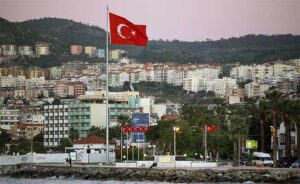
Turkey has identified another 1,070 people who, according to the investigation, obtained Turkish citizenship through fake real estate transactions. This marks the second major wave of investigations into schemes involving the granting of citizenship through residential property investments.
Turkish Justice Minister Akın Gürlek announced the new operation on September 21. The investigation is being conducted by the Istanbul Chief Prosecutor’s Office in collaboration with police units responsible for combating illegal migration.
Investigators examined real estate transactions conducted through the companies Gül İnşaat, Beyaz İnşaat, and LİV İnşaat. The audit covered sales to 734 foreign nationals, with 274 transactions deemed fictitious or suspicious. The total value of the transactions exceeded 3.5 billion Turkish lira, or approximately $72 million.
According to the Turkish Ministry of the Interior, among the 1,070 people who obtained citizenship under these agreements, 263 were direct investors, while another 807 were their family members. Of these, 1,015 received citizenship at the same time as the initial decision, and another 55 children received it later. In addition, 11 individuals were identified whose citizenship application processes were still ongoing.
As part of the operation, judicial measures were applied to 2,011 real estate properties, one hotel, 86 vehicles, two yachts, and 42 bank accounts. State administrators were appointed to 30 companies. Legal proceedings have been initiated against 88 suspects, and dozens of people have been detained.
This is already the second wave of the investigation. The first major operation took place on August 4, 2026. At that time, the investigation established that another 687 people had obtained Turkish citizenship through artificially inflated appraisal reports and fictitious real estate sales. The prosecutor’s office has initiated proceedings to revoke their citizenship. In that case, authorities estimated the amount of investments that did not actually reach Turkey at approximately 2.5 billion lira.
Thus, the two most recent investigations in Istanbul alone involve at least 1,757 cases of citizenship acquisition linked to suspicious real estate transactions, when combining the 687 individuals from the first wave and the 1,070 from the second. However, these two figures pertain to specific criminal investigations and do not cover all reviews of investment-based citizenship in the country.
At the same time, the Turkish Ministry of the Interior has, for the first time, released broader statistics on the review of citizenship obtained through investment programs. According to the ministry, as of September 21, citizenship decisions had been revoked for 5,391 individuals, including investors and their family members. Additionally, citizenship was revoked after it had been granted for 743 individuals, specifically for reasons related to public order and national security. In total, this amounts to 6,134 individuals.
As of February 11, 2026, citizenship grants were separately revoked for 1,393 individuals associated with 458 investors whose documents certifying that their investments met the established requirements were annulled. Citizenship was also revoked from seven other individuals on grounds of national security and public order.
Turkish authorities have not published a breakdown of the 1,070 individuals implicated in the current investigation by their country of origin. No similar official breakdown was published regarding the 687 individuals identified in August either. Therefore, reports claiming a predominance of Russians, Iranians, citizens of Middle Eastern countries, or other nationalities in these specific cases are not currently supported by official documents.
The scheme being investigated by law enforcement agencies was based on fictitious or inflated real estate values and the simulation of required financial transactions. In some cases, real estate with a significantly lower actual value was valued much higher in the documents in order to formally meet the requirements of the citizenship-by-investment program.
Turkey allows foreign investors to apply for citizenship, specifically through the purchase of real estate valued at no less than $400,000. The property must meet established requirements, and the investment and flow of funds are subject to verification by government agencies.

According to the Relocation project, members of the Latvian “Progressive” Party have submitted a bill to the Saeima to abolish the option of obtaining a temporary residence permit through investments of at least 150,000 euros in a state-run alternative investment fund.
Bill No. 1521/Lp14 was introduced on September 3, and on September 10, the Saeima voted 65 to 17 to refer it to parliamentary committees for review.
The new Immigration Act, which takes effect on September 15, 2026, allows a foreign national to obtain a temporary residence permit for up to five years, provided they invest at least 150,000 euros for a period of at least five years through a state-established alternative investment fund manager. Additionally, the investor must transfer 10,000 euros to the state budget.
The “Progressives”’ proposal calls for removing this provision from the law. The authors of the initiative explain their position by citing risks related to national security, anti-money laundering, compliance with sanctions regimes, and the country’s international reputation. This is the position of the bill’s sponsors, not a decision already adopted by the Saeima.
At the same time, the bill does not abolish another investment mechanism for obtaining a residence permit—through an investment in the capital of a Latvian company. Under current law, a foreign investor may apply for a temporary residence permit, specifically, by making an investment of 50,000 euros in a company with up to 50 employees and an annual turnover or balance sheet total of up to 10 million euros, or an investment of 100,000 euros in a larger company. An initial fee of 10,000 euros payable to the state budget is also required upon initial application.
The new Immigration Law was adopted by the Saeima on August 20 and entered into force on September 15, 2026. It replaced the previous regulations governing investment-based residence permits and, in particular, eliminated the previously used grounds related to real estate purchases and subordinated bank deposits.
The fund mechanism was included in the new law following lengthy discussions in the Saeima. In June, Latvian President Edgars Rinkēvičs returned the law to parliament for reconsideration and specifically drew attention to the provision allowing the issuance of a residence permit in exchange for an investment of 150,000 euros in an alternative investment fund and a contribution of 10,000 euros to the budget.
For now, this is only a legislative proposal. To eliminate the investment-based residence permit, the amendments must undergo further review and be adopted by the Saeima.
INVESTMENTS, LATVIA, MIGRATION, REAL ESTATE, RESIDENCE PERMIT

According to Fixygen, PJSC “Ukrainian Financial Housing Company” (“Ukrfinzhilia”), the operator of the state mortgage program “eOselya,” is working to prepare an issuance of securitized securities on international capital markets following the end of the war unleashed by Russia, with a potential volume of approximately EUR1 billion, said Chairman of the Board Yevhen Metzger.
“We are preparing and are indeed the company that will likely be the first to carry out securitization. We have JP Morgan advising us and guiding us into open capital markets,” he said during a discussion on the prospects of Ukraine’s stock market organized by the Kyiv International Economic Forum last week.
Metsger noted that to this end, “Ukrfinzhilye” will form mortgage pools worth the equivalent of $2–3 billion.
The head of “Ukrfinzhilye” clarified that it remains to be determined which markets to enter, as the American and European markets have significant differences. “We must be prepared for both scenarios,” he added.
According to him, the path for issuing securitized securities was paved by the Law on Securitization and Covered Bonds (No. 15172), which was developed jointly with the National Securities and Stock Market Commission and the European Bank for Reconstruction and Development (EBRD).
Metsger noted that there are many investors in the international market active in the housing finance sector, such as the Belgian fund Revive.
“Let’s be frank. We hope that securitization or the issuance of mortgage Eurobonds will be possible after the war. I do not believe that we will be able to do this now—this year, next year, or during the war,” the head of “Ukrfinzhylia” emphasized.
He added that it is also necessary to adopt subordinate legislation and regulations that will allow for proper preparation for the issuance of securitized securities.
“That is why we are moving forward; we hope to use this year and next year productively to prepare for securitization,” Metzger concluded.
“Ukrfinzhylia, ” securitization, INVESTMENTS, mortgages, еОселя

Tether, the issuer of the world’s largest stablecoin, USDT, has launched StableFund, a private credit investment fund, in partnership with the asset management firm Fasanara Capital, according to Fixygen.
The fund’s initial capital amounts to $400 million, provided by Tether and Fasanara. Going forward, the partners intend to raise up to $3 billion in institutional capital from third-party investors.
StableFund will provide loans primarily to small and medium-sized enterprises that face difficulties in securing bank financing. According to the project organizers’ estimates, the global funding gap for small and medium-sized businesses amounts to approximately $5.7 trillion.
Tether and Fasanara estimate the global private credit market itself at roughly $3 trillion, and it could grow to $5 trillion by 2029.
A key feature of the project is the use of stablecoin infrastructure to finance companies in the real economy. This means that USDT is gradually moving far beyond its traditional role as a settlement instrument for crypto exchanges.
For Tether, this marks a continuation of its business diversification. The company is already investing in government bonds, gold, Bitcoin, energy projects, artificial intelligence, and telecommunications.
The launch of StableFund demonstrates a new market trend: the largest stablecoin issuers are beginning to transform from infrastructure companies in the crypto sector into full-fledged financial intermediaries.
For USDT itself, this also potentially creates an additional source of real demand—the use of the stablecoin not only for crypto trading and international money transfers, but also for business lending.

According to the Relocation project, five Eastern Caribbean nations—Antigua and Barbuda, Dominica, Grenada, Saint Lucia, and Saint Kitts and Nevis—plan to send a joint delegation to Brussels for negotiations on the future of citizenship-by-investment (CBI) programs, Prian reports, citing Investment Migration Insider.
Dominica’s Prime Minister Roosevelt Skerrit stated that the negotiations are scheduled to take place toward the end of September 2026, although the exact date of the meeting has not yet been agreed upon. The delegation expects to hold consultations with the leadership of the European Commission, the European Council, and the European External Action Service.
The decision to launch the joint mission was made on July 10 at a meeting of leaders from the Eastern Caribbean at Roseau, Dominica. In an official statement, the meeting participants emphasized the economic importance of investment citizenship programs for small island states and the need to take into account their dependence on CBI-related revenues.
The negotiations are taking place against the backdrop of the European Union’s hardline stance on such programs. As previously reported, on June 25, European Commissioner for Home Affairs and Migration Magnus Brunner sent a letter to Antigua and Barbuda proposing that the investment citizenship program be phased out by June 1, 2028, with a 24-month transition period. According to industry sources, similar demands were also sent to four other countries.
The reason for the pressure from Brussels is primarily linked to visa-free access for citizens of these countries to the Schengen Area. The updated EU mechanism allows for the existence of a program that grants citizenship in exchange for investment—without the applicant having a substantial connection to the country—to be considered grounds for suspending the visa-free regime. EU documents also emphasize the need to strengthen vetting of applicants and to phase out such schemes.
As early as September, Caribbean states are to strengthen vetting of candidates and completely exclude individuals subject to EU sanctions from these programs. At the same time, the countries are working to establish a single regional supervisory body—Eastern Caribbean Citizenship by Investment Regulatory Authority (ECCIRA). The decision to form a common regulator was adopted by five states back in 2025.
ECCIRA is expected to set common standards for vetting investors, monitor the activities of national programs, and facilitate the exchange of information between countries. The regulator’s headquarters is to be located in Grenada.
Citizenship-by-investment programs remain an important source of revenue for small Caribbean economies. Foreigners can obtain citizenship after making a specified contribution to a government fund or investing in approved projects, particularly in real estate. As of 2026, all five programs continue to accept applications, and the minimum investment threshold starts at approximately $200,000, although specific requirements vary by country.
Caribbean governments intend to persuade the EU not to abruptly terminate the programs and are proposing that the EU take into account their role in financing infrastructure, climate projects, education, healthcare, and recovery from natural disasters.
According to Skerrit, the goal of the upcoming mission is to work with Brussels to find “practical and mutually beneficial solutions” that will allow for both the EU’s security requirements and the interests of small island economies to be taken into account.

Italy is preparing the TERRA program, with a total budget of up to 105 million euros, aimed at expanding access to financing for Ukrainian micro, small, and medium-sized enterprises in the agri-food sector, according to the Ministry of Agrarian Policy and Food of Ukraine following negotiations with the Italian side.
The program was presented during a meeting between Deputy Minister of Agrarian Policy Denys Bashlyk and Davide La Cecilia, the Italian Minister of Foreign Affairs’ Special Representative for Ukraine’s Recovery. The parties identified support for small farmers and the development of agricultural cooperatives as key priorities for cooperation.
According to materials from the Italian Ministry of Foreign Affairs and International Cooperation, TERRA Ukraine—Transforming and Empowering Resilient and Responsible Agribusiness—consists of two main components.
Up to 100 million euros are planned to be allocated to financial instruments managed by the Italian state-owned financial institution Cassa Depositi e Prestiti (CDP). The funds are to be used to mitigate risks for Ukrainian financial intermediaries and expand lending to micro, small, and medium-sized enterprises in the agri-food sector. The financial component includes a counter-guarantee from the European Commission under the Ukraine Investment Framework.
An additional 5 million euros is earmarked for technical assistance and capacity building, with this part of the program to be implemented primarily in collaboration with the Food and Agriculture Organization of the United Nations (FAO).
The Italian side views TERRA not merely as a mechanism for providing financing. The program is intended to facilitate the modernization of Ukrainian agricultural enterprises, the adoption of European sanitary, environmental, and corporate standards, as well as the transition to a more sustainable model of agricultural production in line with the European Green Deal.
“For us, it is important not just to teach farmers to work together, but to create a practical model that will enable them to pool resources, produce large volumes of goods, and enter new markets. If this approach proves successful, it can be scaled up to all regions of Ukraine,” Bashlyk noted.
The Ukrainian side also hopes to draw on Italy’s experience in developing agricultural cooperation and bringing together small-scale producers for joint processing, logistics, and access to larger markets.
Italian Ambassador to Ukraine Carlo Formosa previously reported on September 3, 2026, that TERRA is being prepared as one of the new tools to support the Ukrainian agricultural sector. According to him, the program is primarily aimed at facilitating access to credit for agricultural SMEs.
At the same time, Italy is expanding its agricultural projects in the Odesa region. According to Italian officials, approximately 25 million euros have already been allocated in the region for agricultural projects, including the Pro.UKR programs, support for viticulture and winemaking through the FAO, and a 6-million-euro project to modernize irrigation systems in Tatarbunary and Kiliya. In addition, a 7-million-euro ROOTS project is being prepared between the Friuli-Venezia Giulia region and the Odesa region.
Ukraine and Italy have agreed to expedite the organizational decisions necessary for the practical launch of TERRA. Specific dates for the start of funding disbursements to Ukrainian agricultural enterprises and the terms for obtaining loans have not yet been publicly announced.



