

Ukraine plans to introduce criminal liability for transferring or receiving bank cards, accounts, and access to them for subsequent use in fraudulent and other criminal schemes.
On September 15, 2026, the Verkhovna Rada adopted in principle Presidential Bill No. 16013, “On Amendments to the Criminal Code of Ukraine and the Criminal Procedure Code of Ukraine Regarding the Protection of Citizens and Their Funds from Illegal Actions Involving Payment Instruments and Bank Accounts.”
A total of 299 members of parliament voted in favor of the bill in its first reading. The bill was registered on September 2 and designated by the president as urgent. According to the Verkhovna Rada, it is currently being prepared for its second reading.
The legislative changes are aimed, in particular, at so-called “drops” or “money mules”—people who transfer bank cards, accounts, account details, or access to online banking to third parties to conduct financial transactions.
The urgency of the issue is confirmed by data from OpenDataBot, published on October 2. Using the “Babusia” court registry search engine, at least 16 convictions were found over the past nearly eight years involving schemes that used drop accounts.
In 81% of these cases, the “drops” were part of schemes related to drug trafficking, and in 19%, to online fraud.
In 75% of the verdicts found, the primary punishment was imprisonment. Sentences ranged from two to ten years, although in eight cases, the defendants were granted probation. In four other verdicts, the primary punishment was a fine.
The fines specified in the court rulings ranged from 98,600 UAH to 850,000 UAH. In one of the identified rulings, the court also ordered the defendant to pay the victim 8.65 million UAH in compensation for material and moral damages.
It is important to note that the presence of a “drop” in the case files does not yet mean that the account holder was convicted specifically for transferring their card or bank details. As OpenDataBot points out, in some of the analyzed verdicts, “drops” were one element of a broader criminal scheme, and the convicted individuals may have played other roles.
Draft Law No. 16013 aims to address precisely this legal loophole; it provides for separate liability for unauthorized transactions involving payment instruments and bank accounts.
However, as of October 2, the bill has not yet become law. It has only passed its first reading, so the final provisions and liability may change as the bill is prepared for its second reading.

More than half of all notaries in Ukraine are concentrated in Kyiv and the country’s four largest regions, according to an Experts Club analysis based on data from the Unified Register of Notaries.
As of the end of August 2026, there were 6,156 notaries in Ukraine. Of these, 3,162, or about 51.4%, were registered only in Kyiv and the Kharkiv, Dnipropetrovsk, Lviv and Odesa regions.
Kyiv remains the absolute leader, with 1,365 notaries. Thus, the capital accounts for more than 22% of all specialists in the country, meaning that in practice every fifth Ukrainian notary is based there.
There are 460 notaries registered in the Kharkiv region, 457 in the Dnipropetrovsk region, 449 in the Lviv region, and 431 in the Odesa region.
According to Experts Club, this structure reflects the high concentration of demand for notarial services in the country’s largest economic and business centers, where real estate transactions, corporate deals, inheritance cases and other legally significant transactions are concentrated.
At the same time, the highest growth rates over the past year were recorded not in major centers, but in frontline regions with a low comparison base.
In the Luhansk region, the number of notaries increased from 4 to 22, or 5.5 times. In the Kherson region, it rose from 33 to 84, or 2.5 times. In the Donetsk region, the figure increased from 48 to 63, and in the Zaporizhzhia region, from 114 to 147.
One of the reasons for this dynamic was changes to the rules governing the work of private notaries. Since June 2025, specialists whose workplaces are located in territories of possible or active hostilities have been allowed to change the address of their workplace within their region while retaining the notarial district specified in their registration certificate.
Thus, the formal increase in the number of notaries in frontline regions partly reflects not the emergence of new demand, but the adaptation of professional infrastructure to wartime conditions and the relocation of specialists.
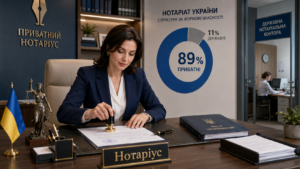
Ukraine continues to see a structural shift of notarial services toward the private sector: as of the end of August 2026, 5,484 out of 6,156 notaries included in the Unified Register of Notaries were working privately.
Thus, the share of private notaries reached about 89%, or almost nine out of ten professionals, according to an Experts Club analysis based on Opendatabot data.
There were 652 notaries working in state notary offices, accounting for about 10.6% of the total number, while another 20 professionals worked in state notarial archives.
Over the past year, the number of private notaries increased by 345 people. At the same time, the number of notaries in state institutions decreased by 34.
As a result, the entire net increase in the register was provided by the private sector. The total number of notaries increased by 311 people over the year, or by approximately 5%, to 6,156.
According to Experts Club, this dynamic indicates a further shift of the Ukrainian notarial services market toward the private model. The state segment is gradually shrinking both in absolute terms and as a share of the total number of professionals.
At the same time, the increase in the register does not mean a similar influx of new personnel. Of the total increase, only 40 notaries were new, while the majority were professionals who renewed their certificates. Another 104 notaries stopped working during the year.
A notable feature of the profession remains the significant predominance of women: they account for 82% of all notaries in Ukraine. Over the year, the number of women in the register increased by 250, while the number of men increased by 61.
Source: Opendatabot, data from the Unified Register of Notaries as of the end of August 2026.

The Verkhovna Rada of Ukraine has approved, in its entirety, a bill to improve the operation of industrial parks (IPs). According to a correspondent for the “Interfax-Ukraine” news agency, 270 deputies voted in favor of the bill, exceeding the required minimum of 226 votes.
“Based on the results of ongoing monitoring of the development of industrial parks, we identified issues, the solutions to which have now been approved by the Rada. Essentially, these are technical issues that arose during the practical implementation of the legislation adopted in 2022. But resolving each of them will contribute to the faster development of this sector and the emergence of new manufacturing facilities,” wrote the bill’s sponsor, Dmytro Kysilevskyi, deputy chairman of the parliamentary committee on economic development.
He noted that the bill, in particular, more clearly delineates the functions of all entities within an industrial park, and grants the initiator of a park’s creation the ability to also act as the managing company without establishing a separate legal entity.
In addition, the concept of an “eco-industrial park” has been introduced, the Cabinet of Ministers has been granted the authority to establish criteria for them, and a new category of land use designation has been introduced: land for industrial parks.
The procedure for increasing and decreasing the area of an industrial park has also been regulated, as have issues regarding the transfer of ownership rights to a land plot within an industrial park from the park’s initiator to another party; opportunities for establishing industrial parks have been expanded: land plots may now be considered adjacent if there are forest buffer strips between them.
Among the issues addressed are improvements to the competitive selection process for management companies and the introduction of the possibility for management companies whose primary activity is the leasing of real estate to obtain loans under the “5-7-9” program.
Temporary restrictions on the acquisition of power capacity for small electricity distribution systems in industrial parks have also been lifted, and provisions regarding state incentives for industrial parks have been improved, in particular through the transfer of international technical assistance from local government bodies to industrial parks.
As of the end of 2025, 37 factories had been built or were under construction in Ukraine’s industrial parks. Throughout 2026, manufacturing enterprises in the parks continued to open.
As previously reported, Bill No. 12117 was adopted in principle on February 11, 2025, with amendments to its provisions, by a vote of 244 members of parliament.

Ukrainian legislation needs a clearer distinction between the elements of crimes related to collaboration, treason, and war crimes, according to Inna Linyova, director of the Human Rights Institute of the Ukrainian Bar Association.
In an interview with Interfax-Ukraine, she noted that the practice of adjudicating cases of collaboration remains ambiguous. According to her, civil society organizations have already documented cases where individuals who, under international humanitarian law, may fall into protected categories were held criminally liable.
This includes, for example, employees of municipal utilities who continued to clean the streets during the occupation, doctors who continued to work in hospitals, or teachers who ensured the basic functioning of local institutions. Under international humanitarian law, such actions may be viewed as maintaining the region’s viability rather than as criminal collaboration with the occupying power.
A different situation, Linyova emphasized, arises in cases where a person passes on information about the location of Ukrainian military forces, directs fire, holds leadership positions in the occupying authorities, or heads a police department or local administration under Russian control. In such cases, there may be grounds for criminal prosecution, but the right to a defense must be ensured here as well.
Separately, Linyova cited the example of employees at the Zaporizhzhia Nuclear Power Plant. According to her, if a person performs technical or professional functions necessary for the safe operation of the nuclear power plant, this in itself is not a crime. But if we are talking about administrative and managerial functions in the interests of the occupying authorities, the assessment may be different.
The expert believes that the problem lies in the imperfection of the legislation: some criminal offenses overlap, and a clear line between treason, collaboration, and war crimes is not always evident.
According to her, the Office of the Prosecutor General is working on drafting a bill intended to systematically bring Ukrainian criminal and criminal procedure legislation into compliance with the Rome Statute.
Such reform is important not only for domestic judicial practice but also for Ukraine’s international reputation. Cases involving war crimes and collaboration are closely monitored by international organizations, and the quality of judicial proceedings can influence the trust of partners, European integration, and future compensation mechanisms.
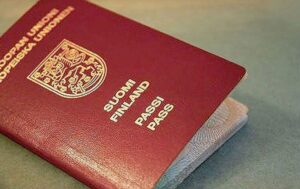
The Finnish government has submitted a bill to parliament that would introduce a mandatory citizenship test for applicants for a Finnish passport. The test is intended to assess knowledge of Finnish society, its structure, and key principles, and if approved by parliament, the new rules are scheduled to take effect in early 2027.
As clarified by the Finnish Ministry of the Interior, the exam will be part of a broader reform of the citizenship law, aimed at tightening naturalization requirements and placing greater emphasis on integration, employment, and adherence to the norms of Finnish society. The test will be available in Finnish or Swedish.
The reform continues the current government’s phased approach to tightening migration policy. Finland had previously increased requirements regarding length of residence, income, and compliance with the law for citizenship applicants, and has now decided to add a separate test of civic knowledge.
This discussion is of particular importance for Finland’s labor market and migration environment, as the country remains significantly more dependent on external population inflows than it was just a few years ago. According to Statistics Finland, the country’s population stood at 5,652,881 by the end of 2025, and population growth in recent years has been largely driven by migration. In 2025, 50,060 people arrived in Finland, and net migration stood at 34,852 people, fully offsetting the natural population decline.
Authorities are also noting an increase in the number of new citizens. According to the Finnish Immigration Service, 14,689 people received Finnish citizenship in 2025—a record high. Of these, 13,483 received citizenship upon application, and 1,206 through the notification procedure.
According to official data from Statistics Finland, 5.65 million people resided in Finland at the end of 2025, and the number of residents of foreign origin and foreign citizens continued to grow; specific databases from Statistics Finland provide a breakdown by citizenship and country of origin, and also show that the growth in recent years was largely due to the influx from Ukraine. Official releases from Statistics Finland explicitly noted that in 2023, the largest numbers of people arrived in Finland from Ukraine, Russia, Sri Lanka, and India.



