

According to the Serbian publication Parametar, on November 19, the National Assembly (parliament) of Serbia elected 48-year-old Aleksandar Čupić, a representative of the “Student List” party—which won the parliamentary elections—as the new speaker of parliament. At the same time, he assumed the duties of the country’s president until new presidential elections are held, according to the Serbian government’s official website.
Of the 239 deputies present at the session, 140 voted for Čupić. His opponent, Stojan Radonović—a representative of the Serbian Progressive Party (SNS) and the candidate of the “Aleksandar Vučić—Serbia Wins” parliamentary group—received 97 votes.
After the results were announced, Čupić took the Speaker’s seat and began presiding over the parliamentary session.
The election of the new Speaker marked the completion of an important stage in the formation of government bodies following the early parliamentary elections on October 25, 2026, in which the “Student List – Students Win” coalition won 140 of the 250 parliamentary seats. The electoral bloc of former President Aleksandar Vučić won 103 seats, while another seven went to representatives of national minorities.
Thus, for the first time in 14 years, supporters of the Serbian Progressive Party lost their parliamentary majority. The new political force now has the opportunity to form a government on its own, without having to form a coalition with the former ruling party.
Čupić also became acting president of Serbia. This position had remained vacant following Aleksandar Vučić’s resignation on September 27, 2026. Until the election of the new parliament, the former Speaker of the National Assembly, Ana Brnabić, served as acting head of state.
Under Serbian law, following the early termination of the president’s term, the Speaker of Parliament temporarily assumes the president’s duties. Presidential elections must be held no later than December 27, 2026.
In his first speech following his election, Čupić emphasized the need to restore the authority of parliament, foster political dialogue, and uphold the principles of equality and mutual respect. He stressed that parliament must ensure public oversight of the executive branch, and that political decisions must be made based on reasoned arguments.
Čupić’s appointment marked a continuation of sweeping political changes in Serbia that began following student protests triggered by the collapse of a concrete canopy at the Novi Sad train station in November 2024, which resulted in the deaths of 16 people. The protest movement, which advocated for the fight against corruption, accountability of government officials, and the strengthening of institutional independence, subsequently formed its own electoral platform.
The next stage of political reform will be the formation of a new government. It must secure parliamentary approval within the statutory deadline of 90 days following the first session of the new legislature.
Aleksandar Čupić was born in 1978 in the city of Prokuplje in southern Serbia. In 2003, he graduated from the Faculty of Transportation at the University of Belgrade, and in 2014, he defended his doctoral dissertation. Since 2004, he has worked at the university as an associate professor in the Department of Postal Transportation and Networks. He specializes in logistics, transportation networks, and the optimization of transportation processes.
In addition to his academic work, Čupić is involved in agriculture. Together with his wife Ana, a physician by profession, he is raising six children. The family lives in the municipality of Sopot near Belgrade, where they run a farm specializing in the organic production of fruits and vegetables.
Prior to his election to parliament, Čupić had not held any high-level government positions. He gained widespread recognition for his support of the student movement, particularly for providing overnight shelter to participants in the protest marches in February 2025.
The National Assembly of Serbia is a unicameral parliament consisting of 250 deputies elected for a four-year term under a proportional representation system. The parliament passes laws, approves the government and the state budget, and exercises oversight over the activities of the executive branch.

The Verkhovna Rada of Ukraine passed, in the second reading and as a whole, a law implementing Ukraine’s accession to the Convention on Combating Bribery of Foreign Public Officials in International Business Transactions (Bill No. 15056).
According to an Interfax-Ukraine correspondent, during a parliamentary session on Tuesday, November 10, the decision was supported by 247 members of parliament, with no votes “against” and 10 abstentions.
The document brings the provisions of current national legislation into line with those of the international Convention and stipulates that bribery of any foreign public officials or members of international parliamentary assemblies is a criminal offense.
To implement these objectives, amendments have been made to the Criminal Code of Ukraine, the Code of Criminal Procedure of Ukraine, and the Law “On Preventing Corruption.” In particular, the law aligns the definition of the term “official of a foreign state” with the terminology of the Convention, standardizes provisions regarding the application of criminal law measures to the legal successors of legal entities, and allows for the appeal of an investigating judge’s ruling on the application or refusal to apply restrictions on the activities of a legal entity during a pretrial investigation.
In addition, it is stipulated that authorized representatives of a legal entity—namely, individuals who, in accordance with the law, the legal entity’s founding documents, a contract, instructions, or other oral or written authorizations, have the right to act on behalf of the legal entity or represent its interests—are required to take measures to prevent corruption. As previously reported, the bill was adopted in its first reading on May 26.

The Hungarian Parliament has repealed several provisions of a 2021 law that restricted the distribution to minors of materials containing information about homosexuality, gender identity, and gender transition. This information has been confirmed by Hungarian and international sources; however, this does not constitute a complete repeal of all existing restrictions on LGBT content in the country.
The amendments were adopted on October 13, 2026: 139 members of parliament voted in favor, while 51 voted against. Provisions prohibiting the “display” or “promotion” of sexual and gender diversity in content accessible to persons under the age of 18 have been removed from the legislation. Instead, a more general provision has been introduced to protect minors from material that could seriously harm their physical, intellectual, emotional, or moral development.
The restrictions were introduced in 2021 under Viktor Orbán’s government as part of the so-called Child Protection Act. In addition to measures against pedophilia, the document included a ban on the distribution to minors of materials that the authorities interpreted as “promoting” homosexuality or gender transition. The restrictions applied, in particular, to educational and media content.
The legislative change marked one of the first notable policy revisions in this area since Prime Minister Péter Mádjár’s government took office. The ruling Tisza Party, which holds a two-thirds majority in parliament, supported the amendments. Former Prime Minister Viktor Orbán’s Fidesz party voted against them.
The parliament’s decision followed a ruling by the Court of Justice of the European Union on April 21, 2026. The court found Hungary’s 2021 restrictions to be incompatible with EU law and the fundamental values of the European Union. Following the vote, EU representatives described the changes as an important signal of Hungary’s commitment to common European principles.
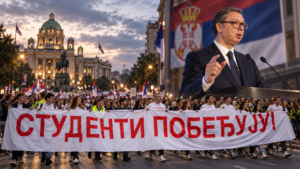
As the Serbian portal Parametar reports in its article, two weeks before the snap parliamentary elections on October 25 in Serbia, published opinion polls continue to show sharply differing pictures of support for the two largest forces — the “Aleksandar Vučić – United Serbia” list and “Students Win”.
The most recent Faktor Plus poll, conducted on September 16–20 with a sample of 986 people, gives Vučić’s list 48.6% and the student list 37.1%. The gap amounts to 11.5 percentage points. In the same survey, Ivica Dačić’s Socialists receive 4.9%, while “European Serbia” receives 3.6%.
However, the NSPM poll published on September 30 shows almost the opposite situation: “Students Win” – 44.4%, “United Serbia” – 41.7%. Moreover, in the previous measurement by the same organization, the figures were 39.6% and 37.5%, respectively.
Thus, the difference between the two latest publicly available surveys is fundamental: one gives the authorities a lead of more than 11 points, while the other gives the students a lead of almost 3 points.
At the same time, the dynamics within the polls themselves are also interesting. At the beginning of September, Faktor Plus estimated Vučić’s list at 47.2% and the students at 31.5%. Just a few weeks later, the students’ figure rose to 37.1%, that is, by 5.6 percentage points, while Vučić’s list gained only 1.4 percentage points.
A separate June survey by CRTA and the Stanford Democracy Action Lab also showed a high degree of political polarization. It recorded significant differences in the views of supporters of the student list and the SNS and confirmed that Serbian society is increasingly dividing into two large political camps.
It is noteworthy that sociologists themselves are now cautious about attempts to determine the exact balance of support. Faktor Plus representative Vladimir Pajić stated on October 1 that the only thing that can be considered sufficiently probable based on the survey data is high voter turnout.
Turnout itself may become one of the key factors on October 25. In the September Faktor Plus survey, 64% of respondents said they would definitely vote, while another 11% were undecided. Among those intending to participate in the elections, 69% already knew exactly whom they would vote for.
Against this background, the campaign is increasingly resembling a referendum between the two largest blocs. Even NSPM researcher Đorđe Vukadinović explicitly spoke of the approaching “referendum atmosphere,” in which the space for third forces is noticeably narrowing.
There will be 18 parties on the ballot on October 25, but the actual struggle for the majority of votes is increasingly concentrated around the two largest political projects.
Source: Parametar, NSPM, CRTA.
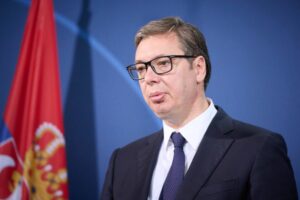
Serbia’s presidential election may take place on December 13, 2026—this date is currently considered the most likely, according to the Serbian business news site Parametar, citing the Center for Local Self-Government (CLS).
According to the center, the presidential election would in that case be scheduled after the conclusion of the parliamentary election, and the campaign would last no more than 30 days.
However, the CLS emphasizes that a final decision has not yet been made and other options remain on the table.
Early presidential elections became necessary after Aleksandar Vučić resigned on September 27, ending his second presidential term early.
Ana Brnabić, Speaker of the National Assembly, has assumed the duties of acting president. Under Serbian law, the speaker of parliament may serve as acting head of state for no more than three months.
Following the early termination of the presidential term, an election must be held no later than three months thereafter. There must be no fewer than 30 and no more than 60 days between the official announcement of the election and Election Day.
Thus, the deadline for holding the presidential election is December 27, 2026; therefore, the date of December 13 cited by CLS falls within the timeframe prescribed by law.
Serbia’s political landscape now presents an unusual configuration. First, the country will hold early parliamentary elections, after which a new parliamentary composition is expected to take shape; then, Serbs will have to elect a new president.
Vucic himself stated after his resignation that he intends to participate in the parliamentary election campaign as an ordinary citizen.
Therefore, the December presidential election could become the second key vote for Serbia in less than two months and finally determine the new power structure following the conclusion of Vučić’s nine-year presidency.
The candidates for president have not yet been definitively determined.
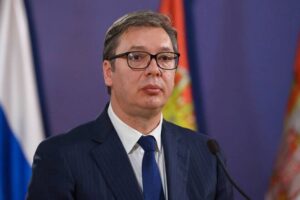
The Serbian business publication Parametar has prepared an interesting analysis of the parliamentary elections in Serbia. President Aleksandar Vučić has called for early parliamentary elections on October 25. Serbia has 250 parliamentary seats to fill, but in essence, the campaign is turning into a choice between preserving the current model of government and attempting a political reset.
The main favorite is the “Aleksandar Vučić—United Serbia” bloc centered around the SNS. Vucic himself is running as a candidate for prime minister. According to the Serbian media outlet Parametar, his campaign will focus on stability, infrastructure development, investment, economic growth, and the argument that the country must not return to a period of political instability.
For the first time, the main competitor is not a traditional party, but the Student List, which emerged from the protests following the tragedy in Novi Sad. Its main themes are corruption, government accountability, the independence of institutions, and bringing new people into politics. The movement’s slogans are as simple as possible: “Students Will Win” and “Either Serbia or the Mafia.”
Part of the opposition has already decided to support the students, but there will be no single anti-government list. Running separately are the pro-European “European Serbia,” the “People’s Serbia” bloc, Ivica Dačić’s Socialists, and several national-conservative and sovereigntist groups.
The campaigns of the two main power centers are also divided by fundamentally different emotional agendas. According to sociologist and co-founder of Active Group Aleksandar Pozniy, Vučić will build his campaign primarily around the theme of stability—reminding voters of economic growth, large-scale infrastructure projects, an influx of investment, and the overall progress Serbia has made in recent years. This strategy aims to convince voters that a change in government carries the risk of losing the country’s hard-won achievements. The Student List, on the other hand, will appeal to the long-standing demand for fighting corruption and reforming the political system, contrasting the current elite with new faces unaffiliated with traditional parties. Thus, the election may largely turn into a clash between two basic formulas—“stability and economic results” versus “a change in power and the cleansing of institutions.”
That is precisely why the key question will be what voters deem more important: preserving economic and political stability or the demand for profound systemic change.
Parties representing national minorities will traditionally form a separate segment. A special electoral system applies to minorities: they are not required to clear the general 3 percent threshold, and when seats are allocated, their results are adjusted using a special coefficient. At the start of the campaign, the Union of Vojvodina Hungarians (SVM), the Bosnian parties SPP and SDA, representatives of the Albanian and Romani populations, and a number of small regional groups are expected to participate. Their composition may still change before the registration deadline.
Polling data so far is conflicting. Faktor Plus gives the SNS about 47% and the Students’ Party about 32%. An earlier CRTA poll showed the opposite picture—about 45% for the Students’ Party versus 36% for the SNS.
On international betting platforms, Vučić currently appears to be the clear favorite, but there is still a month and a half until the election, and the final list of candidates is still taking shape.
Read more at Parametar.rs.



