
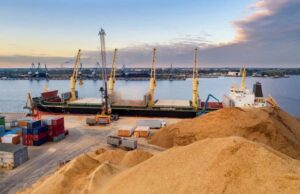
The suspension of the maritime corridor since late July has led to a drop in grain exports from Ukraine: from August 1 to 12, exports totaled 590,000 metric tons, or 30% of demand, Agriculture Minister Taras Vysotsky said at a briefing in Kyiv on Friday.
“From August 1 to 12, we exported 590,000 metric tons. That’s about 30% of the required volume. We expect to be able to reach 50% going forward… taking into account all the relevant impacts on international trade balances,” the minister said.
He clarified that of these 590,000 metric tons, about 40% were exported by rail, about 40% via the Danube region, about 10% by road, and the remaining 10% consisted of several ships that were still able to leave Ukrainian ports in early August.
“If we subtract those, we can say that as of today, 45% is exported by rail, 45% via the Danube region, and about 10% by road,” the minister stated.
At the same time, he emphasized that there is potential to partially increase exports, but even so, without the resumption of operations at the Black Sea ports, exports will amount to no more than 50% of demand.
According to Vysotsky, due to the drought, the Danube route is currently unable to operate at full capacity; reaching its full potential—about 1.5 million metric tons per month—will be possible closer to the end of the year.
The minister also reported that Ukraine currently has sufficient permanent storage facilities for grain, but in November, after the corn harvest, there may be a storage capacity shortfall of 8 to 11 million metric tons, which they hope to cover using temporary storage facilities and silo bags.
According to Vysotsky, a request for $10 million in funding for the temporary storage of 2–2.5 million metric tons has already been sent to international partners. In addition, a similar request to the World Bank for $25 million—covering more than 6 million metric tons of grain—is being finalized.
He noted that it is currently difficult to predict how quickly maritime exports can be resumed.
“We see that every day there are various rumors… gossip about different proposals (regarding a maritime ceasefire)… As always, we must rely first and foremost on ourselves. By ‘ourselves,’ I mean the military… As of today, the only way to enable exports is through military security… This is a very important area; the military is working on it, but so far, they cannot report any progress on their end. Therefore, as of today, exports from the ports of Greater Odesa are suspended. We are focusing on alternative logistics channels,” stated the head of the Ministry of Agrarian Policy.
Regarding the U.S. Department of Agriculture’s downward revision this week of its forecast for grain exports from Ukraine this marketing year by 2.21 million metric tons—to 37.77 million metric tons—Vysotsky noted that, overall, the figures remain within the range of the typical annual balance.
“We do not rule out that this could be the case. We are still only a month and a half into the marketing year. We understand that, provided there is some recovery during a certain period, we can make up the shortfall. Therefore, from our point of view, this balance is currently based on the annual cycle—no more, no less—rather than on an assessment of the current situation,” the minister said.
He noted that this year’s total harvest of grains and oilseeds is expected to exceed 80 million metric tons, of which domestic consumption and adequate carryover stocks will account for up to 20 million metric tons.
“The baseline volume of exports of grains, oilseeds, and processed products could reach up to 60 million metric tons. However, given how logistics are currently developing, we understand that there is a possibility this trend will continue throughout the year, and exports will amount to no more than 30 million metric tons,” Vysotsky said, outlining the worst-case scenario.
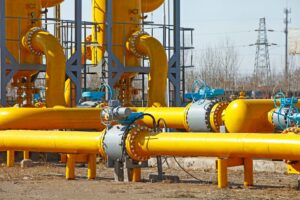
According to Interfax-Ukraine, the relative level of gas reserves in European storage facilities has reached its lowest value on this date in recorded history.
Previously, the all-time low for storage levels at this time of year was recorded in 2021 (the pandemic impacted the industry’s capacity). However, since the start of the injection season, the 2026 trend has steadily been closing the gap with the previous record low.
The average level of gas reserves in Europe’s underground storage facilities reached 57.11% at the end of the gas day on August 1, according to data from Gas Infrastructure Europe (GIE), the association of European gas infrastructure operators. The reserve level on the same date in 2021 was slightly higher—57.28%. A day earlier, the figures were different: as of July 31, 2026, the level stood at 56.88% (higher), while as of July 31, 2021, it was 56.83% (lower).
Natural gas storage levels in Europe are a key indicator for the global gas market. The total capacity of the EU’s storage system is 109 billion cubic meters of active gas. Collectively, Europe has become the largest importer in the global LNG market. Gas Infrastructure Europe brings together operators active in the transportation and storage of natural gas, as well as LNG. The statistical database covers the operation of underground natural gas storage infrastructure since 2011, and the receipt and regasification of LNG since 2012. Gas days in the European gas industry are counted starting at 6:00 a.m. Central European Time (CET).
Renewable sources are expected to contribute to the EU’s energy balance. Since the beginning of August 2026, wind power in Europe has been meeting an average of 10% of electricity demand, according to the WindEurope association. A year ago, in August 2025, the contribution of wind power plants stood at 14%.
Europe is also actively importing liquefied natural gas (LNG). However, in August 2026, gas imports from abroad are down 7% compared to last year’s level. LNG imports in August 2026 may drop to 6.9 million metric tons.
The spot price for “next-day” delivery at the benchmark European TTF hub closed at $696 per 1,000 cubic meters on Friday, up from an average of $626 in July.
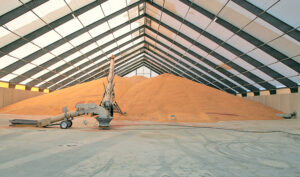
The Food and Agriculture Organization of the United Nations (FAO) has completed the distribution of 615 modular grain storage facilities to small and medium-sized farms in seven frontline areas, the FAO press service reported on Facebook.
The FAO specified that this initiative was implemented with the support of the governments of Canada and Japan in close cooperation with the Ministry of Economy, Environment, and Agriculture. The FAO is convinced that the program contributes to stabilizing the work of farms, preventing post-harvest losses, and ensuring the continuity of agricultural production.
Farmers could apply to participate in the program through the State Agrarian Register (DAR). In 2025, the FAO received 747 applications from producers who cultivate between 200 and 1,000 hectares. After verification, 615 farms were selected to receive modular grain storage facilities. The distribution took place in seven regions: Chernihiv (62), Dnipropetrovsk (116), Kharkiv (124), Kherson (14), Kirovohrad (84), Mykolaiv (128), and Odesa (87).
This initiative is part of a broader Grain Storage Support Strategy that FAO and partners have been implementing since 2022 in response to a critical shortage of storage capacity. During this time, Ukrainian agricultural producers have received a wide range of storage solutions – more than 37,000 grain sleeves, 105 sets of loading and unloading equipment, and a total of 859 modular grain storage facilities. Collectively, this support has enabled farmers across Ukraine to preserve more than 8 million tons of grain and sustain agricultural production in wartime conditions.
Despite significant progress, the lack of storage infrastructure remains a key constraint to the recovery of the agricultural sector, especially in frontline and recently liberated areas, the FAO stressed. As preparations for the 2026 season get underway, the sustainable development of modern and secure grain storage facilities will remain critical to protecting livelihoods and preserving national food production.
“For farmers, the ability to safely store their harvest is not just about grain. It’s about peace of mind, about the confidence that months of hard work will not be lost. These storage facilities give Ukrainian farmers what is especially needed today in times of war: stability and the ability to look to the future with hope. We will continue to support them on this path,” assured Shakhnoza Muminova, Head of the FAO Office in Ukraine.
FAO, together with its partners, plans to provide support to approximately 100 more farmers in early 2026, but the scale of needs far exceeds available resources. Strengthened cooperation and continued active involvement of the international community will be key to enabling farmers to withstand ongoing challenges and contribute to Ukraine’s long-term recovery, the organization believes.

Ukraine would be grateful to Germany for assistance in unblocking the export of agricultural products and organizing mobile grain storage facilities due to the expected shortage of storage capacity this autumn, Prime Minister Denys Shmyhal said at a meeting with Federal Minister for Food and Agriculture of Germany Chem Ozdemir.
“According to preliminary estimates, in October we may not have enough storage facilities to store crops for 10-15 million tons. The Ministry of Agrarian Policy is considering the possibility of organizing mobile storage facilities,” he wrote in a telegram on Saturday.
Shmyhal stressed that Russia is deliberately destroying agricultural facilities, such as Ukraine’s second largest grain terminal in Nikolaev a few days ago.
In early June, the Ukrainian Grain Association (UGA) increased the forecast for grain and oilseeds harvest in Ukraine this season by 5.2% compared to the April forecast – up to 66.5 million tons.
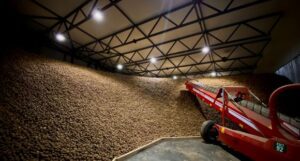
Continental Farmers Group agricultural holding put into operation a potato storage facility in the village of Chukva (Lviv region), designed for simultaneous storage of up to 16,000 tonnes of potatoes, investments in the project amounted to UAH 111.4 million, according to the website of the group.
“After launching a new complex in the village of Chukva, our company has the ability to simultaneously store over 100,000 tonnes of potatoes and supply them to our customers throughout almost the entire year with the preservation of quality indicators,” Continental Farmers CEO Georg v. Nolcken said.
Construction work at the facility with a total area of over 6,000 square meters was conducted during 10 months. The storage is zoned into six chambers for bulk storage of potatoes with a total capacity of 2,650 tonnes each, its shelf life is about 10 months.
Continental Farmers Group said that the floor of the potato storage is equipped with forced air systems that evenly distribute ventilation around the entire perimeter of the building, this technology is used for the first time in Ukraine.
The agricultural holding indicated among its priorities the cultivation of potatoes: chips, seed and food varieties. The total area under potatoes in the current production season amounted to 1,800 hectares, its harvest is stored in warehouses in Ternopil and Lviv regions with a total capacity of 103,000 tonnes. The group also has its own starch plant.
Agroholding Mriya and CFG, united under the name Continental Farmers Group, have been operating as a single business since November 2018.

The Ministry of Health of Ukraine allowed to store the undiluted vaccine against COVID-19 Comirnaty produced by Pfizer-BioNTech at temperatures from + 2°C to + 8°C for a month instead of five days, the ministry said on its official website.
The Ministry of Health received the corresponding letter from Pfizer Export B.V. with a request to review the requirements for the cold chain of the Comirnaty vaccine on June 24, 2021. The company turned to regulators after a series of new studies.
The European Medicines Agency, the U.S. Food and Drug Administration, UK Medicines and Healthcare Products Regulatory Agency and the relevant authorities of other countries have also changed the storage requirements for the vaccine.



