According to Experts Club, Turkey has the highest net positive sentiment among Ukrainians among the Middle Eastern countries included in the study—44.9 percentage points. More than half of those surveyed—52.3%—view the country positively. At the same time, neutral attitudes prevail toward Saudi Arabia and Jordan, while Lebanon is the only country in this group with a negative balance. This is evidenced by the results of the third wave of the study “Ukrainians’ Attitudes Toward Countries Around the World,” conducted by Active Group in collaboration with Experts Club, according to the Experts Club Information and Analytical Center.
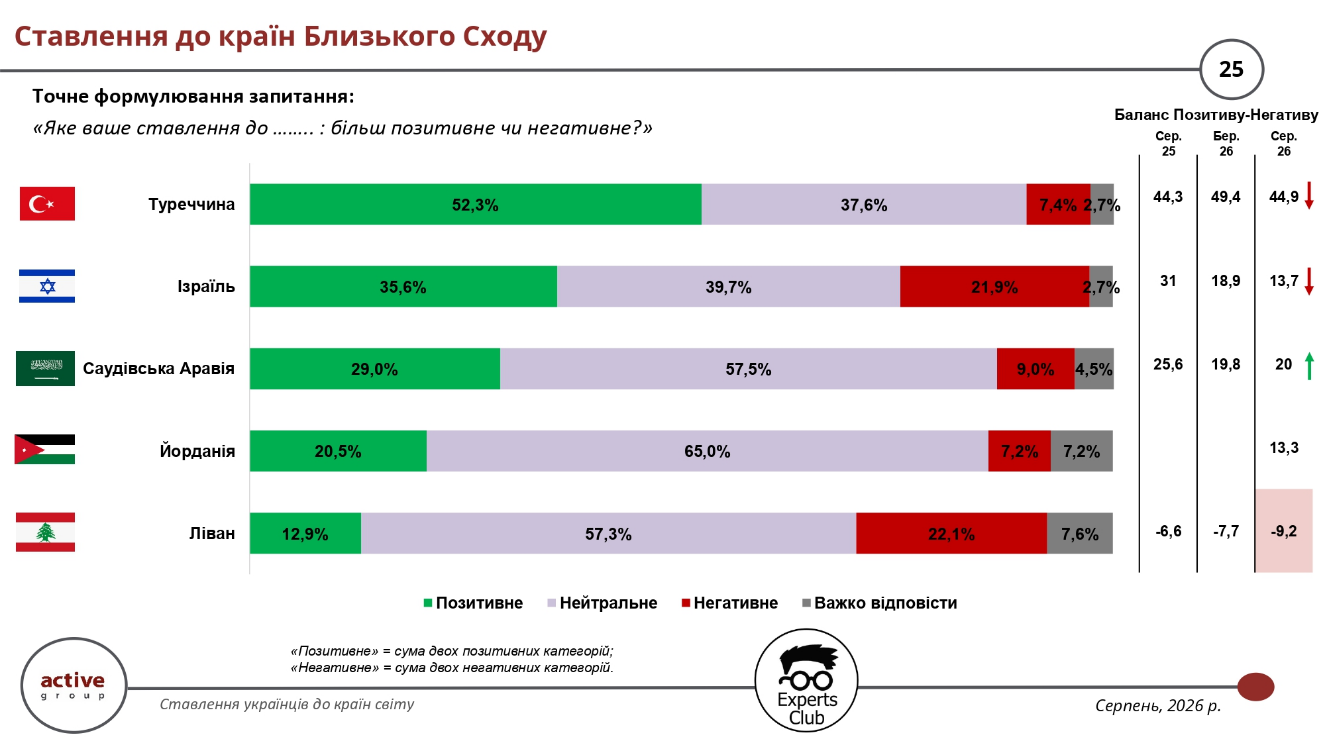
52.3% of respondents view Turkey positively, 37.6% neutrally, 7.4% negatively, and another 2.7% were undecided. The balance of positive and negative assessments stands at 44.9 percentage points, compared to 49.4 percentage points in March 2026 and 44.3 percentage points in August 2025. Thus, following a spring increase, the indicator has returned to roughly last year’s level.
Israel ranks second among the countries shown on the slide in terms of the share of positive assessments—35.6%. 39.7% of respondents view it neutrally, 21.9% negatively, and another 2.7% were undecided. The balance stands at 13.7 percentage points and continues to decline: in August 2025, it was 31 percentage points, and in March 2026, it was 18.9 percentage points.
Saudi Arabia is viewed positively by 29% of Ukrainians, while the majority—57.5%—hold a neutral stance. The share of negative assessments is 9%, and the balance is +20 percentage points, compared to 19.8 percentage points in March. Compared to August 2025, when it stood at 25.6 percentage points, the figure remains lower.
Regarding Jordan, 65% of respondents hold a neutral stance—the highest figure in this regional group. 20.5% of those surveyed view the country positively, 7.2% negatively, and another 7.2% are undecided. The balance of positive and negative assessments stands at 13.3 percentage points.
Lebanon has the lowest score. 12.9% of Ukrainians view the country positively, 22.1% negatively, and 57.3% neutrally. The balance stands at minus 9.2 percentage points and is gradually deteriorating: from minus 6.6 percentage points in August 2025 to minus 7.7 percentage points in March and minus 9.2 percentage points in August 2026.
Maksym Urakin, founder of the Experts Club information and analytical center, emphasized the importance of foreign governments maintaining constant communication with the Ukrainian public.
“The first recommendation is to regularly showcase specific achievements and concrete actions. Second, be open to questions and inquiries from the media and the public,” Urakin noted. He also recommended that diplomatic missions systematically inform Ukrainians about the concrete results of cooperation.
Oleksandr Pozniy, director of the research company Active Group, drew attention to the need to combine an information presence with the practical development of bilateral relations.
“We should focus not only on raising general awareness. First and foremost, business associations, the Ministry of Economy, and the Ministry of Foreign Affairs need to take action,” Pozniy noted.
In his view, economic and diplomatic institutions should more actively tap into the potential of markets where Ukraine can expand its cooperation.
Overall, the study shows that Ukrainians’ perceptions of Middle Eastern countries vary significantly. Turkey has a distinctly positive image, while neutrality dominates perceptions of Saudi Arabia and Jordan; assessments of Israel are more polarized, and negative assessments of Lebanon outweigh positive ones.
The survey was conducted in August 2026 using self-administered online questionnaires in the SunFlowerSociology panel among 800 Ukrainian citizens aged 18 and older. According to the organizers, the sample is representative by age, gender, and region, and the maximum theoretical statistical margin of error is 3.5%. This is the third wave of the study, following surveys conducted in August 2025 and March 2026.
ACTIVE GROUP, EXPERTS CLUB, ISRAEL, JORDAN, LEBANON, MIDDLE EAST, SAUDI ARABIA, SOCIOLOGY, TURKEY, UKRAINE

Related: