In August 2026, the majority of Ukrainians maintained a neutral attitude toward Saudi Arabia—57.5% of respondents gave this answer. Twenty-nine percent of those surveyed viewed the country positively, while 9% viewed it negatively. Compared to the previous wave of the survey, the distribution of opinions changed only slightly, according to the Experts Club Information and Analytical Center.
According to the results of the August survey, 5.5% of Ukrainians have a completely positive attitude toward Saudi Arabia, while 23.5% have a mostly positive attitude. A neutral stance is held by 57.5% of respondents. Seven percent view the country mostly negatively, 2% view it entirely negatively, and another 4.5% were undecided.
The balance of positive and negative assessments stands at plus 20 percentage points. Thus, positive attitudes outnumber negative ones by more than three to one; however, the large neutral group remains the defining characteristic of perceptions of Saudi Arabia. In the overall picture of Ukrainians’ attitudes toward Middle Eastern countries, Saudi Arabia also ranks among those toward which neutral assessments predominate.
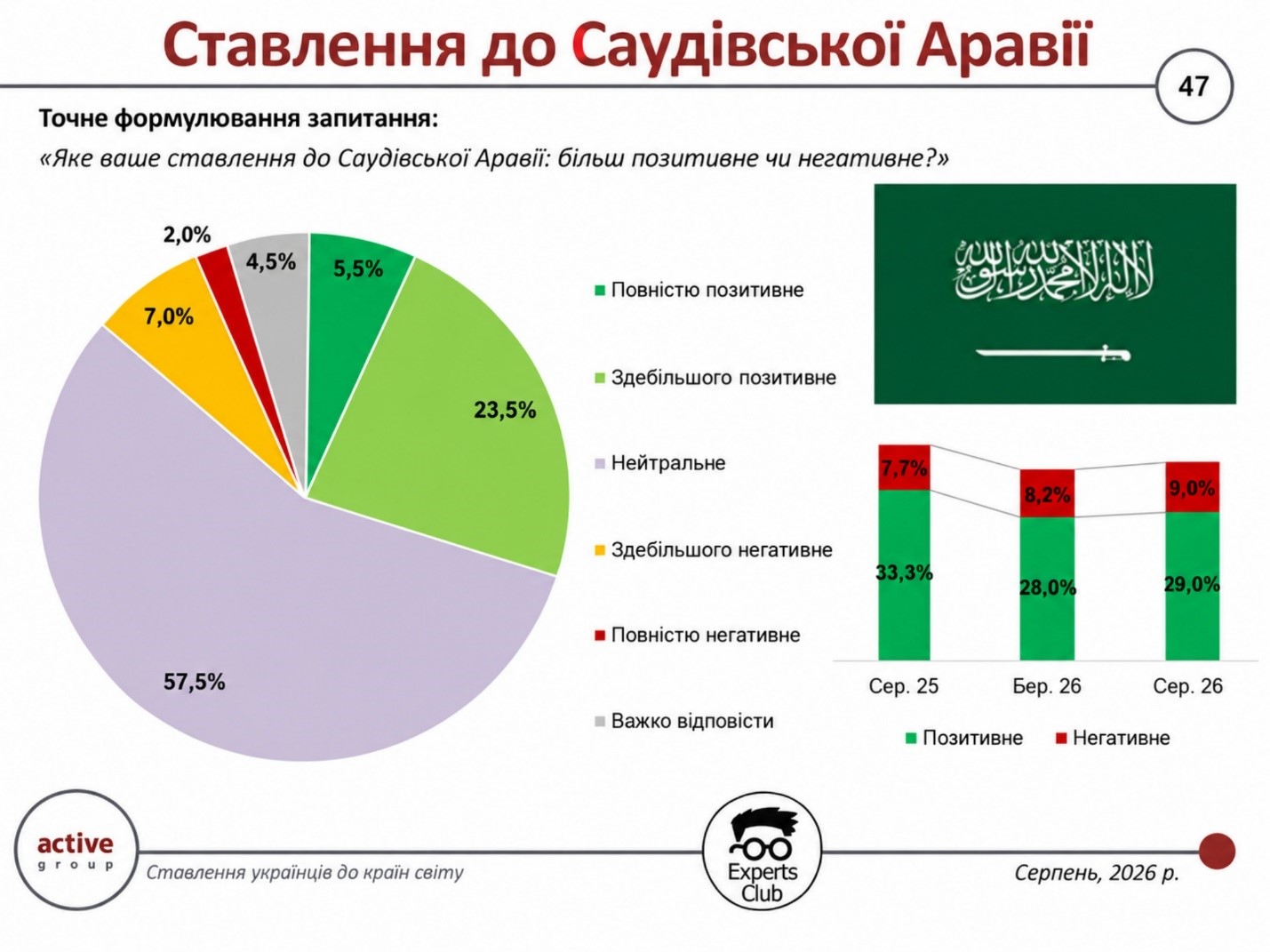
Compared to March 2026, the figures remained nearly stable. In the previous survey, 8.4% of respondents had a completely positive attitude toward Saudi Arabia, and 19.6% had a mostly positive attitude—meaning the combined share of positive responses was 28%. A neutral stance was held by 58.7% of respondents, 8.2% viewed the country negatively, and another 5.1% were undecided.
Thus, over the course of five months, the share of positive assessments increased by 1 percentage point—from 28% to 29%—while negative assessments rose by 0.8 percentage points, to 9%. The neutral segment decreased by 1.2 percentage points. The balance between positive and negative attitudes remained virtually unchanged: approximately +19.8 percentage points in March and +20 percentage points in August.
At the same time, changes occurred within the positive segment. The share of fully positive assessments fell from 8.4% to 5.5%, while the share of mostly positive assessments rose from 19.6% to 23.5%. In other words, the overall share of favorable responses remained stable but became less categorical.
Maksym Urakin, founder of the Experts Club Information and Analytical Center and a candidate of economic sciences, commenting on the survey results and the significant share of neutral attitudes toward a number of Ukraine’s partners, emphasized the need for more active public communication.
“The first recommendation is to regularly showcase concrete achievements, specific actions, and the presence here of foundations, embassies, teams, and diplomats in the humanitarian sphere and in science. Second, we must be open to questions and inquiries from the media and the public. We also need to use our sociological data to draw conclusions and strengthen our relationships, particularly trade relations,” Urakin noted.
In the case of Saudi Arabia, the results of the two survey waves show a high degree of stability in public perceptions. Nearly three-fifths of Ukrainians continue to hold a neutral position, while positive attitudes consistently outweigh negative ones by approximately 20 percentage points.
The survey was conducted in August 2026 using an online self-administered questionnaire via the SunFlowerSociology panel among 800 Ukrainian citizens aged 18 and older. The previous survey wave in March also included 800 respondents; the sample was representative by age, gender, and region, with a maximum theoretical margin of error of ±3.5 percentage points for indicators at the 50% confidence level.
ACTIVE GROUP, EXPERTS CLUB, international relations, MIDDLE EAST, PUBLIC OPINION, SAUDI ARABIA, SOCIOLOGY, UKRAINE, URAKIN