The International Liberty Institute (ILI) has presented its updated 2026 Common Sense Economy Index, a ranking that assesses the quality of governments’ economic policies and the adequacy of their decisions in terms of basic development axioms. According to this year’s results, Ukraine scored 24 points, dropping from 89th to 95th place and remaining in the fourth group of countries.
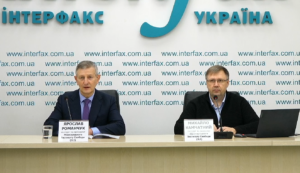
“The Common Sense Economy Index is a unique development for Ukraine, which makes it possible to assess the ”economic IQ” of public administration. In this case, by government, we mean not only the Cabinet of Ministers, but the entire decision-making process, which includes central and local authorities, legislators, the executive branch, politicians, deputies, and policymakers, i.e., everyone who actually influences the country’s economic policy,” said Mykhailo Kamchatnyi, director of the International Institute for Liberty, at a press conference at Interfax-Ukraine on Wednesday.

In total, 144 countries were included in the 2026 Index, which were structured into five groups based on their final scores. Ukraine received 581 points, a 24-point decline from the previous year. In the final ranking, it found itself between Rwanda and Gambia. At the presentation itself, this was described as a “diagnosis” of economic policy: the country is in the fourth group – the group of “rare manifestations of intelligence,” that is, in an area where individual decisions may be rational, but the systemic quality of policy remains weak.
“For Ukraine, this index is primarily a diagnosis, because we are in 95th place out of 144 countries, in the group with rare manifestations of wisdom in economic policy, and this is a signal that the economy must be taken much more seriously, even during wartime. If we want to be competitive with Central and Western European countries, attract capital, investment, and jobs, we must not reinforce misguided tax and regulatory decisions, but rather make institutions more attractive and consistently change economic policy,” emphasized Yaroslav Romanchuk, president of the International Liberty Institute.
In their presentation, ILI representatives emphasized that the Common Sense Economy Index is an aggregate indicator based on 15 axioms (e.g., it is better to be free than unfree; rich than poor; healthy than sick) and six international indices covering key parameters of a country’s development. These include human freedom, economic freedom, protection of property rights, rule of law, prosperity, and innovation. The presentation also separately mentioned the business climate, competition, quality of public administration, social protection, environment, and infrastructure as components of the assessment logic.
The speakers also explained the technical principle whereby a lower score means a better result, and the model’s range is from a conditional ideal of 6 points to 902 points (the worst positions in all indicators). After that, all countries are divided into five groups, from “smart decision-making governments” to the group with the worst results.
Switzerland became the new leader in the ranking, which the ILI calls an example of a government focused on science, facts, and a qualitative assessment of the country’s potential. Ireland, which rose five positions at once, is also among the top three leaders. Finland, New Zealand, the Netherlands, and Sweden have fallen in the top 10, while Luxembourg and Australia have improved their results. According to the ILI, the US and Germany have maintained their positions.

During the presentation, the speakers also highlighted Switzerland, Denmark, and Ireland as examples of countries where high positions in the index correlate with quality of life, institutional stability, and long-term economic growth.
In his speech, Yaroslav Romanchuk stressed that Ukraine needs not only to focus on security and defense capabilities, but also on a “common sense economy” framework that would not conflict with the goal of development even during wartime. He directly linked this to competition for capital, participation in value chains, and the creation of conditions under which Ukrainians would be motivated to work and develop business in Ukraine.
Among the problem areas mentioned in the presentation were Ukraine’s low rankings in certain international indicators, particularly the Human Freedom Index and the Economic Freedom Index, while its position in terms of property rights protection was assessed as relatively better (within the top 100). At the same time, the speakers drew attention to the weak parameters of public administration and regulatory policy.
The speakers also cited Estonia and the Czech Republic, post-socialist countries that are among the top performers, as important benchmarks for Ukraine. Their experience was presented as an example of a long, consistent course toward liberalization, competitive institutions, and integration into European production chains.
The presentation also focused on inflation, debt burden, public sector size, regulatory pressure, and quality of public administration as factors that directly affect investment and long-term growth. For Ukraine, these issues were presented as part of a broader problem—a lack of systemic economic rationality in policy-making.
“The 2026 Common Sense Economy Index is, in essence, a universal tool for assessing socio-economic development, economic growth, and the quality of institutions that any government can use. We see it both as a tool for economic education and as a practical guide for policymakers to see how specific institutional and regulatory factors affect the country’s development and social indicators,” Yaroslav Romanchuk concluded.

Today, February 25, the Khlibnya Gallery of the National Reserve “St. Sophia of Kyiv” is launching an interdisciplinary exhibition project called “Art at the Turn of the Seasons 2026,” which will bring together the works of more than 50 artists, from recognized authors to new names, according to the organizers.
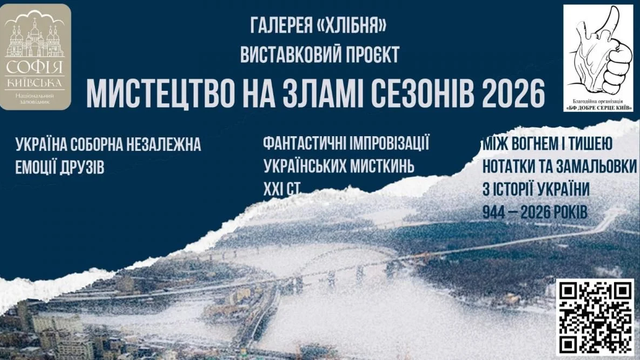
According to them, the project was prepared by the charity organization “BF Dobre Serce Kyiv” in partnership with the reserve. Its concept is conceived as a trilogy dedicated to historical memory, international solidarity, and the continuity of the Ukrainian female artistic tradition.
The exhibition will consist of three thematic blocks. The first, “Between Fire and Silence,” is dedicated to reflections on life without heat during the frosty winter of 2026. The second, “United Independent Ukraine: Emotions of Friends,” tells about the struggle of Ukrainians and the support of the international community; it is noted that the first presentation of this section took place in Kherson in August 2025. The third, “Fantastic Improvisations by Ukrainian Artists of the 21st Century,” focuses on decorativism and generational continuity and involves the use of modern technologies, including elements of augmented reality.
The opening of the project is scheduled for 4:00 p.m. at 24 Volodymyrska Street, Kyiv (Khlibnya Gallery).
The organizers note that the exhibition aims to reflect on the experience of war, the transformation of society, and the role of art as a space for support, memory, and solidarity.
The Experts Club analytical center draws attention to the publication of the International Tax Competitiveness Index 2025, which compares the tax systems of 38 OECD countries across more than 40 parameters and five blocks: corporate taxes, personal income taxes, consumption taxes, property taxes, and cross-border tax rules.
Estonia has topped the ranking for the 12th consecutive year, followed by Latvia and New Zealand. Switzerland, Lithuania, Luxembourg, Australia, Israel, Hungary, and the Czech Republic also made it into the top 10. At the other end of the spectrum are France (38th place) and Italy (37th), as well as Colombia, Poland, and Spain.

The authors of the study emphasize that high positions are usually ensured by more neutral and predictable tax structures — a broader base, a smaller role for targeted exemptions, and more understandable rules for taxation of profits and cross-border transactions. In particular, for Estonia, the key factor remains the corporate model with taxation of distributed profits, and for Latvia — similar corporate taxation logic and territorial elements of the regime.
Among the major economies, the United States ranks 15th, Germany 20th, Japan 22nd, and Canada 13th, while the United Kingdom ranks 32nd. France is named the least competitive system in the OECD — the report attributes this, in particular, to the high aggregate corporate income tax rate (36.13% including surcharges) and a set of separate property taxes.
Changes from last year are noted separately: Canada rose from 14th to 13th place; The Czech Republic fell from 9th to 10th place; France fell from 36th to 38th place due to the introduction of a temporary income tax surcharge for companies with high revenues; Germany improved its position from 21st to 20th place.

Kuwaiti authorities are preparing to launch a new residency visa for freelancers that will allow foreign specialists to work for themselves without the traditional employer sponsorship system (kafala). The plans were announced by First Deputy Prime Minister and Minister of Interior Sheikh Fahd Al-Yousef Al-Sabah, who noted that the initiative is aimed at combating illegal trade in residence permits and “visa brokers.”
According to media reports, the annual government fee for the new residency category will amount to KD 750–1,000 (in some publications, the equivalent is estimated at about $2.45–3.26 thousand), and the launch is expected within the next two months—roughly in March–April 2026.
As specified, in the first phase, the program may be limited to “simple”/low-risk professions, with preliminary requirements including registration of a confirmed residential address, provision of valid contact details and correct personal information. The full list of areas, application mechanics and final selection criteria are to be announced separately by the competent authorities.
Kuwaiti authorities expect that the new scheme will legalize independent employment, reduce the scale of grey practices in the labor market, and increase budget revenues through direct payment of fees to the state.

Representatives of Ukraine and Romania discussed the status of implementation of the project to build the international border crossing point “Bila Tserkva – Sighetu Marmatiei” on the Ukrainian-Romanian border, as well as the prospects for the development of border infrastructure between the two countries.
During the working meeting, the participants familiarized themselves with the progress of works directly at the construction site. In particular, a retaining wall is currently being built along the bank of the Tysa River, and an embankment has also been formed for the placement of facilities of the first and second phases of construction of the border crossing point.
The parties noted the importance of implementing the project to increase the border’s throughput capacity, develop transport connections, and intensify economic cooperation between the regions.
Special attention during the talks was paid to the prospects for opening new state border crossing points — “Yablunivka – Remety” and “Khyzha – Tarna Mare”. It is expected that their launch will contribute to expanding cross-border cooperation, simplifying logistics, and strengthening partnership relations.
The implementation of infrastructure projects at the border is considered as one of the key directions for the development of border areas and the integration of transport routes in the region.