
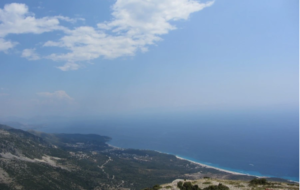
Foreign buyers are increasingly entering the Albanian real estate market, but in some cases they are purchasing properties at higher prices than local residents. This is particularly noticeable in popular tourist destinations, especially in Saranda, on the Albanian Riviera, and in central Tirana.
According to experts, in certain high-demand markets, foreigners may pay 5–10% more for comparable properties than local buyers. For an apartment costing around EUR 150,000, the overpayment can range from EUR 500 to EUR 15,000.
As noted, the price difference is not solely due to the buyer’s foreign status. The final price is influenced by the remote nature of negotiations, high demand for move-in-ready housing, and increased interest in properties with sea views, which are inherently more expensive. Another factor is the limited access foreigners have to off-market listings, whereas locals often receive information about sales through personal connections.
At the same time, many foreign buyers generally view their transaction experiences in Albania positively. Among the advantages, they cite the friendliness of local professionals and the relatively straightforward notarization process compared to several other Mediterranean countries.
For the Albanian market, this trend implies a further strengthening of the role of external demand, particularly in tourist areas. In the medium term, this may support price growth in coastal regions, but simultaneously widen the gap between purchasing conditions for locals and foreigners.

According to Fixygen, Zavalivsky Graphite Plant PJSC intends to hold a general meeting of shareholders on April 30, 2026. The company published a notice convening the meeting on March 30, and materials for shareholders regarding the annual meeting have been posted on the issuer’s corporate website.
The company is registered as Zavalivsky Graphite Plant PJSC and is located in the town of Zavaliv, Kirovohrad Oblast. According to public registries, the company was founded on October 26, 1994; its authorized capital is UAH 285,882 thousand, and its CEO is Ihor Semko. The company’s primary activity is the extraction of other minerals and quarrying.
According to SMIDA data on major shareholders for the fourth quarter of 2025, 78.9472% of the plant’s shares are owned by LLC “Graphitinvest.”
Zavalovsky Graphite Plant PJSC is a key enterprise in the Ukrainian graphite industry; in its annual report, the company explicitly stated that it has no competition in Ukraine and is a monopolist in this market. The plant specializes in the extraction and enrichment of graphite ore.
According to Opendatabot, in 2025, the company’s revenue was 8.614 million UAH, its net loss was 1.541 million UAH, and its assets were 71.195 million UAH. For comparison, in 2024, the plant’s revenue was 7.135 million UAH, and its net loss was 2.278 million UAH.
According to Fixygen, Budtrans PJSC intends to hold a general meeting of shareholders on April 30, 2026. The company has posted the relevant notice of the meeting, as well as the accompanying documents for participation and voting, on its corporate website. Budtrans PJSC is registered in Kyiv, operates as a private joint-stock company, and, according to public registry data, was founded on November 13, 1998. The company’s authorized capital is 527,300 UAH. Alexander Grigorovich is listed as the company’s director.
The company’s primary activity listed in the state registry is the construction of residential and non-residential buildings. Additional areas of activity include freight trucking, real estate leasing and management, and the manufacture of metal doors and windows, as well as metal structures for construction.
According to Opendatabot, the largest shareholder with a significant stake is Alexander Grigorovich, who owns 75.4352% of the shares. In the registry information, the owners are also referred to as “shareholders according to the registry.”
According to data from public registries, in 2025, Budtrans PJSC’s revenue amounted to 7.17 million UAH, net profit to 141,500 UAH, and assets at year-end to 695,100 UAH. A year earlier, the company’s revenue was 4.94 million UAH, and net profit was 156,000 UAH.
https://www.fixygen.ua/news/20260418/budtrans-provede-zbori-aktsioneriv-30-kvitnya.html
According to Serbian Economist, the U.S. has granted Serbia’s oil company NIS a new 60-day exemption from sanctions, allowing it to continue its operations at least until mid-June. Serbia’s Minister of Mining and Energy, Dubravka Jedović-Handanović, announced the license extension. This refers to an OFAC authorization that maintains NIS’s ability to import crude oil and reduces the risk of disruptions to the country’s oil refining infrastructure.
For Serbia, this decision has not only energy-related but also macroeconomic significance. NIS operates the country’s only oil refinery—in Pančevo—and therefore this latest license extension reduces risks for the domestic fuel market, logistics, and price stability.
Meanwhile, negotiations continue regarding the sale of Russia’s stake in NIS to Hungary’s MOL. According to Reuters, Washington has set a deadline of May 22 for the deal’s completion. Belgrade hopes that the change of government in Hungary will not derail the process, though a final agreement has not yet been formalized.
NIS’s ownership structure remains the key reason for sanctions pressure. According to the report, 45% of the company’s shares are owned by Gazprom Neft, another 11.3% are linked to Gazprom, while Serbia owns nearly 30%, with the remainder held by minority shareholders. It is precisely the withdrawal of Russian entities from NIS’s capital that the U.S. views as a condition for a sustainable resolution of the situation.
For the Serbian economy, the current delay means buying time, but not a final solution to the problem. Until the deal with MOL is closed, NIS and the country’s entire oil sector remain dependent on temporary licenses from Washington. This creates uncertainty for the energy market, the budget, and the investment climate, particularly regarding long-term planning for supplies and the modernization of refining.
https://t.me/relocationrs/2658
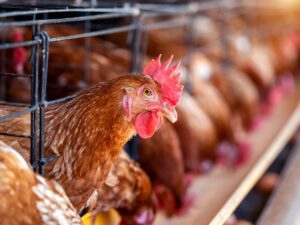
The Oliyar Group of Companies has launched a new line of business and opened a poultry farm in the Lviv region for the production of table eggs with a design capacity of 2.3 million birds, State Service for Food Safety and Consumer Protection head Serhiy Tkachuk announced on his Facebook page on Friday.
“For the company, poultry farming is a new venture. The project includes 20 poultry houses, a sorting facility, a packing facility, and a storage warehouse. At full capacity, the complex will produce more than 2 million eggs per day, which is of strategic importance for Ukraine’s food security,” the agency head noted following a visit to the facility together with Gerard Bakker, General Inspector of the Dutch NVWA.
According to Tkachuk, the first phase of construction has been completed at the facility, which already houses more than 100,000 birds. For comparison, he cited the example of the Netherlands, where a farm of this scale is considered a large-scale industrial facility.
A distinctive feature of the complex is the use of a cage-free, multi-tiered aviary housing system that complies with European animal welfare standards. The facility is equipped with automated systems for manure removal and egg transport.
“It is very important that the new business is immediately geared toward European requirements. This not only ensures the proper physiological condition of the birds and the quality of the products, but also opens the way to exports, strengthening Ukraine’s position in international markets,” Tkachuk emphasized.
He added that modern automation systems make it possible to minimize the human factor and carry out effective veterinary and sanitary control.
The “Oliyar” Group of Companies was founded in 2003 in the village of Stavchany (Lviv region). It specializes in the production of vegetable oils and meal, phospholipid concentrates, and fatty acids. Production facilities include plants for processing sunflower seeds at a capacity of 1,200 tons per day, rapeseed at 1,000 tons per day, and soybeans at 880 tons per day. The complex has a refining facility with a capacity of 350 tons of oil per day and a sunflower meal processing line with a capacity of 650 tons per day. A grain elevator with a capacity of 43,000 cubic meters is used to store raw materials.
Products under the “Mayola,” “Rodinna,” “Soniashna,” and “Oliyar” brands are exported to the EU, the Middle East, Africa, the U.S., and Canada. The company also provides private label manufacturing services for retail chains.
According to Opendatabot, the company’s net profit for 2025 decreased by 56% to UAH 268.19 million, while revenue grew by 33.8% to UAH 12.50 billion. Assets increased by 41% to 13.23 billion UAH, while liabilities nearly doubled to 7.24 billion UAH.
The results of a public opinion poll conducted in March 2026 by the research company Active Group in collaboration with the Experts Club information and analytical center show that Ukrainians’ attitudes toward Saudi Arabia remain largely neutral, though with a slight decline in positive assessments and a gradual increase in negative sentiment. This forms a perception profile characteristic of some Middle Eastern countries—low polarization with a high degree of uncertainty.
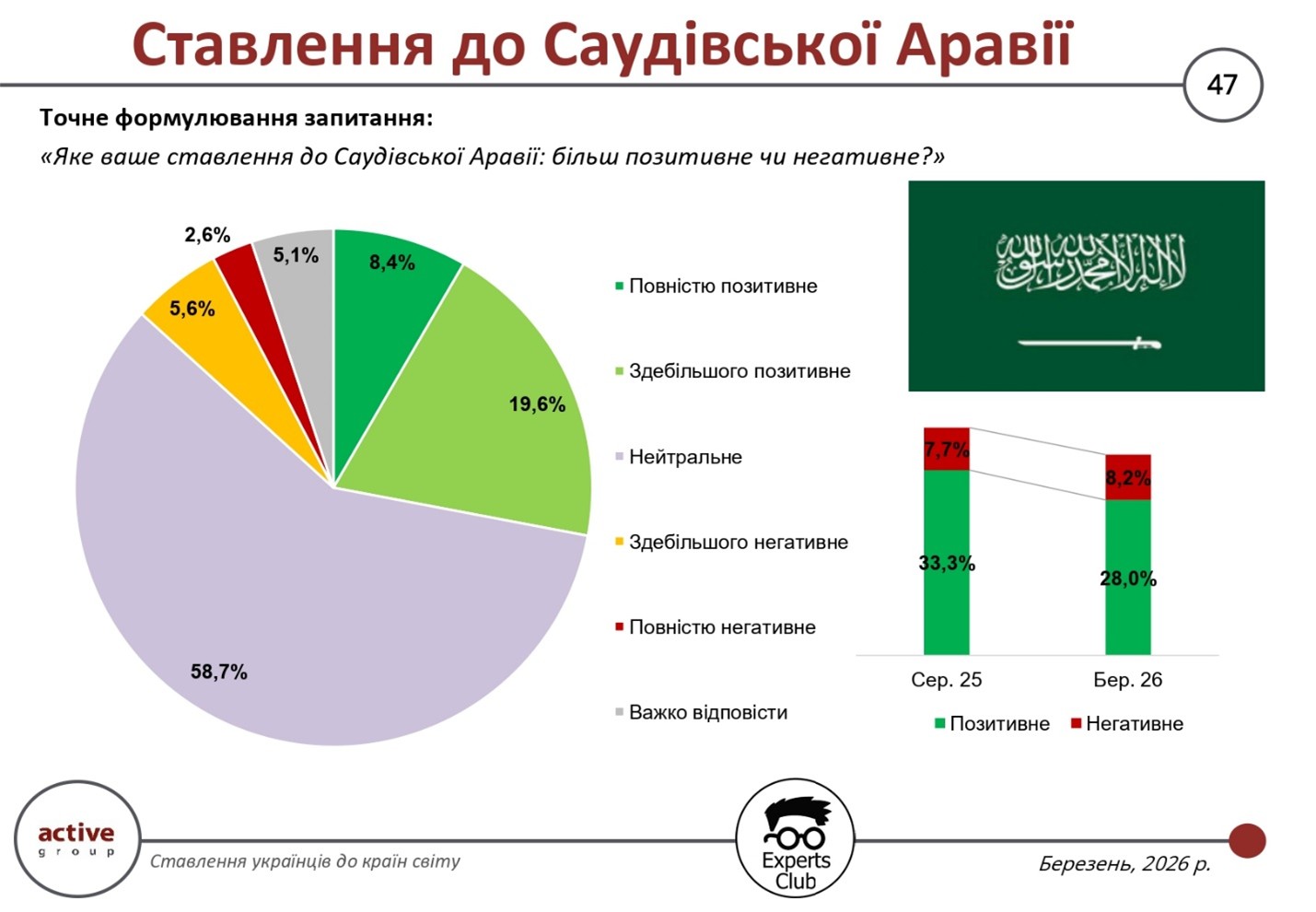
The overall level of positive attitudes toward Saudi Arabia stands at 28.0%. Of these, 8.4% of respondents view the country “entirely positively,” while another 19.6% view it “mostly positively.” At the same time, negative assessments reach 8.2% (5.6% — “mostly negative,” 2.6% — “completely negative”). As in previous waves of the survey, the largest share is held by neutral attitudes — 58.7%, while another 5.1% of respondents were unable to determine their position.
Compared to August 2025, positive attitudes decreased from 33.3% to 28.0%, while negative assessments rose slightly—from 7.7% to 8.2%. This trend indicates a gradual shift in the balance of assessments toward a more critical perception, although the changes remain moderate and do not go beyond the general neutral pattern.
The high proportion of neutral responses indicates that Saudi Arabia does not occupy a clearly defined place in the consciousness of Ukrainian society. Perceptions of the country are formed in a fragmented manner, without a systematic information presence or intensive contacts that could shift the balance toward more defined assessments. Under such conditions, even minor informational or political signals can influence the dynamics of public opinion.
“When we see that a country remains predominantly in the zone of neutral perception, it means that it effectively lacks sufficient ‘weight’ in the everyday information landscape of Ukrainians. In such a situation, even small changes in the information landscape can shift the balance of assessments in one direction or another. That is why, for such countries, it is crucial not only to increase their presence but also to shape a clear and positive image,” noted Maksym Urakin, founder of the Experts Club information and analytical center.
Thus, Saudi Arabia remains in the group of countries with a predominantly neutral image in Ukraine, where the level of positive perception is gradually declining, while the negative segment is slowly growing. The further evolution of this balance will depend on the intensity of economic, political, and informational contacts between the countries, as well as on how actively Saudi Arabia can shape its own image in the perception of Ukrainian society.
According to a study conducted by the Experts Club information and analytical center based on data from the State Customs Service, Saudi Arabia ranks 34th in total trade volume with Ukraine, amounting to $530.8 million. At the same time, Ukraine has a trade surplus with this country, as exports exceed imports by more than 1.6 times.
The study was presented at the Interfax-Ukraine press center; the video can be viewed on the agency’s YouTube channel. The full version of the study can be found at this link on the Experts Club analytical center’s website.
ACTIVE GROUP, EXPERTS CLUB, Pozniy, SAUDI ARABIA, SOCIOLOGY, SURVEY, UKRAINE, URAKIN



