
The results of a sociological survey conducted in March 2026 by the research company Active Group in collaboration with the Experts Club information and analytical center show that Lebanon remains one of the countries with a predominantly neutral perception among Ukrainians, though with a trend toward increasing negative assessments. The largest share of responses is a neutral attitude—62.5%, which indicates the country’s limited presence in Ukraine’s information space.
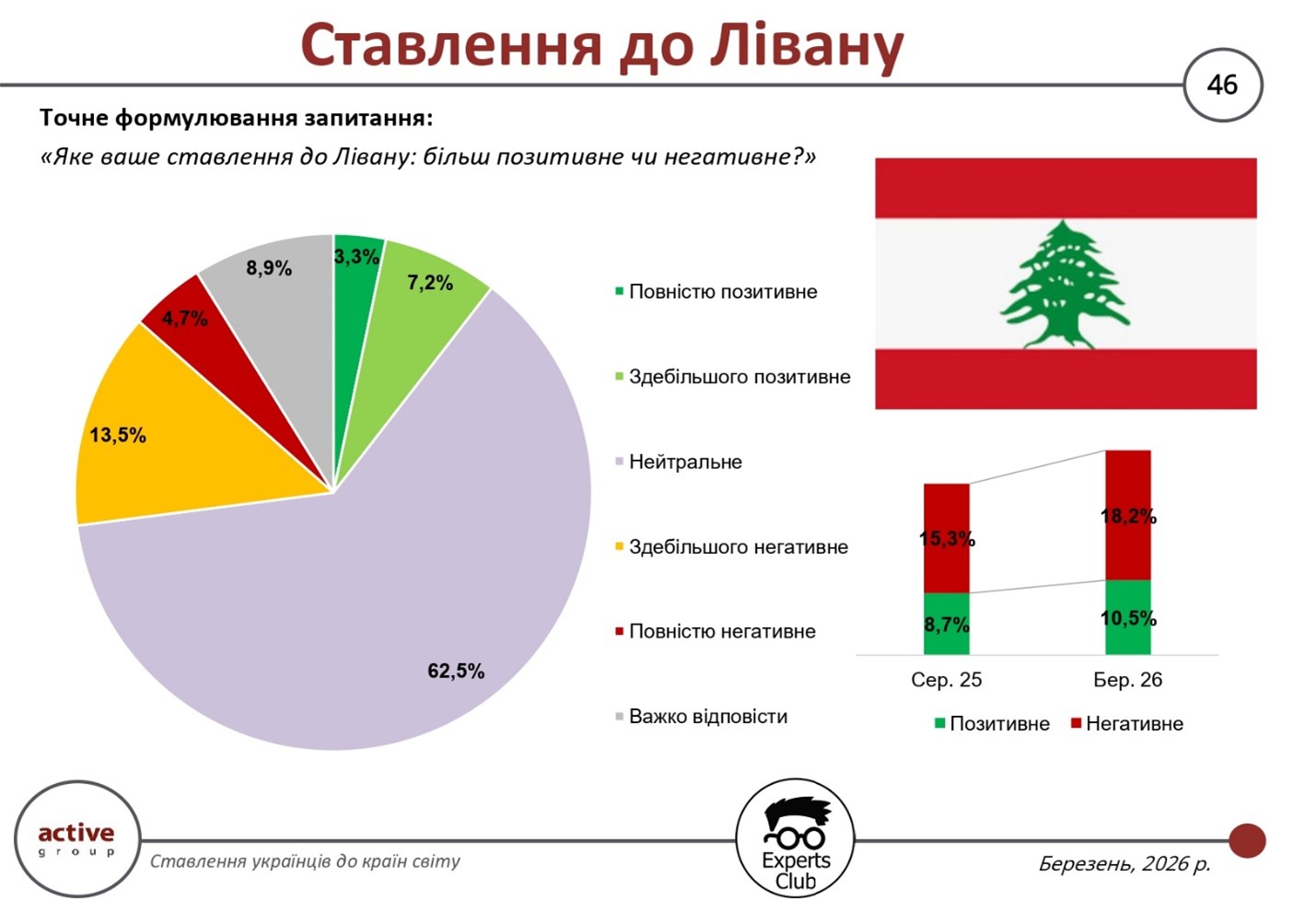
The share of positive attitudes toward Lebanon is relatively low—10.5%. Specifically, 3.3% of respondents indicated a “completely positive” attitude, and 7.2% — a “mostly positive” one. At the same time, negative assessments are significantly higher — 18.2% in total, of which 13.5% represent a “mostly negative” attitude and another 4.7% — a “completely negative” one. Additionally, 8.9% of respondents were unable to determine their position.
Compared to August 2025, there has been a simultaneous increase in both positive (from 8.7% to 10.5%) and negative (from 15.3% to 18.2%) attitudes. This trend indicates the gradual formation of a more defined image of Lebanon in Ukrainian society, although the neutral segment remains dominant.
A high level of neutrality combined with a rise in negative assessments may point to a fragmented perception of the country, shaped not through systematic interaction but through isolated information signals. Under such conditions, even a limited information background or media events can significantly influence the balance of assessments.
“When we see that, alongside neutrality, the share of negative assessments is also beginning to rise, it means that the country is gradually entering the information space, but this process is not accompanied by a sufficient number of positive signals. In such cases, an asymmetrical perception forms, where individual events or news stories have a disproportionately large impact. That is why it is important for countries with a similar profile to work not only on their presence but also on the content of that presence,” noted Maksym Urakin, founder of the Experts Club information and analytical center.
Thus, Lebanon is among the group of countries with a weak established image in Ukraine, where neutrality is gradually shifting toward a more polarized perception. The future trajectory of these assessments will largely depend on the intensity of contacts, media presence, and the nature of interaction between the countries.
According to a study conducted by the Experts Club Information and Analytical Center based on data from the State Customs Service, Lebanon ranks 33rd in total trade volume of goods with Ukraine, with a figure of $532.9 million. This is one of the most striking examples of a trade surplus for Ukraine, as Ukrainian exports far exceed imports from Lebanon.
The study was presented at the Interfax-Ukraine press center; the video can be viewed on the agency’s YouTube channel. The full version of the study can be found at this link on the Experts Club analytical center’s website.
ACTIVE GROUP, EXPERTS CLUB, LEBANON, Pozniy, SOCIOLOGY, SURVEY, UKRAINE, URAKIN
The results of a sociological survey conducted in March 2026 by the research company Active Group in collaboration with the Experts Club information and analytical center show that Indonesia remains one of the countries with the highest level of neutral perception among Ukrainians. According to the study, 71.6% of respondents chose a neutral assessment, indicating limited involvement of this country in Ukraine’s informational and economic space.
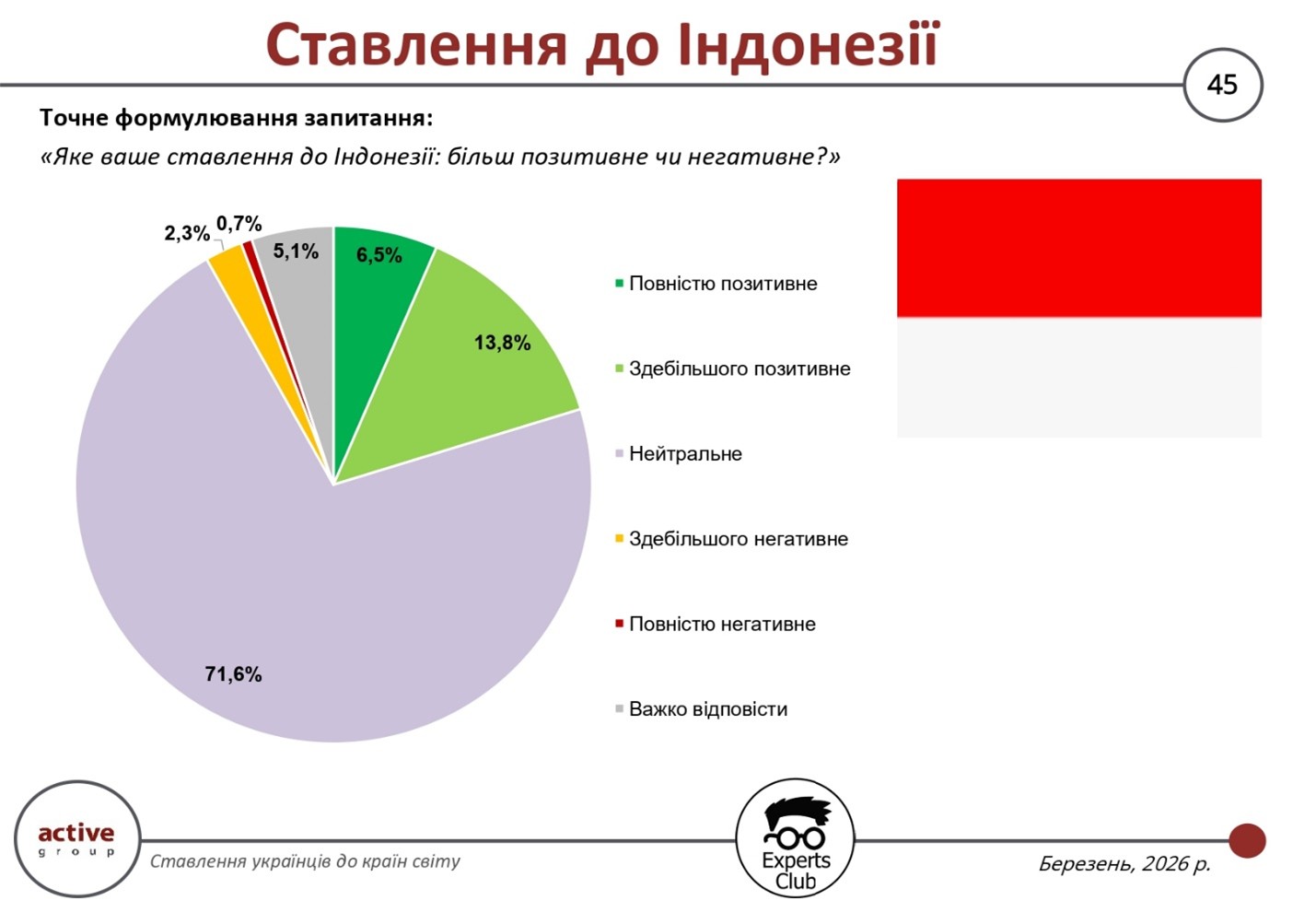
The share of positive attitudes toward Indonesia stands at 20.3%. Specifically, 6.5% of respondents indicated a “completely positive” attitude, and 13.8% — “mostly positive.” At the same time, negative assessments remain minimal — a total of 3.0%, of which 2.3% answered “mostly negative” and only 0.7% — “completely negative.” Another 5.1% of respondents were unable to determine their position.
This pattern of responses is typical for countries that do not have a significant influence on Ukraine’s domestic agenda or are not associated with key political, security, or economic processes. The high proportion of neutral assessments indicates not a negative perception, but rather the absence of a clearly formed image of the country in the public consciousness.
“When we see over 70% neutral responses, it means that the country is effectively outside the active information field of Ukrainians. In such cases, perceptions are formed not through experience or interaction, but through fragmented impressions. That is why even a slight increase in economic or humanitarian contacts can quite quickly shift the balance of assessments in a positive direction,” noted Maksym Urakin, founder of the Experts Club information and analytical center.
Thus, Indonesia remains a country with the potential to build a positive image among Ukrainians; however, this potential has not yet been realized due to low visibility and limited practical interaction. If bilateral contacts are intensified, particularly in the economic and educational spheres, the neutral segment could become the foundation for growing positive perceptions.
According to a study conducted by the Experts Club information and analytical center based on data from the State Customs Service, Indonesia ranks 32nd in terms of total trade in goods with Ukraine, amounting to $578.3 million. At the same time, Ukraine has a small trade surplus, as exports to Indonesia slightly exceed imports.
The study was presented at the Interfax-Ukraine press center; the video can be viewed on the agency’s YouTube channel. The full version of the study can be found at this link on the Experts Club analytical center’s website.
ACTIVE GROUP, EXPERTS CLUB, INDONESIA, Pozniy, SOCIOLOGY, SURVEY, UKRAINE, URAKIN
The results of a survey conducted in March 2026 by the research company Active Group in collaboration with the Experts Club information and analytical center indicate that Ukrainians’ attitudes toward Taiwan (referred to as “a province of China”) remain predominantly neutral, despite the presence of a moderately positive segment. The share of respondents who view Taiwan positively stands at 36.6%, which is lower than the August 2025 figure (41.0%). At the same time, negative assessments have decreased slightly—to 7.2% from 7.7%.
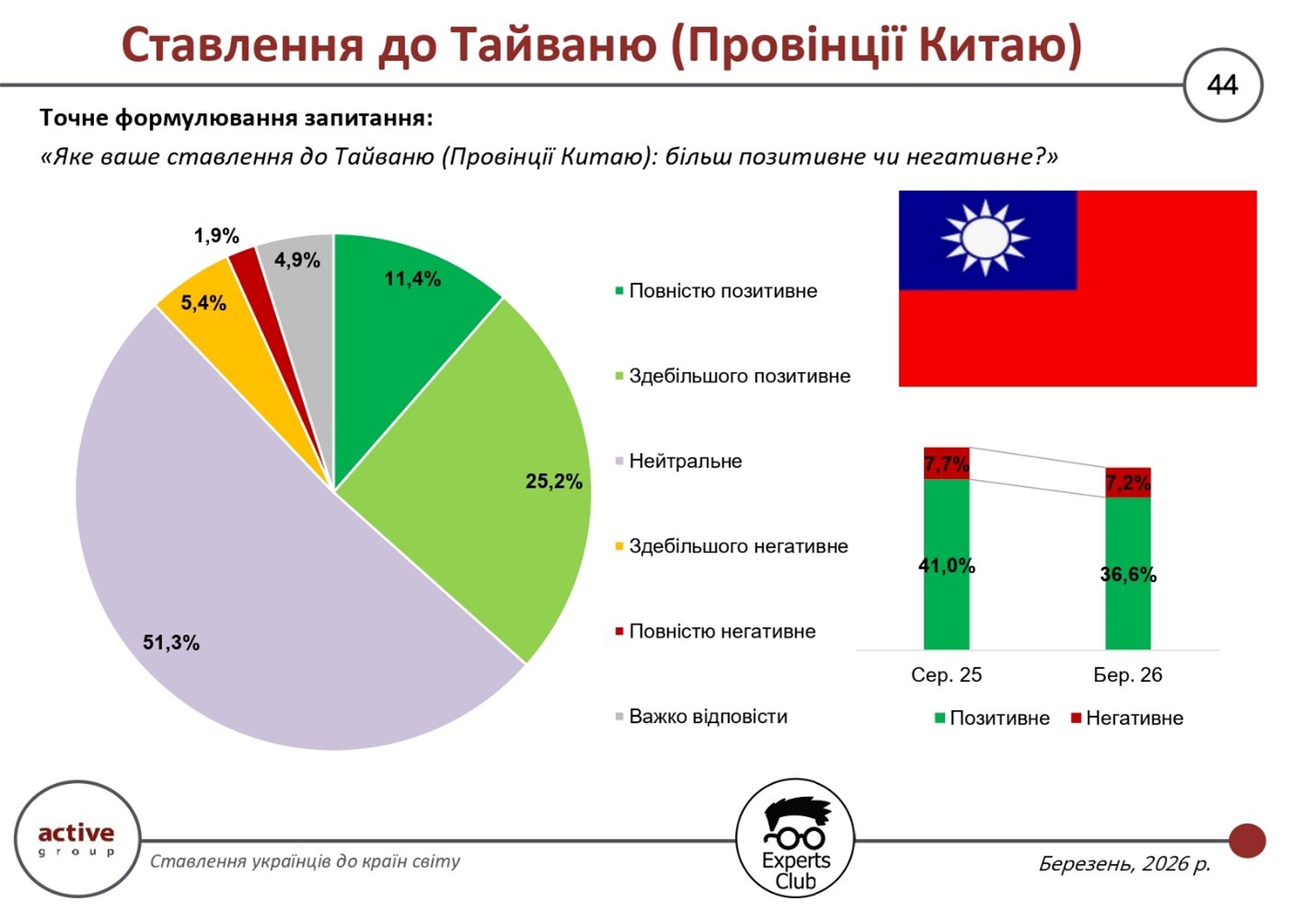
In the breakdown of responses, only 11.4% of respondents indicated a “completely positive” attitude, while another 25.2% said “mostly positive.” At the same time, neutral assessments constitute the absolute majority—51.3%, which is one of the highest figures among the countries surveyed.
The negative segment remains relatively limited: 5.4% of respondents answered “mostly negative,” and 1.9% — “completely negative.” Another 4.9% of respondents were unable to determine their attitude.
Comparative trends show that the decline in positive perceptions occurred without a significant increase in negative ones. This means that some respondents shifted to a neutral position, which is typical for countries that do not have a strong media presence or direct influence on the daily lives of Ukrainians.
“Ukrainians tend to assess countries about which they have limited experience or information with caution. In such cases, a neutral attitude dominates, which is not a sign of indifference but rather an indication of these countries’ insufficient involvement in Ukraine’s informational and social space. At the same time, even a moderate presence of positive sentiment indicates potential for building trust in the future,” noted Oleksandr Pozniy, director of the research firm Active Group.
Thus, for Ukrainian society, Taiwan remains a country with an undefined but not negative image. The high level of neutral assessments indicates significant potential for a shift in perception, which depends primarily on the intensity of contacts, information exchange, and political visibility.
According to a study conducted by the Experts Club information and analytical center based on data from the State Customs Service, Taiwan, a province of China, ranks 31st in total trade volume of goods with Ukraine, with a figure of $650.8 million. At the same time, imports from Taiwan almost entirely dominate the structure of bilateral trade, resulting in a significant trade deficit for Ukraine of over $607 million.
The study was presented at the Interfax-Ukraine press center; the video can be viewed on the agency’s YouTube channel. The full version of the study can be found at this link on the Experts Club analytical center’s website.
ACTIVE GROUP, EXPERTS CLUB, Pozniy, SOCIOLOGY, SURVEY, TAIWAN, UKRAINE, URAKIN
The results of a survey conducted in March 2026 by the research company Active Group in collaboration with the Experts Club information and analytical center indicate a consistently positive attitude among Ukrainians toward Denmark, although a slight decline in the overall level of positive assessments has been recorded compared to August 2025. The share of respondents who view Denmark positively stands at 69.9%, down from 73.7% previously. At the same time, negative assessments remain at a minimal level—1.2% compared to 1.3% in the previous period.
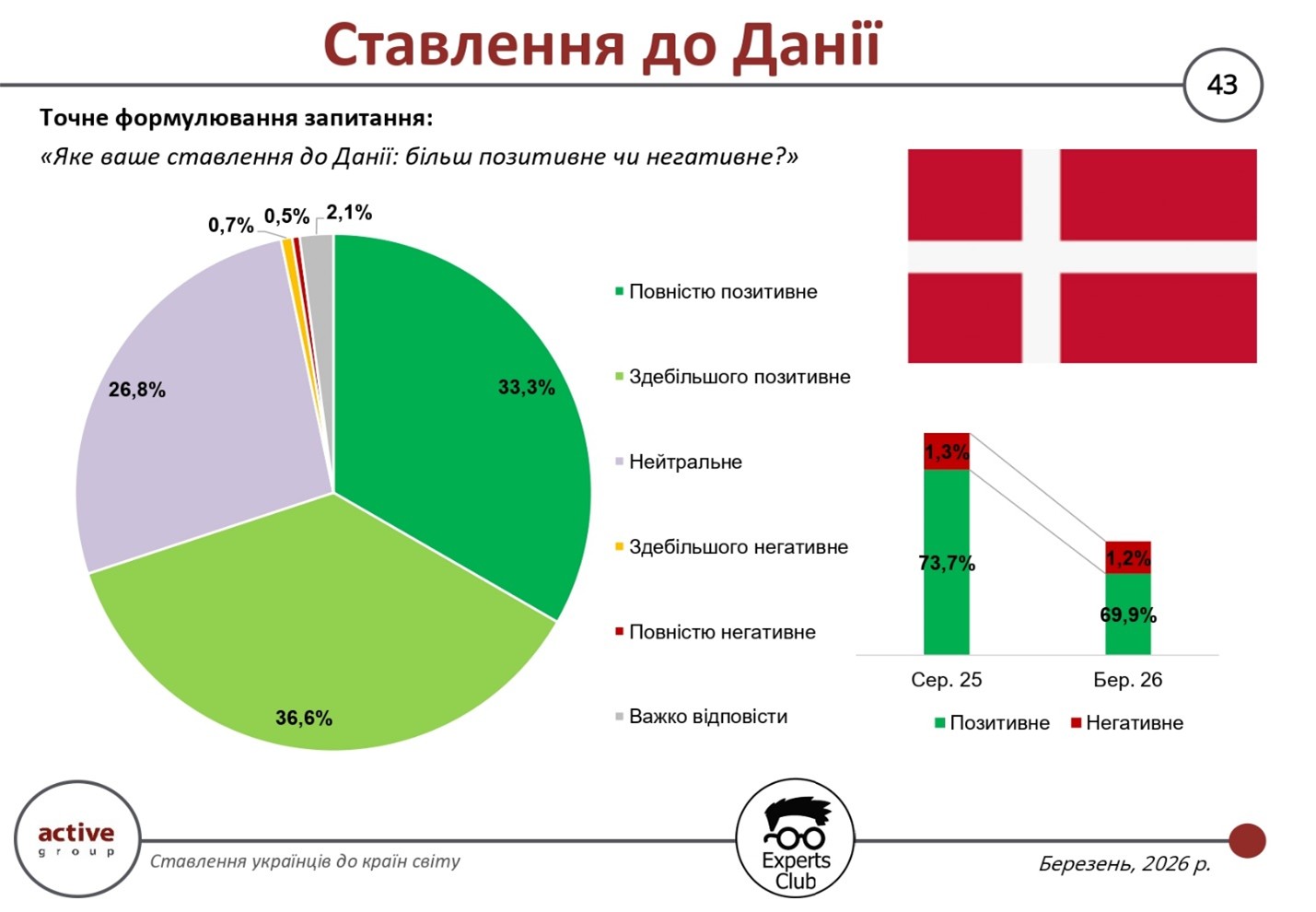
In the breakdown of responses, 33.3% of Ukrainians chose the option “completely positive,” while another 36.6% selected “mostly positive.” A neutral attitude was expressed by 26.8% of respondents, indicating a certain degree of distance in the perception of the country, despite the generally high positive sentiment.
The negative segment remains marginal: 0.7% of respondents answered “mostly negative,” and only 0.5% — “completely negative.” Another 2.1% of respondents were undecided. This distribution of assessments underscores that Denmark belongs to the group of countries with the lowest level of critical perception among Ukrainians.
Comparative trends show that the decline in positive assessments occurred primarily due to an increase in neutral responses, rather than a shift into the negative segment. This indicates a gradual shift in perception from emotionally positive to more restrained or less defined.
“Ukrainians do not perceive the world in black-and-white terms and evaluate different countries quite thoughtfully. Where the level of awareness or informational presence is lower, a neutral stance is more likely to form. At the same time, countries that demonstrate consistent support maintain a high level of trust even amid certain fluctuations in indicators,” noted Oleksandr Pozniy, director of the research company Active Group.
Overall, Denmark continues to rank among the countries with the best image in Ukrainian society. A slight decline in positive perception does not alter the overall picture, which is characterized by stable trust, a low level of criticism, and the absence of significant polarization in assessments.
According to a study conducted by the Experts Club information and analytical center based on data from the State Customs Service, Denmark ranks 30th in total trade volume with Ukraine, which amounts to $671.9 million. At the same time, imports of Danish goods are more than double Ukrainian exports, resulting in a trade deficit of over $231 million.
The study was presented at the Interfax-Ukraine press center; the video can be viewed on the agency’s YouTube channel. The full version of the study can be found at this link on the Experts Club analytical center’s website.
ACTIVE GROUP, DENMARK, EXPERTS CLUB, Pozniy, SOCIOLOGY, SURVEY, UKRAINE, URAKIN

Prices for construction materials have risen by 20-25% since the start of 2026, and there is a trend toward further increases; to ensure the effective operation of the “eOselya” state program, price limits must be updated, according to Sergey Pilipenko, CEO of PSG “Kovalskaya.”
In comments to the “Interfax-Ukraine” agency, he noted that the construction market has shown a gradual recovery over the past two years, with annual growth of 12-15%, indicating that businesses are adapting and that supply and demand are gradually balancing out. Currently, as in recent years, there is no shortage of construction materials. Production capacity even occasionally exceeds effective demand, so the market as a whole is balanced.
“In certain segments, situational shortages are possible due to power outages, staff shortages, or a lack of raw materials. But overall, the market fully meets the demand for construction materials. “Despite the harsh winter, our forecast for 2026 remains quite confident and optimistic: we expect growth of about 15% in volume terms across virtually all of Kovalskaya’s business segments. At the same time, prices remain a key factor influencing the market,” said Pilipenko.
According to him, the market is already feeling their significant rise due to global trends, particularly the rise in oil and fuel prices, as well as domestic economic challenges. It all began with a revision of cement prices, but since the start of the year, prices across the entire supply chain have risen by approximately 20–25%, and this is not yet the limit.
“We are currently seeing a rapid rise in prices for construction products and services due to a number of factors: rising costs for logistics, energy, and labor shortages are significantly impacting the direct cost of most products. Fluctuations in the national currency’s exchange rate are exacerbating this trend, as part of the cost structure involves imports. In any case, the impact of all these factors will be significant. By the end of the year, price increases for construction products could reach 30–35%, and some suppliers are already reporting even higher figures,” said Pilipenko.
He emphasized that this will have a significant impact on purchasing power and, in the medium term, may affect the dynamics and volume of construction: costs will rise, and consequently, the price per square meter will increase in both the residential segment and state-funded projects.
“Given this, the state program ‘eOselya’ will require a revision of its limits. Currently, the program is based on an average maximum cost of 48,000 UAH per square meter (66,000 UAH in Kyiv) and has certain restrictions on the maximum amount. However, if construction materials continue to rise in price, the limits will have to be increased by at least 20–25%. Otherwise, only a very limited number of projects will qualify for the program,” Pilipenko concluded.
The Kovalskaya Industrial and Construction Group has been operating in Ukraine’s construction market since 1956. It unites more than 20 enterprises in the fields of raw material extraction, product manufacturing, and construction. Its products are represented by the brands “Beton ot Kovalskaya,” “Avenue,” and Siltek. Kovalskaya’s enterprises operate in the Kyiv, Zhytomyr, Lviv, and Chernihiv regions. The aerated concrete plant in the Kherson region has been out of operation since the start of the occupation.
The European aviation market is entering a phase where rising fuel prices, geopolitical instability, and cost pressures are increasingly forcing carriers to review their flight schedules and fleet composition. A clear signal came from Lufthansa, which announced the acceleration of its anti-crisis measures: the group is removing all 27 aircraft from the regional subsidiary Lufthansa CityLine’s flight schedule, phasing out four long-haul Airbus A340-600s by the end of the summer schedule, and further reducing the main brand’s capacity on short- and medium-haul routes by an additional five aircraft during the 2026–2027 winter season. The company directly attributed these steps to rising fuel costs and the consequences of labor disputes.
This is an important indicator for the industry. It is no longer just a matter of local optimization by a single carrier, but rather a broader market shift toward capacity discipline. In a situation where fuel prices are rising, part of the fleet is aging, and margins on short- and medium-haul routes remain weak, airlines are beginning to phase out inefficient aircraft more quickly, reduce less profitable frequencies, and reallocate capacity in favor of more sustainable routes.
In the near future, such steps may also affect other European carriers, primarily those with a high proportion of older aircraft, which are sensitive to kerosene prices and operate in markets with intense competition on short-haul routes. Regional and network carriers appear to be the most vulnerable, as they must simultaneously maintain hubs, renew their fleets, and cope with rising operating costs.



