

Norway is allocating over €9 million to repair the protective sarcophagus covering the Chernobyl Nuclear Power Plant following damage caused by a Russian drone, the Norwegian Embassy in Ukraine reported.
“Norway is allocating 100 million kroner (approximately 9.1 million euros – IF-U) for the repair of the protective structure covering the No. 4 reactor at the decommissioned nuclear power plant in Chernobyl. The structure was damaged as a result of a Russian drone strike in February 2025.”
The aid will be provided through the European Bank for Reconstruction and Development (EBRD) fund, the International Chornobyl Cooperation Account (ICCA).
State Secretary Eivind Vad Petersen announced the support during a visit to Kyiv, also mentioning the incident on June 7, when a spent nuclear fuel storage facility in the Chernobyl zone was hit by a Russian strike.
“These attacks also pose a threat to European and international security. Norway will make efforts to reduce the risk of radioactive emissions and ensure that the Chernobyl NPP continues to operate safely,” Petersen said.
In April, the U.S. expressed its readiness to provide up to $100 million as part of the Group of Seven’s joint efforts to repair the new sarcophagus over the Chernobyl NPP. Ahead of the 40th anniversary of the Chernobyl accident, the EU called on Russia to stop attacks on nuclear facilities in Ukraine.

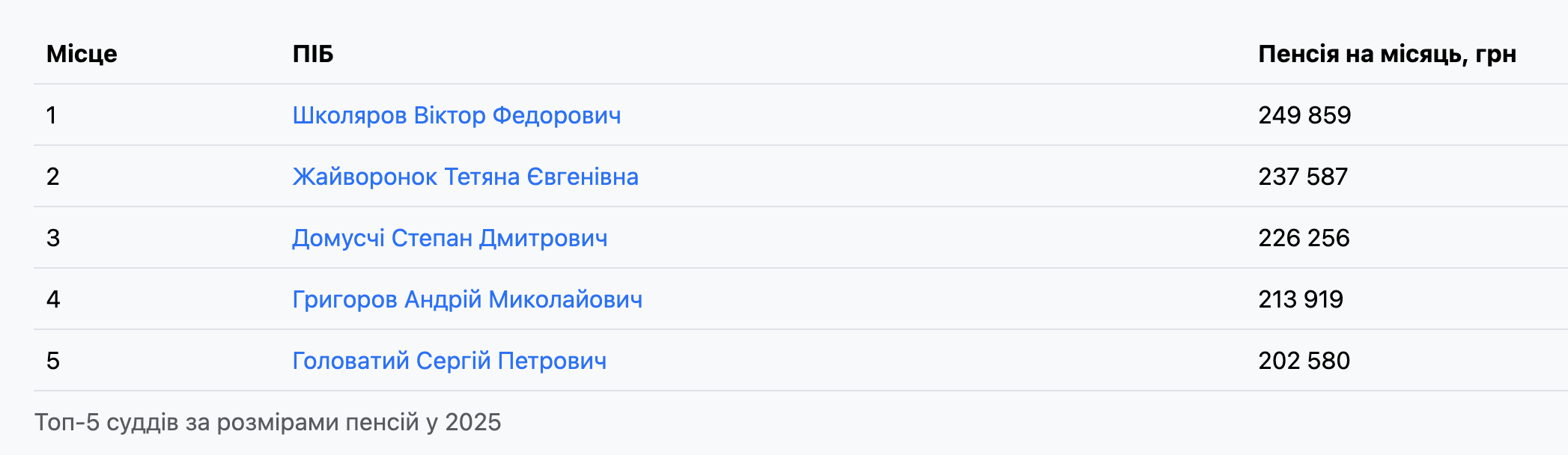
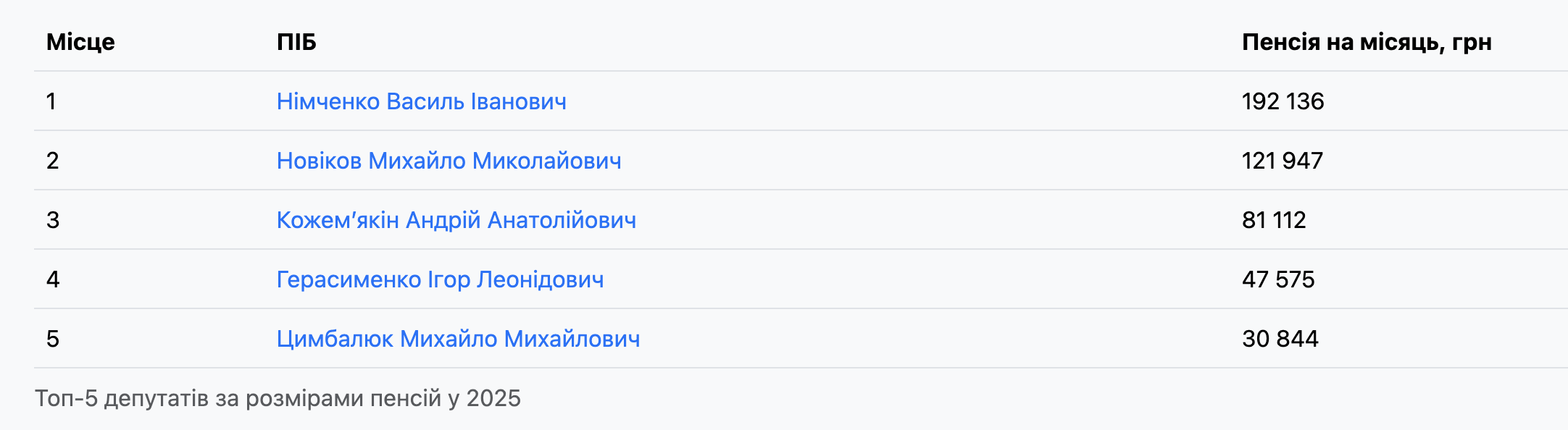
In Ukraine, 913 current lawmakers and judges have declared that they will receive pension payments in 2025, according to data from Opendatabot based on the Unified State Register of Declarations.
This includes 55 current lawmakers and 858 judges, accounting for about 14% of the total number of officials who filed annual declarations for the past year.
Vasyl Nimchenko, who previously served as a judge on the Constitutional Court of Ukraine, declared the highest pension among lawmakers. Over the course of the year, he received 2.3 million UAH in pension payments, or over 192,000 UAH per month.
Mykhailo Novikov took second place among MPs with a pension of 1.46 million UAH per year, or nearly 122,000 UAH per month. Andrii Kozhemyakin came in third, declaring 973,000 UAH in pension payments for the year, or over 81,000 UAH per month.
At the same time, the highest pension payments among judges turned out to be even higher. The absolute record-holder was Supreme Court of Ukraine Judge Viktor Shkolyarov, who retired in 2025. His annual pension amounted to nearly 3 million UAH, or an average of 249,900 UAH per month.
Second place among judges went to Tetyana Zhayvoronok, a judge of the Supreme Court of Ukraine, with a pension of 2.85 million UAH per year, or 237,600 UAH per month. Third place went to Stepan Domuschy, a judge of the Fifth Administrative Court of Appeal, who declared a pension of 2.72 million hryvnias per year, or over 226,000 hryvnias per month.
Despite the significant difference between the highest payments, the typical pension among lawmakers and judges is nearly the same. The median pension among lawmakers is 229,600 UAH per year, and among judges, it is 227,100 UAH. This means that half of the recipients in each of these groups receive payments above this level, and half receive less.
For comparison, the average pension in Ukraine currently stands at 7,236 UAH per month, or approximately 85,000 UAH per year. Thus, a judge’s maximum monthly pension is more than 34 times higher than the national average pension.
Opendatabot notes that special pensions for members of parliament were abolished for new recipients, but some current lawmakers continue to receive high pension payments. This primarily applies to individuals who became eligible for a special pension before the pension reform, retained it through court rulings, or hold additional titles.

Passenger traffic across Ukraine’s western border increased by 7.6% during the week of June 6–12, reaching 596,000: With the end of the school year and the onset of summer, the flow of travelers from Ukraine traditionally increases at this time, according to daily statistics from the State Border Service, which are monitored by the agency “Interfax-Ukraine.”
According to these statistics, the number of outbound border crossings rose to 340,000 from 292,000 the previous week, while the number of inbound crossings, conversely, decreased slightly—to 256,000 from 262,000.
The number of vehicles passing through checkpoints also rose this week—to 127,000 from 125,000 last week—while the number of vehicles carrying humanitarian cargo remained unchanged at 469.
According to the State Border Guard Service, as of 12:00 p.m. on Sunday, the largest number of passenger cars were waiting to cross the border with Poland at the “Ustyluh” and “Krakivets” checkpoints—40 and 35, respectively. Smaller lines were observed at the “Nizhankovychi” CP—15 vehicles, and at the ‘Ugryniv’ and “Rava-Ruska” CPs—10 each.
At the border with Hungary, 28–20 passenger cars were waiting to cross at the “Luzhanka,” “Kosino,” “Tisa,” and “Dzvinkove” checkpoints.
At the border with Slovakia, there was a line of 15 cars at the Maly Berezny checkpoint, while 10 cars were waiting to cross at the Uzhgorod checkpoint.
At the border with Romania, according to the State Border Guard Service, vehicles had accumulated at only one checkpoint, “Dyakivtsi” – 34, while there were no lines at the other checkpoints, as was the case at the border with Moldova.
Last year, passenger traffic across the border during this week was nearly the same—600,000—and was similarly driven by a seasonal increase in outbound crossings from Ukraine (334,000). The number of vehicles last year also matches this year’s figure—127,000. The following three weeks saw further growth, totaling an additional 25%.
As reported, starting May 10, 2022, the outflow of refugees from Ukraine, which began with the start of the war, shifted to an inflow that lasted until September 23, 2022, totaling 409,000 people. However, since late September—possibly influenced by news of mobilization in Russia and “pseudo-referendums” in the occupied territories, followed by massive shelling of energy infrastructure—the number of people leaving has exceeded the number of those entering. In total, from late September 2022 until the first anniversary of the full-scale war, this figure reached 223,000 people.
In the second year of the full-scale war, the number of border crossings out of Ukraine, according to the State Border Service, exceeded the number of crossings into the country by 25,000; in the third year, by 187,000; in the fourth, by 221,000; and since the start of the fifth year, by 125,000.
In its April inflation report, the National Bank maintained its estimate of 0.2 million people migrating from Ukraine last year due to the deterioration of the security situation at the end of the year and the easing of exit rules for young people, but noted that this figure would be less than 0.5 million in 2024. The NBU continues to forecast a net outflow of 0.2 million in 2026, while net returns, according to its forecast, will begin in 2027 and amount to about 0.1 million people, increasing to 0.5 million people in 2028.
At the same time, after a brief pause, the UNHCR announced new data on the number of Ukrainian refugees, according to which the figure in Europe as of April 30, 2026, had decreased to 5.213 million from 5.375 million on February 19, and globally to 5.762 million from 5.924 million.
In Ukraine itself, according to the latest UN data for January 2026, there were 3.70 million internally displaced persons (IDPs), compared to 3.34 million in July and 3.76 million in April 2025.

In January–May of this year, Ukraine’s iron ore mining companies reduced iron ore exports by 26.1% in volume terms compared to the same period last year—to 10,125,260 tons from 13,545,967 tons.
According to statistics released by the State Customs Service (SCS) on Friday, 2,239,167 thousand tons of IOR were exported in May, 2,163,837 thousand tons in April, 2,300,467 thousand tons in March, in February – 1,254,516 thousand tons, and in January – 2,054,539 thousand tons.
In the first five months of the year, foreign exchange earnings from mineral ore exports decreased by 28.6% to $766.946 million.
Mineral ore exports were mainly shipped to China (44.10% of shipments in monetary terms), Slovakia (18.09%), and Poland (14.73%).
In addition, Ukraine imported 224 tons of raw materials worth $62,000 from the Netherlands (38.71%), Poland (32.26%), and Italy (29.03%) in January–May 2026, whereas in January–May 2025, it imported 65,000 tons worth $46,000.
As reported, Ukraine’s mining enterprises reduced ore exports in physical terms by 8% in 2025 compared to the previous year—to 30,995,363 tons from 33,699,722 tons, foreign exchange earnings decreased by 16.6%—to $2.337765 billion from $2.803223 billion. Exports were mainly directed to China (44.98% of shipments in monetary terms), Slovakia (17.15%), and Poland (16.09%).
In addition, in 2025, Ukraine imported $95,000 worth of raw materials totaling 130 tons from the Netherlands (46.32%), Italy (36.84%), and Norway (13.68%), whereas in the previous year it imported 2,042 tons worth $414,000.

The state-owned enterprise “Boryspil International Airport” (Kyiv) announced a tender on May 15 for the procurement of compulsory civil liability insurance for owners of land vehicles (OSAGO), according to the Prozorro electronic public procurement system.
The estimated cost of the services is 439,100 UAH. The deadline for submitting bids is June 23.

In January–May 2026, Ukraine increased its imports of aluminum and aluminum products by 20% compared to the same period last year, reaching $247.912 million.
In May, imports of aluminum and aluminum products amounted to $58.220 million.
At the same time, exports of aluminum and aluminum products in January–May of this year rose by 25.3% compared to the same period last year—to $72.393 million. In May, $18.641 million worth of aluminum was exported.
As reported, Ukraine increased imports of aluminum and aluminum products by 15.3% in 2025 compared to 2024, reaching $514.098 million. Exports of aluminum and aluminum products in 2025 rose by 22.9% to $152.919 million.
Aluminum is widely used as a structural material. The main advantages of aluminum are its lightness, formability, corrosion resistance, high thermal conductivity, and the non-toxicity of its compounds. In particular, these properties have made aluminum extremely popular in the production of cookware, aluminum foil in the food industry, and for packaging. The first three properties have made aluminum the primary raw material in the aviation and aerospace industries (though it has recently been replaced by composite materials, primarily carbon fiber). After construction and packaging production—aluminum cans and foil—the largest consumer of the metal is the energy sector.
For a more detailed overview of global aluminum production from 1970 to 2024, watch the video on the Experts Club YouTube channel.



