

Agrotrade Group has launched its 2026 spring sowing campaign in four regions of Ukraine, namely Chernihiv, Sumy, Kharkiv and Poltava regions, Ivan Kriuchkov, director of the group’s agro-industrial department, said on the agricultural holding’s Facebook page.
According to the statement, the agricultural holding revised its crop rotation structure for the 2026 season: the areas under sunflower and corn were increased at the expense of soybean plantings. About 16.5 thousand hectares were allocated for corn (24.9% of the total structure), 16 thousand hectares for sunflower (28.6%), while soybeans will occupy 3 thousand hectares.
“We have good expectations for this season. Timely implementation of agricultural operations and proper crop care are important conditions for success. The team is focused on delivering everything planned,” Kriuchkov said.
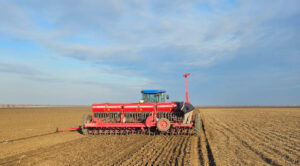
As of April 21, the agricultural holding had completed sowing on about 12% of the planned production area, using 18 seeders. The campaign is expected to be completed within three weeks. In 2026, Agrotrade plans to improve efficiency through the introduction of Strip-Till and no-till technologies.
As reported, corn became the most productive crop for Agrotrade in 2025 and showed an average yield of 9.89 tonnes per hectare, which was 17% above plan. In particular, the borderland clusters in Sumy and Chernihiv regions recorded yields of 10.3-10.4 tonnes per hectare.
Agrotrade Group is a vertically integrated holding cultivating more than 70 thousand hectares of land. It owns a network of elevators with a total capacity of 570 thousand tonnes and a seed plant based at the Kolos farm in Kharkiv region. Its founder and CEO is Vsevolod Kozhemiako.
As of April 20, farmers had sown 1,251.9 thousand hectares with spring grain and leguminous crops, which amounts to 21% of the forecast for 2026, the press service of the Ministry of Economy, Environment and Agriculture reported on Tuesday.
According to оперативе statistics, over the past week farmers sowed 254.9 thousand hectares compared with 168.7 thousand hectares the previous week. The pace of field work increased by 1.5 times, but the overall figures are 15.3% behind last year’s pace, when as of April 25, 2025, 1,478.7 thousand hectares had been sown.
The Ministry of Economy clarified that so far 623.8 thousand hectares of barley have been sown (83% of the plan), peas – 238.3 thousand hectares (87%), wheat – 158.8 thousand hectares (85%) and oats – 117.5 thousand hectares (85%). Corn sowing has intensified and reached 75.7 thousand hectares (2% of the forecast), the area under millet amounts to 1.2 thousand hectares (3%), and buckwheat sowing has started (0.01 thousand hectares). Other spring grain and leguminous crops have been sown on 36.5 thousand hectares (27% of the forecast).
The highest sowing rates for grain and leguminous crops have currently been recorded in Odesa region (168.2 thousand hectares), Ternopil region (96.3 thousand hectares), Mykolaiv region (89.4 thousand hectares) and Poltava region (86.5 thousand hectares).
At the same time, sowing of industrial crops is continuing, with 440.8 thousand hectares already sown. In particular, 293.6 thousand hectares have been allocated for sunflower (6% of the forecast), and 21.8 thousand hectares for soybeans (1%). Sugar beet has been sown on 125.4 thousand hectares, which is 64% of the planned area.
As reported, as of April 25, 2025, 2,000 thousand hectares in Ukraine had been sown with spring grain and leguminous crops. In particular, corn accounted for 705 thousand hectares, barley – 702.1 thousand hectares, wheat – 199.8 thousand hectares, peas – 201.8 thousand hectares, and oats – 154.2 thousand hectares. On the same date last year, 1,236.8 thousand hectares had been sown with sunflower, 187.6 thousand hectares with soybeans, and 228.5 thousand hectares with sugar beet.
According to the forecast of the Ministry of Economy, the total area of spring grain and leguminous crops in 2026 will amount to 6.002 mln hectares, of which corn will account for 4.418 mln hectares. Among industrial crops, 5 mln hectares are planned for sunflower, 2.04 mln hectares for soybeans, and 197.2 thousand hectares for sugar beet.
AGRICULTURE, FARMERS, GRAINS, SOWING CAMPAIGN, SPRING SOWING

The Embassy of the Republic of Uzbekistan invites representatives of the business community, investment companies, the banking and financial sector, industry associations, chambers of commerce and industry, international organizations, and the expert community to participate in the 5th Anniversary Tashkent International Investment Forum.
The event will take place June 16–18, 2026, in Tashkent and will serve as one of the key international platforms for discussing investment cooperation and developing new partnership solutions. The forum’s theme—“Investment Resilience: New Frontiers, New Partnerships”—will focus on protecting investments amid global uncertainty, establishing sustainable financial mechanisms, and developing new avenues of cooperation in promising markets.
The forum will feature discussions on macroeconomic trends and the investment potential of Uzbekistan, which is demonstrating steady growth and rising international ratings, as well as practical aspects of implementing investment projects.
Particular attention will be paid to the launch of the Tashkent International Financial Center, the development of financial infrastructure, trade and transport connectivity, the energy transition, and climate finance. The program includes panel discussions, industry sessions, bilateral meetings in B2B and B2G formats, as well as discussions on arbitration and investment protection.
The forum will provide participants with the opportunity to establish direct contacts with representatives of government agencies, international financial institutions, and the business community, learn about investment projects, and expand business cooperation.
Additionally, a rich business and cultural program is planned, including thematic events, networking sessions, and special events for forum participants.

According to data for January–February 2026, Ukraine ranked second among the largest suppliers of chocolate products to Uzbekistan. This was reported by the National Statistics Committee of Uzbekistan.
According to official data, in the first two months of 2026, Uzbekistan imported approximately 6,600 tons of chocolate products worth $27.7 million from 34 countries. At the same time, the volume of imports decreased by 1,100 tons compared to the same period last year.
Russia remains the largest supplier of chocolate to Uzbekistan, with a volume of 4,407 tons. Ukraine ranks second with 607 tons. Next are Turkmenistan with 209.1 tons, Kazakhstan with 201.8 tons, and Turkey with 190.7 tons.
Thus, Ukrainian producers maintain a strong position in the Uzbek chocolate market, trailing only Russian suppliers and outpacing other regional exporters.

Disruptions in global oil supplies caused by the war in Iran have led to an increase in the cost of long-haul flights from Europe by more than $100 per passenger, according to the European Federation for Transport and Environment (T&E).
According to its data, rising aviation fuel prices have increased airlines’ costs by an average of 88 euros ($104) per passenger on long-haul flights from Europe and by 29 euros on flights within Europe. For example, fuel for a flight from Barcelona to Berlin will cost €26 more per passenger, and on the route from Paris to New York, it will cost €129 more.
T&E compared prices as of April 16 with the cost of flights immediately before the start of the war between the U.S. and Israel against Iran. The group calculated the average fuel consumption for all routes departing from European airports and divided it by the number of departing passengers.
The calculations showed that the additional costs associated with the spike in fuel prices far exceed the costs airlines incur to comply with the European Union’s climate change policies. “The crisis in the Middle East proves that our real vulnerability lies in a tank filled with foreign oil, not in laws designed to fix it,” said T&E Aviation Director Diana Vitti.

According to Fixygen, PJSC “Cherkasy River Port” plans to hold a general meeting of shareholders on April 22.
The company is registered in Cherkasy and operates in the river logistics and cargo transshipment sector. According to public records, the company was founded on July 23, 1996, with a registered capital of UAH 58,476 thousand, and is headed by Viktor Tantsyura. The company’s primary activity is river freight transport. Additional areas of operation include the extraction of sand, gravel, clay, and kaolin; freight trucking; the sale of building materials; and the leasing and operation of real estate.
According to SMIDA data as of March 31, 2026, the company’s largest shareholders are Viktor Atamanenko and Nadezhda Bidna, each of whom owns 37.5881% of the shares.
The Cherkasy River Port is one of the river port facilities on the Dnieper River, focused on handling general and bulk cargo. Industry reports note that the port accommodates river-sea vessels with a carrying capacity of up to 3,000 tons, and its cargo portfolio includes metal, equipment, reinforced concrete products, mineral-building materials, and containerized and general cargo.
According to Opendatabot, the company’s revenue in 2025 amounted to UAH 2.285 million, compared to UAH 1.533 million the previous year. The net loss for the past year decreased to 912,000 UAH from 1.613 million UAH in 2024, and assets as of the end of 2025 were estimated at 2.445 million UAH.



