
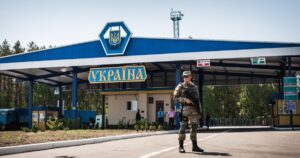
Chernivtsi and Transcarpathian regions accounted for 67% of all reports for illegal crossings or attempted illegal crossings of Ukraine’s state border in the first half of 2026.
According to data from the State Border Guard Service cited by OpenDataBot, 2,834 reports were filed in Bukovina over the six-month period, or 38% of the total. Another 2,170 reports, or 29%, were filed in Zakarpattia Oblast.
The Odesa region ranks third, with 997 reports, or 13%.
Thus, the Chernivtsi, Zakarpattia, and Odesa regions alone account for 80% of all recorded violations.
The situation has changed particularly significantly in the Chernivtsi region. The number of reports there is now approximately 30 times higher than it was before the start of the full-scale war. For the past two years, Bukovina has ranked first in the country in terms of the number of such violations.
Until 2022, the Odesa and Zakarpattia regions were the main leaders in this regard.
A significant increase has also been recorded in the Ivano-Frankivsk region. Before the full-scale war, not a single such report was filed there; in 2022, there were only five, but by 2024, that number had risen to 1,209.
In 2025, 1,109 reports were filed in the Ivano-Frankivsk region, and in the first half of 2026 alone—there were already 377.
Across Ukraine, border guards filed 7,523 reports from January through June, which is about one-third fewer than during the same period last year.
Despite the decline, the frequency of such violations remains nearly ten times higher than pre-war levels. Before the full-scale war in Ukraine, approximately 2,700 reports were filed annually, whereas now an average of about 1,250 are filed per month.
However, the filing of a report does not automatically mean that a person is found guilty. Such cases are heard by the courts.
In 2025, the courts heard 24,519 cases under Article 204-1 of the Code of Ukraine on Administrative Offenses. Fines were imposed on 12,628 individuals, while 10,493 cases—or 43%—were dismissed due to the absence of an incident or the elements of an administrative offense.
The total amount of fines imposed was 85.97 million UAH, but only 24 million UAH—or 28%—was paid voluntarily.
Source: OpenDataBot, based on data from the State Border Guard Service and the State Judicial Administration, published on August 28, 2026.

According to Experts.news, the decline in the number of recorded attempts to illegally cross the state border has not yet been accompanied by a corresponding decrease in migration outflow from Ukraine through official border crossing points.
In the first half of 2026, border guards issued 7,523 citations for illegal border crossings or attempted illegal border crossings—approximately one-third fewer than a year earlier.
At the same time, official border statistics show that over the six-month period, Ukrainians left the country 7.13 million times and returned 6.89 million times.
Thus, the net difference between departures and returns amounted to 244,300 people. A year earlier, during the same period, it was comparable—about 251,000.
At first glance, these figures demonstrate a significant gap between illegal attempts to leave the country and the overall migration outflow. However, these are fundamentally different statistical categories.
244,300 is not the number of detected emigrants, but the arithmetic difference between official departures and arrivals of citizens during the first half of the year. Some of these people may return to Ukraine later.
Furthermore, this figure includes all citizens with legal grounds for crossing the border, specifically women, children, men in relevant categories, and other individuals.
The figure of 7,523, in turn, does not represent the number of Ukrainians who managed to leave the country illegally, but rather the number of administrative reports filed by border guards for detected illegal border crossings or attempts to do so.
However, the aggregate data show that the main demographic risk for Ukraine today is linked not only to illegal border crossings but also to the number of citizens who legally leave the country and subsequently do not return.
For the full year of 2025, the difference between the number of departures and returns of citizens amounted to 290,300 people. This was 1.5 times less than in 2024, when the negative balance reached nearly 443,000 people. Over the four years of full-scale war, according to OpenDataBot’s calculations, the cumulative difference between official departures and returns amounted to approximately 3.1 million citizens.
At the same time, in the first half of 2026 alone, the negative balance had already reached 244,300 people, which is about 84% of the figure for all of 2025.
June accounted for the bulk of this year’s difference: during that month, the number of people leaving Ukraine exceeded the number of returnees by 210,900. “OpenDataBot” attributes this, in part, to a seasonal increase in travel during the vacation period; therefore, final conclusions regarding annual migration can only be drawn based on the results for the whole of 2026.
Thus, the decline in the number of illegal attempts to cross the border represents a notable change compared to the peak year of 2024; however, this alone does not signify an end to the demographic outflow.

Agricultural holding company IMC reported $34.28 million in net profit for the first half of 2026, down 33% from the first half of 2025, according to the company’s report filed with the Warsaw Stock Exchange on Thursday.
“The decline in normalized EBITDA and net profit … was driven by lower corn and sunflower prices compared to the same period last year—in contrast to the sharp price increases in the first half of 2025—as well as rising logistics costs and the depreciation of the hryvnia,” the document states.
According to the report, EBITDA fell by 22% to $50.23 million.
The company’s consolidated revenue in the first half of 2026 rose by 6% to $88.88 million. Corn sales accounted for the largest share—98.1% compared to 97.8% in the first half of last year.
It is noted that the company’s cost of goods sold rose from $66.4 million in January–June 2025 to $79.9 million in January–June 2026.
IMK added that over the six-month period, the Ukrainian hryvnia depreciated by 5.5% against the U.S. dollar, whereas in the first half of last year it depreciated by only 1.0%; consequently, the company recognized a net loss from foreign exchange differences of $2.11 million.
Net cash flow from operating activities decreased to $12.0 million from $15.0 million in January–June 2025, primarily due to lower prices for agricultural products and higher operating expenses.
According to the report, IMC’s net cash outflow from investing activities decreased to $8.2 million in the first half of 2026 from $10.5 million in the first half of 2025, in line with the group’s capital expenditure program.
IMK Agroholding is an integrated group of companies operating in the Sumy, Poltava, and Chernihiv regions (northern and central Ukraine) in the crop production, grain elevators, and warehousing segments. Its land bank totals 115,000 hectares, storage capacity stands at 554,000 metric tons, and grain and oilseed production in 2025 reached 838,000 metric tons.
IMK’s net profit in 2025 rose by 24% to $67.5 million, while consolidated revenue fell by 10% to $190.5 million.

The Ukrainian chain Lviv Croissants has opened its first restaurant in the state of California—in Fair Oaks, near Sacramento. The new location is the brand’s fourth in the U.S., the company announced.
The restaurant is located at 5343 Sunrise Blvd in the Quail Pointe shopping center. It spans over 206 square meters, and the dining area seats 54 guests. The restaurant operates under the chain’s new design concept, and its operational processes are integrated into a single technology platform that Lviv Croissants uses in the U.S. market.
The franchisee of the new restaurant is Ukrainian entrepreneur Oksana Melnychuk, who has been living in the U.S. for many years. After learning about the brand through Lviv Croissants’ partners in Atlanta, she chose this franchise for her first restaurant project in California.
According to the company, more than ten franchise agreements have already been signed in the U.S. market. By the end of 2026, the chain plans to open one or two more restaurants in the U.S. and continue more active franchise expansion in 2027.
“For us, it’s important not just to enter new markets, but to create the conditions for their long-term development. That’s why we’re investing in local infrastructure, a partnership model, and standards that allow us to scale the brand without compromising on quality,” said Andriy Halytskyi, co-founder and CEO of Lviv Croissants.
According to him, California is the logical next step in the chain’s expansion in the U.S., and the company is seeing strong interest in franchising from entrepreneurs across various states.
One of the key elements of Lviv Croissants’ U.S. strategy has been the creation of its own production infrastructure. Before opening its first restaurant, the company launched croissant production in Atlanta, Georgia. From there, products are shipped to the chain’s U.S. locations, allowing for centralized quality control.
The core menu at U.S. restaurants is standardized, though individual items are adapted to local demand. It includes large and small croissant sandwiches with savory and sweet fillings, breakfast items, salads, soups, specialty coffee, and cold beverages. The Lviv Croissants U.S. website features, among other items, pastrami sandwiches, teriyaki chicken sandwiches, and the classic Lviv Croissant.
The first Lviv Croissants restaurant in the U.S. opened in August 2024 in Roswell, Georgia. In 2025, the chain expanded to the West Coast, opening locations in Kent and Takwila, Washington. The Fair Oaks location became the fourth U.S. restaurant and the first in California.
Lviv Croissants was founded in Lviv in 2015. The first franchise location opened in Sumy that same year, after which the company began rapid expansion. Currently, the chain has over 190 locations in Ukraine and also operates in Poland, the U.S., Slovakia, France, Norway, and South Korea. In 2025, the chain’s locations sold over 11.5 million croissants.
California, FRANCHISE, Lviv Croissants, RESTAURANT, U.S., UKRAINE

According to the “Serbian Economist,” Serbia is ready to provide its territory as a venue for negotiations between Ukraine and Russia if both sides consider Belgrade’s involvement to be useful, said Andon Sapundži, Serbia’s ambassador to Ukraine.
“If there is a need for a venue for dialogue or negotiations, Serbia is ready to offer it,” the diplomat said in an interview with the Ukrainian publication “Apostrophe,” published on August 27.
At the same time, the ambassador emphasized that Belgrade has no intention of imposing its own terms for a settlement on the parties and believes that decisions regarding the start of negotiations, their format, and conditions should be made directly by Ukraine and Russia.
Sapundži also rejected the interpretation of Belgrade’s position as a call for Ukraine to cede part of its territory in order to end the war.
According to him, Serbia consistently supports Ukraine’s territorial integrity within its internationally recognized borders.
At the same time, Belgrade does not consider itself a party to the war and hopes to maintain the ability to engage in political dialogue with both sides.
In early August, Ukrainian President Volodymyr Zelenskyy visited Belgrade. This was the Ukrainian president’s first visit to Serbia in eight years. According to Sapundži, during the visit, Zelenskyy and Serbian President Aleksandar Vučić held three separate meetings in less than a day, including a nearly four-hour informal conversation over dinner, official talks, and a one-on-one meeting.
Oschadbank and the Lviv City Council signed a five-year loan agreement for 582.6 million UAH to finance projects aimed at modernizing the city’s critical infrastructure, the financial institution announced on Friday.
“The new 582.6 million hryvnia loan will enable Lviv to continue upgrading its housing, utilities, and road infrastructure, modernizing its heat supply system, and strengthening energy security,” said Serhiy Chernikov, deputy chairman of Oschadbank’s board of directors responsible for corporate business.
It is noted that the funds will be directed toward nine critical infrastructure projects in the city.
Taking this new agreement into account, the total amount of loans provided to Lviv by Oschadbank over the past three years has reached 2.09 billion UAH: in 2024, the bank provided the city with 840.0 million UAH, and in 2025—668.0 million UAH.
Since the start of the full-scale invasion, Oschadbank has entered into loan agreements with Ukrainian municipalities totaling 7.8 billion UAH. As of August 1, 2026, the bank accounted for over 64% of municipal lending.
According to the National Bank, as of July 1, 2026, Oschadbank, with total assets of 518.87 billion UAH, ranked second among Ukraine’s 59 banks. The bank’s total loan portfolio grew by 6.7% in the first half of the year, reaching 136.83 billion UAH.



