
Ukrainian students have been selected as recipients of the HEC Imagine program, which provides young people from countries affected by war and crises with the opportunity to study at HEC Paris, one of France’s leading business schools.
This was reported by the Embassy of Ukraine in the French Republic following the “Imagine pour la Paix” event, dedicated to supporting the program’s participants.
The event took place at UNESCO headquarters in Paris and brought together representatives from HEC Paris, the French business community, program partners and donors, diplomats, and students.
Among those attending were Jean-Noël Barro, France’s Minister for Europe and Foreign Affairs—an HEC Paris alumnus—as well as Gaël Veissier, former French Ambassador to Ukraine, who currently heads the Crisis Response and Support Center at the French Ministry for Europe and Foreign Affairs.
HEC Imagine fellows shared their personal experiences and insights about studying in France.
The HEC Imagine program was created to support talented students whose education and career prospects have been threatened by wars and other crises. Ukrainian students were among the program’s first participants.
According to HEC Paris, the HEC Imagine Fellows project began in 2022. From the very beginning, the scholarships enabled students from Ukraine, Afghanistan, and Syria to study at HEC.
The program provides not only financial support for tuition but also facilitates the students’ integration into the academic and professional environment at HEC Paris.
The Ukrainian Embassy in France emphasized that supporting the education of Ukrainians takes on special significance amid the war and the destruction of Ukraine’s educational and scientific infrastructure.
“The reconstruction of Ukraine is not just about rebuilding buildings and infrastructure. Above all, it is an investment in people: future entrepreneurs, economists, engineers, and managers who will create jobs, attract investment, and build a modern, European Ukraine,” the Ukrainian Embassy noted.
The diplomatic mission also thanked HEC Paris for its support of Ukrainian students and the Association des étudiants ukrainiens en France for helping to organize Ukraine’s participation in the event.
HEC Paris is one of Europe’s most renowned business schools. The institution specializes in training professionals in the fields of management, finance, entrepreneurship, and business administration, and its graduates work in international companies, financial institutions, the public sector, and their own businesses.
The HEC Imagine program is part of a broader initiative that combines support for students from conflict-affected countries with a discussion on the role of business and education in rebuilding and securing peace.
Sources: Embassy of Ukraine in the French Republic, HEC Paris, UNESCO.
According to Fixygen, U.S. banks have opened a new front in their battle with the crypto industry—the Independent Community Bankers of America (ICBA) has filed a lawsuit against the U.S. Office of the Comptroller of the Currency (OCC), challenging the decision to grant crypto companies simplified national banking licenses.
The lawsuit was filed on October 2 in the U.S. District Court for the District of Columbia, the ICBA reported. The association represents American community banks—that is, small and medium-sized banks—a significant portion of whose business involves lending to individuals and companies in local markets.
The subject of the dispute is the so-called national trust bank charters. These charters allow companies to operate at the federal level with digital assets, provide custody services, and participate in payment transactions, but do not authorize traditional banking activities such as accepting deposits and issuing loans.
The ICBA believes that the OCC has effectively created a simplified path for crypto companies to enter the regulated banking system.
“Congress did not create the national trust license as a back door into the banking system for crypto companies,” said ICBA President and CEO Rebecca Romero Reyni.
Banks point to a fundamental difference in regulation.
Traditional deposit-taking banks must meet capital and liquidity requirements, be subject to consolidated supervision, and participate in the FDIC deposit insurance system. Companies with a national trust charter that do not take deposits are exempt from a significant portion of these requirements.
At the same time, the ICBA believes that a federal license may give customers the impression that a crypto company’s assets have the same government guarantees as funds held at a traditional bank.
The association is demanding that the final rule adopted by the OCC on March 2, 2026, and the related Interpretive Letter No. 1176 be declared unlawful.
Separately, the ICBA is demanding that the conditional approval of a national trust banking license for Protego Holdings be revoked. The company specializes in the custody, trading, lending, and issuance of digital assets.
The dispute extends far beyond a single license.
If the OCC maintains its current approach, crypto companies will be able to obtain federal banking status without converting into traditional commercial banks. This could simplify institutional custody of cryptocurrencies, settlements using digital assets, and the integration of crypto infrastructure into the U.S. financial system.
At the same time, traditional banks are stepping up pressure on the stablecoin market. The ICBA opposes paying interest and rewards to stablecoin holders, fearing a flight of funds from bank accounts into digital dollars. According to the association, a reduction in the deposit base could diminish small banks’ resources for lending to businesses and the agricultural sector.
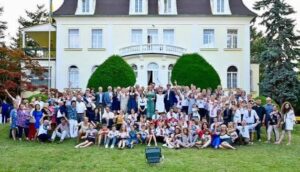
More than 400 Ukrainian children, mostly from Ukraine’s frontline regions, had the opportunity to participate in a health and summer vacation program in Austria with the support of the Embassy of Ukraine and Austrian partners.
This was reported by the Embassy of Ukraine in the Republic of Austria.
The programs for children were organized in cooperation with the federal states of Austria and with the direct participation of Austrian civil society organizations.
“One of the Embassy’s key priorities is to create opportunities for Ukrainian children to receive health treatment and enjoy a vacation,” the diplomatic mission noted.
In total, more than 400 Ukrainian children took advantage of the opportunity to vacation in Austria during the summer. The organizers focused primarily on children from regions located near the front lines that are regularly subjected to Russian shelling.
The embassy expressed gratitude to the federal states, civil society organizations, and other Austrian partners who contributed to the implementation of the programs.
“We thank everyone who participated and gave our children the opportunity to experience the joy of childhood. We hope for continued support in the future,” the statement reads.
Organizing recreational and health programs for Ukrainian children abroad has become one of the areas of Ukraine’s humanitarian cooperation with European countries since the start of the full-scale war. Such programs are primarily aimed at children from frontline regions and areas affected by hostilities.
Original source: Embassy of Ukraine in the Republic of Austria.
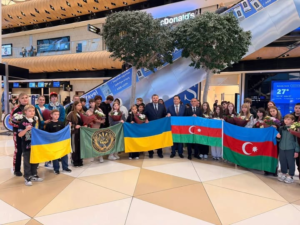
A group of 30 Ukrainian children from the Kharkiv and Kherson regions has arrived in Azerbaijan for psychological and health rehabilitation and recreation, the Embassy of Ukraine in the Republic of Azerbaijan reported.
The group includes children living under constant Russian shelling, as well as children of active Ukrainian servicemen, prisoners of war, and wounded defenders of Ukraine.
The rehabilitation and recreation program has been organized in the city of Gabala, one of Azerbaijan’s main mountain resort centers.
At Heydar Aliyev International Airport, the children were welcomed by Ukraine’s Ambassador to Azerbaijan Yurii Husiev, head of the Azerbaijan-Ukraine Interparliamentary Relations Working Group and member of the Milli Majlis Alibala Maharramzade, and Deputy Chairman of the Board of the Social Services Agency under Azerbaijan’s Ministry of Labour and Social Protection of the Population Vugar Mammadov.
Since the beginning of the full-scale war, 692 Ukrainian children have already undergone recreation, health improvement and rehabilitation in Azerbaijan, the embassy reported.
Thus, taking into account the current group, Azerbaijan continues to implement humanitarian programs aimed at supporting Ukrainian children affected by the war.
“We highly appreciate this assistance, the strong strategic partnership and friendship that unite the Ukrainian and Azerbaijani peoples,” Husiev said.
The ambassador also thanked Azerbaijan for its support for Ukraine and assistance to children who, because of the war, are forced to live under conditions of constant danger and shelling.

Ukraine is proposing that the European Union increase the existing duty-free export quota for Ukrainian bioethanol—currently set at 125,000 metric tons per year—to account for the volume of bioethanol that Ukraine imports from the EU as part of automotive gasoline, Minister of Agrarian Policy and Food Taras Vysotsky told reporters.
“We have calculated that Ukraine currently imports about 10,000 metric tons of bioethanol per month as part of gasoline… This proposal applies to the period of martial law, as the current security situation prevents Ukraine from blending gasoline with bio-components, so we have to import it,” the minister explained.
He noted that the requirement for a mandatory bioethanol content of at least 7% in A-92 and A-95 automotive gasoline took effect in Ukraine on July 1 of this year, while the quota of 125,000 metric tons was set last year, when gasoline was imported without any bioethanol content.
Vysotsky noted that the quota can be flexible: if, for example, 5,000 metric tons of bioethanol are imported in a given month, then an additional 5,000 metric tons of export quota becomes available; if 15,000 metric tons are imported in a given month, then 15,000 metric tons.
According to him, this could amount to an additional 120,000 metric tons of bioethanol over the course of a year.
In the opinion of the Minister of Agrarian Policy, this proposal from Ukraine is very likely to be accepted and implemented by European partners.
Bioethanol, EU, EXPORTS, QUOTA, UKRAINE

Ukraine has been named the Guest of Honor at the 24th Pisa Book Festival, which takes place October 2–4 in Pisa, Italy.
“This year’s guest country is Ukraine, which is presenting a rich and diverse program covering literature, history, and art, organized under the patronage of the Ukrainian Embassy in Rome,” the festival states on its website.
In particular, the festival will feature writer Andriy Kurkov, as well as writers and translators Olena Kostyukovych, Yaryna Hrush, and Olena Ponomariova.
As part of the program dedicated to Ukraine, an exhibition of Ukrainian illustrators titled “Yellow and Blue” is on display at Palazzo Blu through January 10, 2027.
In total, this year’s festival features 90 booths from Italy’s leading independent publishers, as well as professional meetings with editors, translators, and distributors.
Over 100 events are scheduled as part of the festival, which will welcome more than 200 guests.
The festival was founded in 2003 to support independent Italian publishers.



