
According to Fixygen, the widespread adoption of stablecoins could change not only the payments market but also the way central banks’ monetary policy operates, warned Petra Chudin, a member of the Governing Board of the Swiss National Bank (SNB).
The SNB representative outlined her position on new forms of money on September 30 at the KOF Prognosetagung 2026 in Zurich.
One of the main risks is linked to a potential shift of funds from traditional bank deposits to stablecoins.
If individuals and companies begin transferring large amounts of money from bank accounts into digital tokens, commercial banks could lose part of their relatively cheap source of funding.
As a result, resources for lending to the economy will decrease, and banks will have to seek more expensive market-based financing.
But for central banks, the problem runs even deeper. By changing the interest rate, the central bank influences the cost of money within the banking system. Banks then adjust their deposit and loan rates accordingly, which affects household spending, corporate investment, and, ultimately, inflation.
The greater the proportion of money that moves outside the traditional banking system into stablecoins, the weaker this channel for transmitting monetary policy could potentially become.
Chudin also highlighted the fundamental issue of the unity of money. Under normal conditions, one Swiss franc in a bank account is equivalent to one franc in cash or central bank money.
A stablecoin is an obligation of a private issuer and does not necessarily have the same characteristics as central bank money.
This is precisely why the widespread adoption of various private digital currencies could potentially lead to a more fragmented monetary system. At the same time, the SNB does not reject the technology of digital money itself.
Switzerland is one of the most active European markets for institutional tokenization. The central bank is already experimenting with settlements using central bank digital currency for transactions involving tokenized assets.
Thus, the question for regulators is no longer whether new forms of money will emerge, but rather which digital form of money will become the primary unit of account—stablecoins issued by private companies, tokenized bank deposits, or central bank digital currencies.
This rivalry is becoming one of the most prominent structural trends in the financial market of 2026.
In the United Kingdom alone, Barclays, HSBC, Lloyds Banking Group, and NatWest conducted the first interbank transactions involving tokenized deposits in September.
At the same time, European banks are developing their own stablecoin projects, while global financial groups are experimenting with round-the-clock settlements on the blockchain.
As a result, the market is gradually moving beyond the former “cryptocurrency versus banks” dichotomy. Banks and central banks are beginning to build their own digital infrastructure that competes with the functions currently performed by USDT, USDC, and other stablecoins.

The Ukrainian automotive group AutoCraft, headquartered in Odesa, plans to establish a network of auto service centers in Kyiv, according to the group’s owner, Grigory Grinshpun.
“The AutoCraft Group team has decided to launch its own project in Kyiv based on the CareAutoKyiv philosophy. The project’s working title is AUTOMASTER NPS: a network of professional service centers. We plan to create a large multi-brand auto service hub comprising 100 service bays; a separate service area for electric vehicles, a modern detailing center, a restoration repair center with 25 workstations, and a charging hub with fast-charging stations totaling 2 MW in capacity,” he stated on LinkedIn.
According to him, the project will also include a multi-story reinforced-concrete parking garage for the sale of used cars and an underground shelter capable of housing a Ministry of Internal Affairs service center. The complex’s energy independence will be ensured by a modern energy system that will combine a solar power plant, a 5 MW energy storage facility, and an EMS for automated management of electricity generation, storage, and consumption. The project is geared toward servicing cars that are three years old or older.
Grinshpun stated that they are considering land plots in Kyiv with an area of at least 2 hectares, located along one of the city’s main thoroughfares, with the capacity to connect up to 5 MW of electrical power.
The Ukrainian automotive group “Autokraft” is a holding company that unites official dealerships for Renault, Nissan, Skoda, Hyundai, Ford, MG, Suzuki, and Maxus in Dnipro, Cherkasy, and Kropyvnytskyi, and also holds the status of an official INFINITI service partner in Cherkasy. According to OpenDataBot, the company’s revenue for 2025 totaled 4.3 million UAH, which is 1.06% less than in 2024, while its net loss was 343,800 UAH compared to a loss of 477,300 UAH in 2024
According to Relocation, Argentina has officially announced the launch of a citizenship-by-investment program that will allow foreigners to obtain an Argentine passport without going through the standard, multi-year naturalization process. The government plans to begin accepting applications as early as the fourth quarter of 2026.
The program was announced on October 2 during Argentina Week in Paris by Argentine Economy Minister Luis Caputo and Prime Minister Diego Santilli.
The government is offering foreigners two main options for participation.
The first is a non-refundable contribution of $350,000 to the Argentine treasury.
The second is the purchase of a special government bond worth $800,000, which will be issued specifically for program participants. The government has not yet published the detailed terms of this security.
The program allows for the inclusion of family members.
The spouse of the primary applicant, as well as unmarried and childless children between the ages of 18 and 25, will be eligible for citizenship subject to an additional contribution of $100,000 per person.
For a child under the age of 18, the additional contribution will be $25,000.
Thus, a family consisting of two adults and two minor children will be eligible for Argentine citizenship upon making a total non-refundable contribution of $500,000
. One of the program’s key features is that it grants citizenship itself, rather than a residence permit or permanent residency in exchange for investment.
The legal framework for the new program was established back in May 2025, when the government amended Argentina’s citizenship law and created a special Agency for Citizenship-by-Investment Programs. Its mission is to manage such programs and attract foreign capital.
However, it will not be possible to obtain a passport simply by transferring money. The government promises to conduct extensive background checks on applicants.
The origin of funds, the applicant’s financial transparency, and potential risks related to money laundering and terrorist financing will be scrutinized. The authorities state that due diligence procedures will comply with OECD and FATF recommendations. All investments must go through the official financial system.
Another important point for potential participants: the acceptance of applications had not yet begun at the time the program was announced.
The government has announced that the program is scheduled to launch during the fourth quarter of 2026. Therefore, until the final procedures, application forms, review deadlines, and investment bond parameters are published, it is premature to transfer funds or pay for the services of intermediaries who are already promising a guaranteed Argentine passport.
Argentine citizenship is of interest primarily as a tool for international mobility. The country’s passport provides extensive visa-free access, particularly to Schengen Zone countries, and Argentine citizenship opens up additional opportunities for residence and economic activity within South America thanks to the country’s integration into Mercosur.
Before the investment program was introduced, foreigners could obtain Argentine citizenship through the standard naturalization process. The new model creates a separate pathway for wealthy applicants willing to invest significant capital.
Argentina spent over a year preparing the program. In May 2025, a decree by President Javier Milei established the legal framework for obtaining citizenship through investment, and in April 2026, the leadership of a special government agency was appointed. The authorities first announced the official financial terms on October 2.
The Lithuanian government has approved a draft law providing for additional restrictions on the acquisition of real estate by citizens of Russia and Belarus near strategically important facilities, Open4Business reports, citing data from the Lithuanian authorities.
According to a proposal by the Lithuanian Ministry of Foreign Affairs, the restrictions should apply to real estate located near military training grounds and other facilities of importance to national security. The draft law materials refer to areas within a radius of up to 10 km from the relevant facilities.
A significant change is that the restrictions are proposed to be extended, among others, to citizens of Russia and Belarus who have a residence permit in Lithuania.
Currently, the country already restricts the right to acquire real estate for Russian citizens who do not have a temporary or permanent residence permit, as well as for legal entities whose beneficial owners are Russian citizens. An exception is provided for receiving real estate through inheritance.
The new draft law should expand the existing restrictions. Similar rules are proposed to be established for citizens of Belarus and legal entities associated with them, while Russians and Belarusians with a residence permit would additionally be restricted from acquiring real estate near facilities important to national security.
The Lithuanian authorities explain the initiative by the risks of hybrid threats, intelligence activities and possible surveillance of strategic infrastructure and military facilities.
The problem is of a fairly significant scale. According to data from Lithuania’s Centre of Registers published in February 2026, Russian citizens owned about 8.7 thousand real estate properties in which they controlled at least 50% of the ownership. Belarusian citizens owned another approximately 4 thousand properties.
Thus, taken together, citizens of the two countries own approximately 12.7 thousand real estate properties in Lithuania.
The highest concentration of such property is in major cities and their suburbs, as well as in border municipalities, including Visaginas and Šalčininkai.
The authorities are paying particular attention to real estate near strategic infrastructure. According to data cited by Lithuanian media with reference to the Centre of Registers, after the start of the full-scale war, 1,845 Russian citizens acquired real estate near airports, as well as within 10 km of military training grounds and power plants, of whom 364 had temporary residence permits.
At the same time, this does not mean a complete closure of the Lithuanian real estate market to all citizens of Russia and Belarus. The new additional restrictions are primarily tied to territories near facilities of interest to national security.
The draft law still has to be considered by the Seimas of Lithuania. If finally approved, the new rules are planned to apply from January 1, 2027.
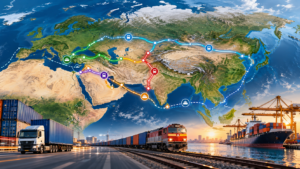
A new system of transport routes is taking shape across Eurasia, aimed at expanding connections between China, Central and South Asia, the Gulf states and Europe. Key projects include the trans-Afghan CASA corridor, the Middle Corridor across the Caspian Sea, the China–Kyrgyzstan–Uzbekistan railway, Iraq’s Development Road and the IMEC economic corridor, the Experts Club information and analytical center reports.
At the end of September 2026, Kazakhstan, Uzbekistan and the UAE agreed to study a railway route linking Kazakhstan, Uzbekistan, Afghanistan and Pakistan with access to the ports of Karachi and Gwadar. CASA’s preliminary potential has been estimated at up to 10 million tonnes of freight, although the project remains at the technical and economic assessment stage.
The Middle Corridor is already operating through Kazakhstan, the Caspian Sea, Azerbaijan and Georgia. According to the World Bank, a combination of infrastructure investment and reforms could increase trade volumes along the route by up to four times by 2040 and reduce delivery times by roughly two-thirds compared with 2023. Required investment in core and supporting infrastructure is estimated at more than $55 billion.
The China–Kyrgyzstan–Uzbekistan railway is expected to strengthen eastward connectivity, while Iraq’s Development Road is designed to link the Grand Al-Faw port with Türkiye and the European transport network. IMEC, meanwhile, is intended to connect India, the Gulf and Europe through combined maritime and rail links.
For Ukraine, the restructuring of Eurasian logistics offers an opportunity to expand access to Central Asian and Chinese markets through the Black Sea, the Caucasus and the Caspian Sea. Ukraine’s 2026 government action plan includes negotiations on integrating Ukrainian ports into the Trans-Caspian route.
“Ukraine should not simply watch this transformation from the sidelines. It should seek the physical and tariff integration of its ports and railways into the new routes,” Experts Club founder Maksym Urakin said.
Ukrainian students have been selected as recipients of the HEC Imagine program, which provides young people from countries affected by war and crises with the opportunity to study at HEC Paris, one of France’s leading business schools.
This was reported by the Embassy of Ukraine in the French Republic following the “Imagine pour la Paix” event, dedicated to supporting the program’s participants.
The event took place at UNESCO headquarters in Paris and brought together representatives from HEC Paris, the French business community, program partners and donors, diplomats, and students.
Among those attending were Jean-Noël Barro, France’s Minister for Europe and Foreign Affairs—an HEC Paris alumnus—as well as Gaël Veissier, former French Ambassador to Ukraine, who currently heads the Crisis Response and Support Center at the French Ministry for Europe and Foreign Affairs.
HEC Imagine fellows shared their personal experiences and insights about studying in France.
The HEC Imagine program was created to support talented students whose education and career prospects have been threatened by wars and other crises. Ukrainian students were among the program’s first participants.
According to HEC Paris, the HEC Imagine Fellows project began in 2022. From the very beginning, the scholarships enabled students from Ukraine, Afghanistan, and Syria to study at HEC.
The program provides not only financial support for tuition but also facilitates the students’ integration into the academic and professional environment at HEC Paris.
The Ukrainian Embassy in France emphasized that supporting the education of Ukrainians takes on special significance amid the war and the destruction of Ukraine’s educational and scientific infrastructure.
“The reconstruction of Ukraine is not just about rebuilding buildings and infrastructure. Above all, it is an investment in people: future entrepreneurs, economists, engineers, and managers who will create jobs, attract investment, and build a modern, European Ukraine,” the Ukrainian Embassy noted.
The diplomatic mission also thanked HEC Paris for its support of Ukrainian students and the Association des étudiants ukrainiens en France for helping to organize Ukraine’s participation in the event.
HEC Paris is one of Europe’s most renowned business schools. The institution specializes in training professionals in the fields of management, finance, entrepreneurship, and business administration, and its graduates work in international companies, financial institutions, the public sector, and their own businesses.
The HEC Imagine program is part of a broader initiative that combines support for students from conflict-affected countries with a discussion on the role of business and education in rebuilding and securing peace.
Sources: Embassy of Ukraine in the French Republic, HEC Paris, UNESCO.



