

The agricultural trading company “A.V. Export Import” (Chortkiv, Ternopil Oblast) plans to commission the first phase of a new oil refining plant in the Chortkiv-West Industrial Park (Ternopil Oblast) by the end of this year; the investment in the project totaled 25 million UAH, according to Dmytro Kysilevsky, deputy head of the parliamentary committee on economic development.
“Installation of equipment for the first phase has been completed at the Chortkiv-West Industrial Park. Work is currently underway to install the building’s exterior elements and landscape the surrounding area. Production is scheduled to begin at the end of 2026,” he wrote on his Facebook page on Friday.
According to him, the first phase of the plant consists of an oil refining shop and a bottling shop. Production capacity is 50 metric tons of refined oil per day.
The second phase involves an investment of 50 million UAH in the construction of a facility for processing sunflower seeds into oil. The plant plans to employ 123 workers.
Kisilevsky noted that the project’s investor, the company “A.V. Export-Import,” became the first participant in the Chortkiv-West Industrial Park. In addition, negotiations regarding the relocation of two enterprises from the Zaporizhzhia and Kharkiv regions are currently in the final stages.
He also added that in 2026, the Chortkiv-West Industrial Park, with financial support from the Ukrainian-Swiss UCORD project, began construction of water supply networks, while the State Fund for Regional Development of Ukraine is financing the development of the park’s electrical networks.
Currently, the Chortkiv community is preparing an application to participate in the state program for co-financing the development of industrial park infrastructure. The funds are planned to be allocated for the construction of an access road and a road interchange within the industrial park.
The Chortkiv-West Industrial Park was registered in October 2019. It is located on a plot of land covering 87.7 hectares. The declared operating period is 30 years.
According to YouControl, “A.V. Export-Import” reported 1.5 million UAH in net profit and 178.4 million UAH in net revenue in the first quarter of 2026.
The company’s owners are Daria Lupashko-Gurevich, a Bulgarian citizen (50%); Andriy Snezhko, a resident of Kyiv (25%); and Valeriy Yureskul, a resident of the Mykolaiv region.
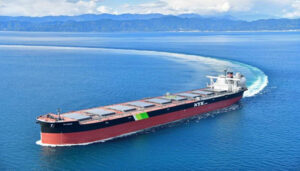
The Japanese government is considering a new package of sanctions against Russia, which could include restrictions on vessels belonging to the so-called “shadow fleet,” as well as further tightening of export controls.
This was reported on October 2 by the Japanese newspaper Yomiuri Shimbun, citing several government officials.
According to the publication, Tokyo is considering joining efforts to further intensify sanctions pressure on Russia amid new restrictions being imposed by European countries.
One of the main targets of the new package could be vessels of the Russian “shadow fleet,” which are used to transport oil and petroleum products in circumvention of Western sanctions.
The Japanese government is also considering expanding the list of goods whose export to Russia is prohibited or restricted, as well as further strengthening export control mechanisms.
The final composition of the new package and the date of its implementation have not yet been officially announced.
As of October 2, the new package has not yet been published in the Japanese Ministry of Finance’s official list of current sanctions. Nor has a corresponding decision been announced in the country’s Ministry of Foreign Affairs’ statements.
The last major package of additional Japanese sanctions related to the war in Ukraine was announced on September 12, 2025.
At that time, Japan imposed asset freezes on 47 Russian organizations and nine individuals. Restrictions were also imposed on five individuals and one organization that Japanese authorities link to the annexation of Crimea, the destabilization of eastern Ukraine, and the Russian occupation of Ukrainian territories.
In addition, three organizations from third countries were subject to the restrictions.
The package included not only asset freezes but also expanded export restrictions. Japan has banned supplies to certain Russian organizations and companies from third countries that, according to the Japanese authorities, are linked to the Russian military-industrial complex or help circumvent the restrictions.
Thus, if the new package is adopted, it will mark the first significant expansion of Japanese sanctions against Russia in over a year.
A focus on the “shadow fleet” will mean a further alignment of Japan’s sanctions regime with the approach taken by the EU, the United Kingdom, and other G7 countries, which in recent years have been actively imposing restrictions on vessels involved in the transport of Russian energy resources.
At the same time, Japan maintains a unique position regarding Russian energy resources. The country continues to import LNG from the “Sakhalin-2” project, viewing these supplies as a crucial element of its own energy security.
The official list of Japan’s current sanctions has been published by the country’s Ministry of Finance. The new restrictions will take effect after the government adopts a corresponding decision and publishes the documents required by Japanese law.
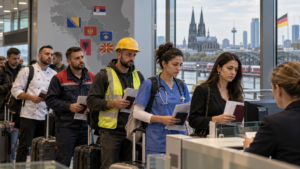
Germany will reduce the annual limit for admitting workers under the Westbalkanregelung programme from 50,000 to 25,000 people, which will affect citizens of six Western Balkan countries at once — Albania, Bosnia and Herzegovina, Kosovo, Montenegro, North Macedonia and Serbia, the Experts Club analytical center reports, citing data from the German government and the Federal Employment Agency.
The new limit is to take effect from 2027 and effectively means a return to the level that existed before June 2024, when Germany doubled the annual quota from 25,000 to 50,000 people.
Westbalkanregelung has been in force since 2016 and is a special mechanism providing citizens of the Western Balkans with access to the German labor market.
The main difference between the programme and many other channels of labor migration is that it applies not only to qualified specialists. A citizen of one of the six countries can obtain permission to work in Germany if they have a specific job offer from a German employer, while recognition of professional qualifications in Germany is generally not a mandatory requirement.
Regulated professions, such as doctors, remain an exception, as separate qualification recognition requirements apply to them.
It is precisely because of this that Westbalkanregelung has become one of the most accessible channels of legal labor migration from the region to Germany.
At the same time, there are no separate national quotas for Serbia, Albania, Bosnia and Herzegovina, Kosovo, Montenegro or North Macedonia. The limit is common to all six countries, so reducing it to 25,000 people will mean increased competition among applicants from across the region.
Demand for the programme already significantly exceeds supply.
According to Germany’s Federal Employment Agency, demand continued to grow after the quota was increased to 50,000 places. In December 2025 alone, the agency had to reject around 18,000 applications because the annual limit had already been exhausted.
At the same time, the scale of labor migration from the Western Balkans significantly exceeds the figures directly related to this programme.
The Federal Employment Agency notes that, among the relevant category of foreign workers, citizens of Albania, Bosnia and Herzegovina, Kosovo, Montenegro, North Macedonia and Serbia account for around a quarter of all employees in Germany covered by social insurance who have a residence permit or permanent residence based on employment.
Thus, over the past decade, the Western Balkans have become one of the important external sources of labor for the German economy.
“The German decision is interesting because it comes against the backdrop of two opposing trends. On the one hand, the German economy is experiencing a structural shortage of workers and is interested in attracting foreign labor. On the other hand, the state is tightening migration controls and reducing one of the most accessible employment channels for citizens of the Western Balkans,” said Maksym Urakin, founder of the Experts Club analytical center.
According to Experts Club, the most immediate consequence of the quota reduction may be increased competition for permits among citizens of the six countries.
If demand already exceeded supply with a limit of 50,000 places, halving the quota could potentially increase waiting times and the share of applicants who will not be able to use the programme in a particular calendar year.
At the same time, the Westbalkanregelung mechanism itself is not being closed. Citizens of the region will still be able to work in Germany through other labor migration channels provided for by law if they meet the established requirements.
Germany’s decision is also of particular interest from the demographic perspective of the Western Balkans themselves. Serbia, Bosnia and Herzegovina, North Macedonia, Albania, Montenegro and Kosovo have for many years been sources of labor migration to EU countries, primarily Germany, Austria and other Western European economies.
For the countries of the region, the mass outflow of the working-age population has a dual effect. Remittances from citizens working abroad support household incomes and domestic consumption, but at the same time emigration increases labor shortages within the Balkan economies themselves.
The outflow of medical personnel, construction workers, drivers, technical specialists, service-sector employees and other categories that are in demand both in Germany and in the domestic labor markets of the countries of the region remains particularly sensitive.
“For the Western Balkans, Germany’s decision may somewhat reduce one of the channels of labor outflow, but it is unlikely by itself to substantially change migration processes. The difference in wages and employment opportunities between Germany and most of the region remains the main economic driver of migration,” Urakin believes.
The reduction of Westbalkanregelung is part of a broader adjustment of the German government’s migration policy. Among its objectives, the cabinet lists reducing irregular migration, expanding the list of safe countries of origin, increasing the number of returns and introducing stricter regulation of migration flows.
At the same time, Berlin continues to emphasize the need for legal migration for the German labor market.
This creates a certain paradox: Germany is restricting one of the most in-demand regional channels of labor migration at precisely the moment when population ageing and staff shortages are forcing the German economy to search more actively for workers outside the country.
For the Western Balkans, the consequences are also ambiguous. The quota reduction potentially reduces opportunities for new labor emigration, but at the same time may somewhat reduce pressure on national labor markets, which themselves face worker shortages.
The key indicator of the effectiveness of the decision will be how quickly the new quota of 25,000 permits is exhausted after its introduction. If demand remains at its current level, Westbalkanregelung will effectively become a significantly more competitive channel of access to the German labor market.
The Westbalkanregelung programme has been in force in Germany since 2016 and applies to citizens of Albania, Bosnia and Herzegovina, Kosovo, Montenegro, North Macedonia and Serbia. In mid-2024, the annual limit was increased from 25,000 to 50,000 people. The German government has decided to limit it again to 25,000 permits per year.
Sources: Federal Government of Germany, Federal Employment Agency of Germany.
EMPLOYMENT, GERMANY, Labor market, MIGRATION, Western Balkans
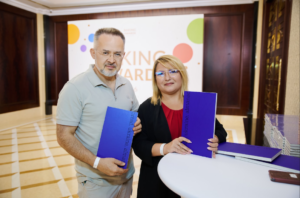
After several years of work, the publication “Bread. Ukraine. Almanac” has been released in Ukraine — a bilingual informational and historical art book dedicated to Ukrainian bread, its role in history, culture, everyday life and the modern food industry.
At the heart of the publication is an attempt to show that the concept of Ukrainian bread is much broader than the familiar product on the everyday table. For some, it is the taste of childhood and a family recipe; for others, it is palianytsia, regional baked goods or bread from a local bakery. At the same time, behind these familiar images stand the history of the development of agriculture, milling and breadmaking, folk traditions and the modern large-scale food industry.
The almanac traces how bread accompanied Ukraine and Ukrainians through different historical periods. It was preserved in family memory and rituals, became an image in cinema, poetry, photography and other forms of art, and with the development of industry turned into an important part of a large production complex.
A special place in the publication is devoted to the dramatic pages of Ukrainian history. The authors address the tragedy of the Holodomor, during which bread became a symbol of the very right of a person to life. It acquired a new symbolic meaning after the beginning of the full-scale war. One of the best-known examples was the word “palianytsia,” which in 2022 became a distinctive linguistic marker of Ukrainian identity.
At the same time, “Bread. Ukraine. Almanac” tells not only about the past. Considerable attention is paid to modern breadmaking, artisanal technologies, regional traditions and the development of the industry. In the book, bread appears simultaneously as an everyday product, a cultural phenomenon, the result of the work of the agricultural and food sectors, and part of the country’s economic history.

At the same time, the authors do not attempt to give a single definition to the concept of “Ukrainian bread.” The book is structured as a collection of different stories, each of which reveals a separate part of this topic — from old mills and family recipes to industrial bakeries, modern technologies and the artistic interpretation of bread.
This approach leaves the reader room for further exploration of the topic: after one piece, one can turn to an old Ukrainian film; after another, one can study regional baked goods, the history of milling, traditional technologies or modern Ukrainian breadmaking in greater detail.
“Bread. Ukraine. Almanac” has been prepared in Ukrainian and English, and is therefore intended not only for a Ukrainian but also for an international audience. The publication can be used as a presentation book about Ukraine, its history, gastronomic culture and one of the country’s most important industries.
The almanac is designed as a modern collectible art book. A distinctive color palette, unconventional layout, archival and contemporary visual materials create a separate visual language for the publication and emphasize its gift-book character.
The premiere of the almanac took place during Baking Awards 2026. The publication was presented by Yurii Duchenko, President of the All-Ukrainian Association of Bakers, and Rodion Rybchynskyi, Director of the “Flour Millers of Ukraine” Union.
The print run of “Bread. Ukraine. Almanac” is limited. Detailed information about the publication and the possibility of ordering it are available on the official “Bread. Ukraine” website.
The partners of the “Bread. Ukraine. Almanac” edition were the All-Ukrainian Association of Bakers and the “Flour Millers of Ukraine” Union. The industry organizations unite enterprises of Ukraine’s breadmaking and flour-milling industries and work to develop the domestic market, increase the competitiveness of Ukrainian products and expand their presence abroad. Among their areas of activity are strengthening Ukraine’s export potential, promoting Ukrainian flour, bakery products and other grain-processing products in foreign markets, developing international contacts and facilitating the participation of Ukrainian producers in specialized international events.
Global grain trade in the 2026/27 agricultural year (July–June) will total 505.8 million metric tons, which is 3.5% less than last year, according to a forecast by the FAO (Food and Agriculture Organization of the United Nations).
According to the organization’s monthly grain report, the new estimate is 3.5 million metric tons lower than the previous forecast made in September. “This reflects a downward revision of wheat and corn export forecasts, driven primarily by shipping challenges through the Black Sea and insufficient capacity on alternative transport routes,” the report states. “The upward revision to the barley trade forecast only partially offsets the lost trade volumes in corn and wheat.”
Forecasts for corn exports from the EU were lowered due to reduced supply from Ukraine resulting from logistical difficulties. At the same time, an increase in export supply from Australia has allowed for an upward revision of the forecast for barley trade, a significant portion of which will be shipped to China.
The improved forecast for wheat exports from Kazakhstan has not fully offset the decline in shipments from Russia and Ukraine.
According to the forecast, international rice trade will decline by 2.2% in calendar year 2026; however, it may increase by 1.7% in 2027, reaching 61.2 million metric tons. “In 2027, a recovery in import demand is forecast for most regions; however, the availability of sufficient domestic stocks in East Asian countries suggests that the downward trend in their purchasing volumes may continue for the third consecutive year,” the document states.
According to the FAO forecast, the wheat harvest in 2026 will total 813.9 million metric tons, 3.3% less than last year, while the total grain output will be 2.979 billion metric tons (2.1% less).
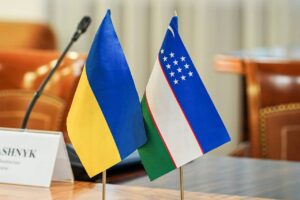
Ukraine and Uzbekistan are introducing a “transport visa-free regime,” which provides for the abolition of permits and related quotas for direct and transit international freight truck transportation between the two countries.
A corresponding protocol between the governments of Ukraine and the Republic of Uzbekistan amending the bilateral Agreement on International Road Transport was signed on September 30, 2026, according to the Ukrainian Embassy in Uzbekistan.
According to the diplomatic mission, the preparation of the document took nearly a year.
The main change will be the simplification of direct and transit freight transport by eliminating the need to obtain permits, as well as quantitative quotas for such transport. This regime, by analogy with other agreements in the field of international road transport, is referred to as “transport visa-free travel.”
For Ukrainian and Uzbek carriers, this will mean the removal of one of the administrative barriers to organizing freight transport between the two countries and transit through their territories.
The embassy expects that the liberalization of road transport will contribute to the restoration of Ukraine’s trade and economic ties with Uzbekistan, which were partially disrupted due to logistical problems following the start of full-scale Russian aggression.
The agreement takes on particular significance amid the restructuring of Ukraine’s foreign trade and the search for alternative transport corridors to Central Asia.
“The removal of bureaucratic barriers should soon facilitate the restoration of full-fledged trade and economic ties between Ukraine and the Republic of Uzbekistan,” the embassy noted.
The diplomatic mission also described the new agreement as one of the steps toward Ukraine’s return to Central Asian markets via new logistics routes.
The protocol, signed on September 30, amends the existing intergovernmental Agreement between Ukraine and Uzbekistan on international road transport. Specifically, it concerns the liberalization of direct and transit freight transport by road. The embassy’s statement does not provide for the abolition of other customs, border, or transportation procedures required for the international transport of goods.
Original source – Embassy of Ukraine in the Republic of Uzbekistan.



