

Poltava Medical Glass Plant JSC (PMGP, Poltava) saw its net profit decline by 19% in 2025 compared to 2024—to 105.564 million UAH, and for the January–June 2026 period, by 30.5% compared to the same period in 2025, to 45.204 million UAH.
As the company reported in the NSSMC’s disclosure system, its net sales revenue in 2025 decreased by 3.52% compared to 2024—to 364.281 million UAH, while in the first half of 2026, revenue grew by 31.76% compared to the same period in 2025, reaching 231.01 million UAH.
According to the company, the main export markets outside Ukraine in 2025 were Kazakhstan, where products worth 51.503 million UAH were shipped; Georgia (3.732 million UAH); Turkey (3.233 million UAH); and Moldova (1.258 million UAH). In total, products worth 61.369 million UAH were exported during this period, which is 2.29% more than the previous year.
In the first three months of this year, the plant manufactured 89,488 million ampoules and shipped 150.923 million units worth 107.4 million UAH. Specifically, in January–March, ampoules were exported to Kazakhstan, Georgia, Turkey, Moldova, and Uzbekistan. The volume of exports increased by 32%.
The company generated 5.402 million UAH from the sale of oxygen and nitrogen.
The cost of goods sold amounted to 70.333 million UAH; the company’s revenue from core and operating activities for the first quarter of 2026 totaled 120.232 million UAH, with net profit at 21.154 million UAH.
As previously reported, in July 2025, Oleksandr Nekrasov, who owned nearly 53.7% of PZMS’s shares, gifted this stake to his relative, Leonid Oleksandrovych Nekrasov, who had previously held more than 6% of the company’s shares; following the gift, his stake exceeded 59.7% of the company’s authorized capital.
Oleksandr, Leonid, and Konstantin Oleksandrovych Nekrasov, in particular, are co-owners of the pharmaceutical manufacturer “Lubnyfarm.”
According to information on its website, the Poltava Medical Glass Plant is Ukraine’s leading manufacturer of ampoules for pharmaceuticals.
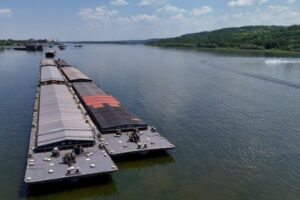
Romanian authorities plan to conduct a controlled sinking of four barges loaded with rocks in the Bala branch of the Danube to redirect more water to the Cernavodă Nuclear Power Plant and prevent the shutdown of its only operating reactor unit.
The operation is scheduled to begin on August 5 after 2:00 p.m. The barges are intended to form a temporary underwater dam and divert part of the flow from the Bala branch to the Old Danube, from where water enters the nuclear power plant’s cooling system. Authorities expect to raise the water level near the plant by 10–12 cm.
Currently, only Power Unit No. 2 is operating at “Cernavodă.” The first of the two reactors was shut down last week due to critically low water levels in the Danube. Under normal conditions, the plant’s two units account for about one-fifth of Romania’s electricity production.
Before flooding the barges, the Romanian military carried out a controlled demolition of part of the Pirjoaia underwater rock formation, which had been hindering the redistribution of the river’s flow. Following this intervention, the drop in water levels near the plant temporarily ceased. Previously, the Danube’s water level in this area had been falling by approximately 2–3 cm per day.
As of the morning of August 5, the water flow at the Danube’s entry into Romania was approximately 1,450 cubic meters per second. By August 7, this figure could drop to 1,400 cubic meters per second—nearly one-third of the long-term average for August, which stands at 3,900 cubic meters.
As early as August 1, representatives of the National Administration “Waters of Romania” warned that without emergency measures, the second power unit would be able to operate at its maximum capacity for only four to five days. If the water level drops below operational thresholds, the reactor will be shut down in a controlled manner in accordance with safety procedures.
At the same time, dredging operations are continuing in the Old Danube–Bala Branch section. Specialists must remove some of the debris left over from the explosion and secure the submerged barges, as the current could displace them and reduce the effectiveness of the temporary dam.
Romania has declared a state of energy readiness for August. Due to reduced output at nuclear power plants and other power stations, the country has increased electricity imports and called on businesses, government agencies, and the public to reduce consumption during peak-load hours.
The critically low water level of the Danube is causing problems not only for Romania. The Paks Nuclear Power Plant in Hungary has also sharply reduced production: three of the four turbines were shut down, and the remaining one was operating at only a fraction of its capacity.

As of August 4, Ukrainian farmers had threshed 4.01 million hectares—or 34% of the projected area—and harvested 17.59 million metric tons of grain from the new crop, according to the press service of the Ministry of Agrarian Policy and Food.
Wheat was harvested from 2,736.5 thousand hectares (53% of the area), yielding 12.51 million metric tons with an average yield of 45.7 centners per hectare.
Barley was harvested from 1,015.0 thousand hectares (68%), yielding 4.42 million metric tons at a yield of 43.5 centners per hectare.
Peas: 261,700 hectares (88%) have been harvested, yielding 669,500 metric tons at a yield of 25.6 centners per hectare.
The Odesa region currently leads in terms of the volume of early grain and legume crops harvested, with 3.593 million metric tons harvested from an area of 857 thousand hectares (wheat—2.108 million metric tons, barley—1.252 million metric tons, peas – 232,5 thousand metric tons).
In the Mykolaiv region, 2.125 million metric tons have been harvested from an area of 606,2 thousand hectares (wheat – 1.440 million metric tons, barley – 577,9 thousand metric tons, peas – 106,8 thousand metric tons).
In the Dnipropetrovsk region, 1.911 million metric tons were harvested from an area of 475,400 hectares (wheat – 1.421 million metric tons, barley – 455,600 metric tons, peas – 34,000 metric tons).
Winter rapeseed has already been harvested from 910,600 hectares (68% of the total area), yielding 2.39 million metric tons.

As of August 5, the European Union has changed the conditions for granting temporary protection to certain Ukrainian citizens subject to military service. New applicants will be required to confirm that they have complied with the requirements of Ukrainian law, have been exempted from military service, or have legally left the territory of Ukraine.
The relevant provisions are contained in EU Council Implementing Decision No. 2026/1912, adopted on July 30 and published in the Official Journal of the European Union on August 4, 2026. The decision entered into force the day after its publication.
The new restriction applies only to individuals who apply for temporary protection after the decision enters into force. Ukrainians who have already been granted this status in an EU country retain their rights, and the new rules do not apply to them.
To obtain temporary protection, a new applicant must confirm compliance with their military obligations in Ukraine. Evidence may include a passport with a stamp confirming lawful departure from the country, or a paper or electronic document confirming exemption from service or the fulfillment of relevant obligations. The decision will depend on the availability of documents confirming the legality of departure and the applicant’s status under Ukrainian law.
At the same time, the Council of the EU has extended temporary protection for Ukrainian citizens for another year—until March 4, 2028. Previously, the program was set to expire on March 4, 2027.
The Council of the EU explained that the new condition was introduced to simultaneously ensure protection for displaced persons and address Ukraine’s defense needs. EU member states agreed that, going forward, temporary protection should be granted only to new applicants who are fulfilling their military obligations in Ukraine.
Temporary protection grants Ukrainians the right to reside in EU countries, as well as access to the labor market, medical care, social security, housing, and education for their children.
According to the Council of the EU, as of the end of May 2026, approximately 4.38 million people who had left Ukraine after the start of the full-scale war were benefiting from temporary protection in the European Union.

PJSC ‘Yuria’ (trademark “Voloshkove Pole”) increased its net profit to 67.2 million UAH in January–June 2026, up from 1.8 billion UAH during the same period last year.
According to the company’s disclosure in the National Securities and Stock Market Commission (NSSMC) disclosure system, its revenue grew by 10.4% to 1.19 billion UAH.
According to the financial statements, the company’s gross profit for the first half of the year increased by 46.1% to 179.8 million UAH, while operating profit rose 14.2-fold to 72.6 million UAH.
As of June 30, 2026, PJSC “Yuria’s” assets totaled 1.092 billion UAH, compared to 1.039 billion UAH at the beginning of the year; its accumulated losses decreased to 275.2 million UAH from 342.5 million UAH, while current liabilities rose to 1.325 billion UAH from 1.271 billion UAH; of this amount, 700.9 million UAH consisted of accounts payable to suppliers, and 473.9 million UAH consisted of advances received.
At the same time, the company significantly reduced its bank debt: long-term loans at the beginning of the year amounted to 67.7 million UAH, while as of the end of June, the financial statements showed only 1 million UAH in short-term loans.
As previously reported, at an extraordinary general meeting on July 2, 2026, the shareholders of PJSC “Yuria” preliminarily approved the conclusion of significant transactions with JSC “Pivdenny” totaling up to 900 million UAH, including loan and other financial agreements, as well as amendments to existing agreements regarding financing limits, terms, interest rates, and fees.
PJSC “Yuria” is the legal successor to the Cherkasy City Milk Processing Plant, which has a design capacity of 25 metric tons of raw milk processing per day. It ranks among the top ten largest Ukrainian milk producers.
The dairy producer, operating under the “Voloshkove Pole” trademark, invested EUR 1.5 million in 2023 to install a Tetra Pak production line in order to double its output of ultra-pasteurized milk. In 2024, the company invested EUR 1.6 million in modernizing the production facilities of its enterprises and commissioned a new production line for glazed cheese curds.
The company has two subsidiaries: “Yuria-2”—a network of brand-name stores and kiosks in Cherkasy—and “Yuria-Trans”—a trucking company that delivers raw materials and supplies for processing, products to retail outlets, and provides other transportation services. Its raw material supply area covers the Cherkasy, Kirovohrad, Poltava, Kyiv, and Vinnytsia regions. Milk is collected from over 200 settlements.
The company’s beneficial owners are Oleksandr and Andriy Tabalov.
According to the annual report, “Yuriya’s” revenue in 2025 grew by 27.8%—to 2.20095 billion UAH—while net profit amounted to 62.68 million UAH, compared to a net loss of 121.95 million UAH the previous year.

The Second Ukrainian Film Festival in Thailand, organized by the Embassy of Ukraine to mark the 35th anniversary of the country’s independence, will take place in Bangkok on August 5–6.
The screenings will take place at the Bangkok Art and Culture Centre. The program includes four Ukrainian films of various genres—a biographical drama, a documentary, a family adventure film, and an anthology of short stories.
The festival will open on August 5 at 4:00 p.m. with a screening of the 2025 film “Malevich,” dedicated to the life and work of Ukrainian avant-garde artist Kazimir Malevich.
At 6:00 p.m., audiences will be treated to the 2026 documentary “The Underground Garden.” The film tells the story of a children’s art studio operating in a Kharkiv bomb shelter as it prepares for its first international exhibition.
On the second day, August 6, at 3:00 p.m., there will be a screening of the family adventure film “The Guard Post,” based on the legends and imagery of the Kievan Rus’ era.
The festival will conclude at 6:00 p.m. with the 2025 anthology of short films *War Through the Eyes of Animals*. It features stories based on real events about animals during a full-scale war. Oscar-winning American actor and director Sean Penn participated in the creation of the project.
The embassy noted that the festival program aims to introduce Thai audiences to the culture and history of Ukraine, the resilience of Ukrainian society, and the lives of people living under wartime conditions.
Admission to all screenings is free, but advance registration is required—https://forms.gle/CkNvc5TjmUdvDmV6A.



